Follow Us on Google
By Chidiebere Onyemaizu
Singaporean President, Tharman Shanmugaratnam, has invited President Bola Ahmed Tinubu on state visit to the country, as the Asian nation seeks strengthened, deepened ties and cooperation with Nigeria.
Nigeria’s Permanent Representative to the United Nations, Ambassador Jimoh Ibrahim, disclosed this in a statement by the Nigerian Mission House at the United Nations, New York.
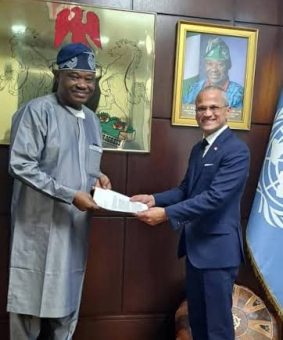
Ibrahim said Singapore’s Permanent Representative to the UN, Ambassador Burhan Gafoor, visited the Nigerian Permanent Mission House, where he delivered a letter from President Shanmugaratnam inviting Tinubu to Singapore.
Gafoor also congratulated Ibrahim on his emergence as Chairman of two prominent UN committees—the Fifth Committee on Administrative and Budgetary Matters and, more recently, the Special Committee on Peacekeeping Operations, also known as the Committee of 34 or C-34.
Receiving the letter, the Nigerian permanent representative to the UN thanked Gafoor for the invitation and assured the people and government of Singapore that Tinubu would find time to visit the country in the nearest future.
He revealed that the President’s economic reforms had attracted international attention and generated interest from countries such as Singapore in sharing experiences with Nigeria, particularly on multilateralism and national development.
Ibrahim compared the boldness of Tinubu’s reforms with the transformation associated with Singapore’s first Prime Minister, the late Lee Kuan Yew.
“President Bola Ahmed Tinubu is making bold economic reforms like the first Prime Minister of Singapore, Lee Kuan Yew. His achievements are enviable and continue to generate concern to countries like Singapore to share experience in multilateralism,” Ibrahim said.
He told Gafoor that Tinubu holds President Tharman in high esteem and congratulated Singapore on the reforms that transformed the country.
According to Ibrahim, Nigeria is also undergoing reforms aimed at transforming the country into a modern contemporary state, where the interests of everyone would be protected and Nigerians would begin to enjoy a viable economic proposition.