Follow Us on Google
By Chukwudi Nweje, Lagos
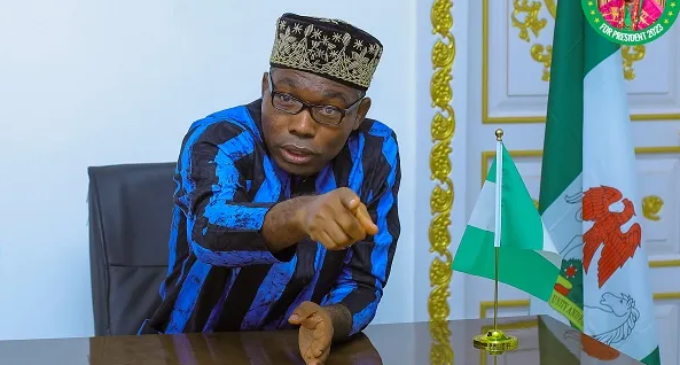
The presidential candidate of the Social Democratic Party (SDP) in the February 25 election, Prince Adewole Adebayo, has said that the greatest decision facing President-elect Ahmed Bola Tinubu is to decide whether his presidency is driven by a passion to build Nigeria to truly become a world leader or a fulfilment of his ambition of be Nigeria’s president.
Adebayo, who contested against Tinubu during the presidential election from the platform of the SDP spoke ahead of Monday, May 29, the inauguration of Bola Tinubu as the eighth Nigerian president since the return to democratic rule in 1999.
He stated that Tinubu has both the competence and capacity to lead Nigeria but will have to decide what to do with his presidency because “you cannot advice a man with power.”
He said, “It is up to Tinubu to decide what to do with power; he has both the capacity and competence but once you grab power you will become a different person; you cannot advise a man with power.”
Adebayo insisted that the SDP manifesto ‘Hope Again; is better than that of Tinubu and the All Progressives Congress (APC) ‘Renewed Hope’, but that Nigerians chose Tinubu to lead.
He equally praised Tinubu’s ‘Renewed Hope’ campaign manifesto and added that if implemented would stand Tinubu out as the best president since 1999.
He further said, “It has studied Tinubu’s ‘Renewed Hope’ manifesto, I still insist that it is not half as good as my ‘Hope Again’ manifesto but if it is implemented Tinubu’s government will be better than all the administrations before him put together. It is up to Tinubu to decide whether he wants Nigeria to move forward or not.
“If Tinubu keeps to his manifesto, his government will be better than all the administrations before he put together. But if he decides to do the same thing APC did when they brought ‘Change’ then it will be unfortunate.
“I pray that Tinubu’s motivation is that he wants to be a great leader that Nigeria and Africa will remember because whichever Nigerian President succeeds in fixing Nigeria would have fixed the whole of Africa and the black race.”
On the less than 10 million votes threshold, the lowest since the return to democracy in 1999 Tinubu polled to win the February 25, 2023 Presidential Election, Adebayo said that the introduction of Bimodal Voter Accreditation System (BVAS) has made numbers coming from the polls more realistic.
He further said, “The figure is not an indication that anything is wrong with Tinubu, it just shows that the excitement of voting is tied to the state of mind of voters at each electioneering time. It may even be lower in the next presidential election in 2027.
“It signifies that democracy is maturing and penetrating in Nigeria. In the past politicians could cook any numbers they wanted during the election but with BVAS it has become impossible. This signifies that the numbers at this election are realistic.”
Adebayo said that Nigeria needed more electoral reforms to make the next transitional elections in 2027 more credible.
He stated that the powers of the Independent National Electoral Commission (INEC) should be whittled down to cut down on the overbearing interferences of the INEC in the internal affairs of political parties.
If you look at the way INEC is configured, you will discover that we are not looking at the best way to conduct free and fair elections, the transition is managed to conform to certain parameters that comfort the status quo.
If you go back to 1999, the transition was managed such that even before it started, they had narrowed it down to two contestants or three at most, and the military had settled for Obasanjo, and even when Obasanjo later appointed Abel Guobadia as INEC chairman, it was to realise his second term. Maurice Iwu was appointed to manage Obasanjo’s PDP to PDP transition and the idea of party registration was all part of the same narrow space. The composition of INEC and all the National Commissioners and the Resident Electoral Commissioners all came from the governors so INEC is part of the political process.
“In Nigeria, from the process of registering a political party to the nomination of candidates, INEC is the one responsible for monitoring and certifying all the business of the political party and through that INEC is responsible for what a political party becomes.
I have concluded that the way INEC is currently configured those in the status quo cannot be surprised by the political outcome.
“If we want to do something about the political space, we must first do something about the overbearing influence of INEC in the internal affairs of political parties,” he said.