Follow Us on Google
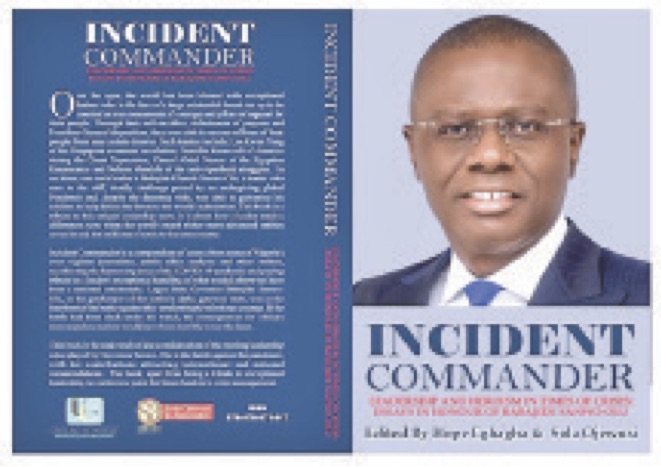
Title: Incident Commander: Leadership and Heroism in times of crisis, Essays in Honour of Babajide Sanwo-Olu
Publisher: Unilag Consult
Year: 2023
REVIEWER: Ray Ekpu
I feel honoured to review this book written in honour of Governor Babajide Sanwo-Olu who has shown exemplary leadership in the management of this megacity called Lagos. The book, a twenty-five chapter collection of essays, is edited by Professor Hope Eghagha of the Department of English, University of Lagos, and Mr Sola Ojewusi, Chief Executive Officer of Sola Ojewusi & Associates. It is published by Unilag Consult in association with Celebrity Chronicles, Sola Ojewusi & Associates. The acknowledgement is written by Professor Mohammed Usman, Managing Director of Unilag Consult and Sola Ojewusi, CEO of Sola Ojewusi & Associates. The introduction is written by Professor Hope Eghagha while the Foreword is done by Professor Oluwatoyin Ogundipe, a former Vice Chancellor of the University of Lagos.
The book has 119 photographs in colour covering various aspects of the war against the corona virus aka Covid-19 in Lagos State. It also has five appendices and a 26-page index that summarises where to find what in the book. The cover of the book is graced by a sharp photograph of Governor Sanwo-Olu in a well cut suit, white shirt and blue tie. He wears his traditional gold rimmed glasses and smiles shyly revealing his admirable tooth-gap.
The essays are written by various people, some of them well known in the writing business. Such names are Muiz Banire, a columnist and Senior Advocate of Nigeria (SAN), O. Emmanuel, an editor at the Nation newspaper, Jimmy Fatunbi, editor of the Lagosian magazine, Gboyega Akosile, Chief Press Secretary to Governor Sanwo-Olu, Sola Solanke, a veteran journalist, and Dele Sobowale, a well-known columnist, etc. Their collective experience has given the book a stamp of authority and professionalism.
The book sees Governor Sanwo-Olu as a courageous, compassionate and charismatic leader who passed the test of true and selfless leadership when a crisis came calling. The unexpected arrival of a corona virus also known as Covid-19 in the world beginning from Wuhan city in China was a major problem for all leaders in the world including Africa and Nigeria. The first documented case of the virus in Africa was reported on February 14, 2020 in Egypt. This was followed by Algeria on February 25, 2020 and Nigeria on February 27, 2020. This index case in Nigeria was an Italian citizen who flew into Lagos from Milan. He actually lived and worked in Ogun State. When the news of the index case in Lagos broke Governor Sanwo-Olu formed, with the speed of lightning, a strong partnership with the Nigerian Centre for Disease Control (NCDC) and the Ogun State government to identify and isolate all passengers on board the aircraft with the Italian. There was a big search for all recent contacts that the Italian had both in Lagos and Ogun States. These decisions led to the quarantine of 39 people on March 9, 2020, including four health workers, at the Italian’s company’s hospital. These decisions were taken speedily to minimise the spread of the virus and establish synergy with the health workers specifically and the people generally. For a thickly populated city like Lagos it was a major problem but Governor Sanwo-Olu was unfazed by it. He knew that he had a war on his hands, a war he had to win. But before getting to fight the main war, the pandemic, he had a preliminary fight, the war of belief or lack of it. Many people, call them naysayers didn’t believe that the virus could kill; some thought it was a virus that was meant to tackle the rich. Their claim was that the poor were already poor so God did not want them to carry some more burden. Some people including pastors and professors said that the virus simply did not exist and if it existed the hot weather in Africa will kill it dead. Infact, two of Nigeria’s State Governors, one of them a Science professor doubted the existence and the ferocity of the virus. Even America’s President Donald Trump refused to wear a nose mask but when he caught the virus and was being driven to the hospital he had no choice but to wear it. Some people even said that China wanted to reduce the population of the world so that it will remain the only country with a huge population. Some religious hacks were telling whoever cared to listen that the virus was a sign that the world was coming to an end. In a word, there were all kinds of conspiracy theories propounded by all kinds of people including the educated.
It was a mark of true, quality and selfless leadership that Sanwo-Olu defied all these fabrications and focused his attention on stemming the spread of the virus through communication and a battery of strategies to fight a faceless but ferocious enemy. As the book tells us he rolled out at various points different and wide-ranging strategies to deal with the problem. He informed people that they must wear nose masks, use sanitisers on the hands or wash them with soap, perform social distancing routine, refrain from hugging anyone or shaking hands; schools, churches, mosques, markets, hotels and entertainment centres were shut and when they were open there were specifications on the number of people that such facilities should contain at a time; schools, when open, had to adopt a shift system to avoid congestion. Some of the borders and beaches were closed to funseekers; certain classes of civil servants were asked to work from home. The government also provided stimulus packages such as food for the most vulnerable members of the society. The government used its Social Register and the data of 4000 Community Development Associations across the 377 wards to identify beneficiaries. The formula was to cater for six people per household and the target was to reach not less than 200, 000 households.
The governor mobilised his civil servants, health workers, media personnel to spread the message and to lead by example. The Governor demonstrated true, selfless leadership along with his Commissioner for Health, Professor Akin Abayomi; both of them caught the virus but they kept going in order not to discourage their fellow Lagosians.
The Lagos State House of Assembly cooperated eminently by passing into law the Corona virus pandemic Bill, as well as the amended version of it to accommodate more stipulations such as the indiscriminate sale and distribution of Covid-19 drugs and vaccines in the State
At the end of the day the Lagos State Government had established the following isolation centres and bed capacities as follows, according to the book:
Infectious Disease Hospital, Yaba, 115
Onikan 100
LUTH 60
Gbagada 180
Landmark 81
Agidingbi 47
Lekki 45
First Cardiology Consultant Hospital 15
Paelon Memorial 11vedic 20
Governor Sanwo-Olu knew that the health workers were taking a big risk in the war against the virus. They were trying to keep other people from danger or to heal them of the danger to which they had fallen. He therefore introduced the Covid-19 allowance to health workers plus 400 percent increase in their monthly Hazard allowance. He also specifically dedicated year 2020 workers day to celebrating the true heroes of the pandemic season, the workers.
In all these exertions the governor took steps to strike the right balance between health, economy and security, a delicate balance that ensured that none of the sectors was unduly ignored.
The book informs us that there had been, since 1918, several pandemics worth mentioning. In 1918, there was the Spanish Flu caused by an influenza A(H1N1) virus; In 1957 there was an influenza A(H2N2) virus; In 1968 influenza A(H3N3) virus; In 2002 there was the Severe Acute Respiratory Syndrome (SARS) caused by SARS corona virus and in 2009 there was the Swine Flu caused by an influenza A(H1N1) virus. There was also the West African Ebola virus Disease (EVD) epidemic between 2013 and 2016, an outbreak with a huge regional significance claiming an estimated 11, 300 lives in total.
In fact, Sanwo-Olu was the ideal Incident Commander who led from the front. On March 17, 2020 he led some members of his Executive Council to the Murtala Muhammed International Airport to make an assessment of what was being done to screen travellers entering the country. To assist people economically during the lockdown the governor launched, on June 18, 2020, HelpNow, a social intervention platform deployed to support at least two million Lagosians through a crowd-funding model that rallied the support of well-meaning individuals and corporations. This was aimed at mitigating the effect of the virus on the income and livelihood of thousands of households in Nigeria. The Governor also set up, as the book tells us, the “War Room Cabinet” comprising a few Executive Council members saddled with different responsibilities during the lockdown. In addition, he set up an inter-ministerial committee for the management of the Covid-19 fund. There is also an outer leg known as the Covid-19 volunteer corps which was coordinated by another cabinet member. Everyone would report to the Incident Commander, the Governor.
During a tour of the facilities set up by the Lagos State Government Mr Boss Mustapha, who is the Chairman of the Presidential Taskforce on Covid-19 and Secretary to the Government of the Federation, praised the efforts made by the Lagos State Government to control the spread of the virus.
When he received the National Productivity Merit Award from the Federal Government, the Lagos State Commissioner of Health, Professor Akin Abayomi said: “I would not have been deserving of the award if not for the purposeful leadership exemplified by the Governor, Mr Babajide Sanwo-Olu who is the Incident Commander of the Covid-19 response in Lagos.” In the same vein, President Muhammadu Buhari was so pleased with the performance and the display of quality leadership by Sanwo-Olu that he decided to support the Governor’s effort with a 10 billion naira donation.
Some of the writers had compared the Governor of New York State with Governor Sanwo-Olu. Both men run a megacity. Their two cities are the economic and financial nerve centres of their countries. Each of these states has a huge population that has elements of diversity. But the comparison ends there. Eventhough the New York Governor, Andrew Coumo, was praised for rising to the occasion in the management of the pandemic he was nearly overwhelmed by it. He had to say “This is not a sprint. It is a marathon.” Because of the courageous and effective manner that Sanwo-Olu managed the crisis he was able to get enormous support from private sector companies such as banks, telecommunications, pharmacies and other corporate entities that donated generously to the cause. Such donations underlined the trust and confidence that these companies had in the way the Governor and his team managed the pandemic. With such public-private partnership, the book informs us that the state was able to increase the number of isolation centres from one to six and from 115 beds at the IDH to a total of 590 beds. These efforts reduced the casualty level to an unexpectedly low minimum considering the congestion in Lagos. As of May 17, 2022 Lagos had reported 58, 713 laboratory confirmed cases of Covid-19; 56, 990 of them had been discharged while 439 patients had died. The relative success of the campaign in Lagos comes into bolder relief when we realise that the megacities affected by the pandemic comprise about 7 percent of the global population while these megacities accounted for 20 percent of Covid-19 deaths.
The Lagos State Government’s response to the pandemic benefited from strong and selfless leadership, robust collaborations with national and international partners, new partnerships with private sector chieftains and the generous donations of altruistic individuals. But in the final analysis it is the Governor’s excellent display of competence, commitment, courage and resilience in the face of such overwhelming odds that made the difference. No one knows a good pilot when the weather is fine but it is during moments of turbulence that the exceptional skills of a good pilot will come in to play. Sanwo-Olu proved to be a good pilot, a good crisis manager who defied all the odds to give his followers true quality leadership and statesmanship. That is why Lagosians have re-elected him as their Governor.
The book is a good compendium of essays on leadership in a moment of crisis with Sanwo-Olu as the exemplar. However, the use of both American and British spellings is unacceptable; only British spellings ought to be used in publications here but such use of Americanese is the evidence of America’s cultural domination in the world. There is quite a bit of repetition here and there. There is no offence in that because repetition which communicators call redundancy is good because it leads to clarity and emphasis.
The book deserves to be read by any person who wants to learn a lesson in crisis management.