Follow Us on Google
• Orders 160 trucks
• Overhauls LAWMA, dumpsites
Lagos State Governor, Babajide Sanwo-Olu, yesterday declared a state of emergency on waste management, acknowledging government’s responsibility for mounting refuse across parts of the metropolis and ordering immediate measures to restore collection and disposal.
The governor, who admitted that the waste system had come under severe pressure, announced the acquisition of 160 compactor trucks, expansion of dumpsites and receiving points, restructuring of the Lagos Waste Management Authority (LAWMA) and tougher enforcement against failing operators and indiscriminate dumping.
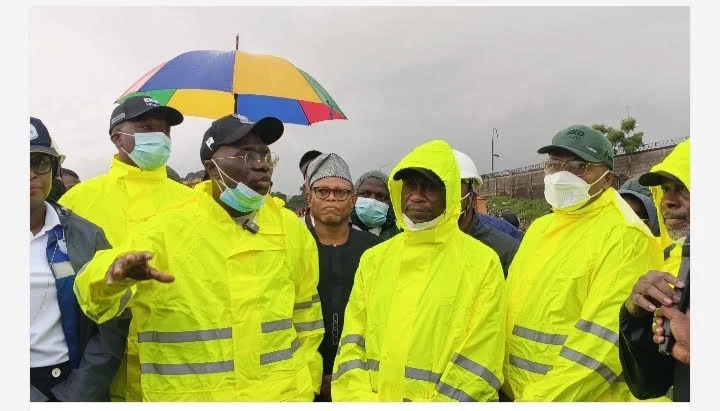
Sanwo-Olu, during an inspection of the Olusosun dumpsite, said the government would immediately increase disposal capacity to cut the long turnaround time that has kept waste trucks at dumpsites instead of evacuating refuse from communities.
At Olusosun alone, which currently receives between 220 and 250 trucks daily, the government plans to raise capacity to between 350 and 450 trucks by increasing the number of tipping points from two or three to four or five.
The governor said Solous 3 in Alimosho, Ewu Elepe in Ikorodu, Oke Osho in Epe and Erekiti in Badagry would also be activated or upgraded to reduce dependence on Olusosun.
He gave a 30-to-60-day window for multiple waste-receiving sites to become operational, saying this would reduce the hours trucks spend waiting to discharge refuse and enable them to return more quickly to collection routes.
Sanwo-Olu disclosed that 160 new compactor trucks had already been ordered and would begin arriving soon to boost waste evacuation from homes and roads.
The state, he added, was considering the procurement of landfill compactors, while Private Sector Participation (PSP) operators were being pressed to increase their own capacity.
But the governor also put the operators on notice, saying the PSP association had agreed to weed out members who lacked either the capacity or willingness to provide effective services.
The exercise, he said, would open the system to new investors and ensure that operators unable to meet required standards no longer retained service areas they could not adequately cover.
Sanwo-Olu similarly turned the spotlight on LAWMA, announcing an overhaul of the agency and questioning why senior personnel remained concentrated in offices while waste accumulated outside.
Other News
“Waste is outside on the street; it’s not in their offices,” he said.
He said LAWMA’s organisational structure would be reviewed to move more personnel into streets, dumpsites and other operational areas.
Residents would not be exempt from the crackdown.
Sanwo-Olu warned that failure by a PSP operator to collect refuse within 24 hours did not give households the right to dump waste on roads, highways or in drainage channels.
Environmental officers would monitor both operators and residents, he said, while offenders could be prosecuted before mobile and regular courts.
The governor, however, urged residents to pay their waste collection bills, arguing that operators could not provide effective services without being paid.
Beyond the immediate emergency response, Sanwo-Olu announced plans for two 2,400-metric-tonne transfer loading stations at Olusosun and Solous 3.
The facilities would receive compacted waste for onward transportation to material recovery facilities being developed in Epe and Erekiti, Badagry, where refuse would be sorted and processed for other uses.
According to him, the projects represent investments running into tens of millions of dollars and are expected to begin coming on stream between the first and third quarters of next year.
Sanwo-Olu acknowledged that Lagos’ rapidly growing population was generating increasing volumes of waste and putting existing infrastructure under pressure.
But he said government, LAWMA, PSP operators and residents all had responsibilities in reversing the deterioration.
The governor assured Lagosians that the emergency measures would be monitored as the administration moves to clear accumulated refuse, improve collection and restore a more efficient waste management system across the state.