Follow Us on Google

By Zika Bobby
Russia’s growing diplomatic and security engagement with African countries has yet to translate into significant economic benefits or reliable security partnerships, raising questions about Moscow’s ability to achieve its ambitions on the continent.
Martin Minns, Co-Executive Producer of the Pan-African podcast Panel 54, said Russia’s economic contribution to Africa remained limited compared with those of the United States, Europe and China, while its security interventions had produced uneven results.
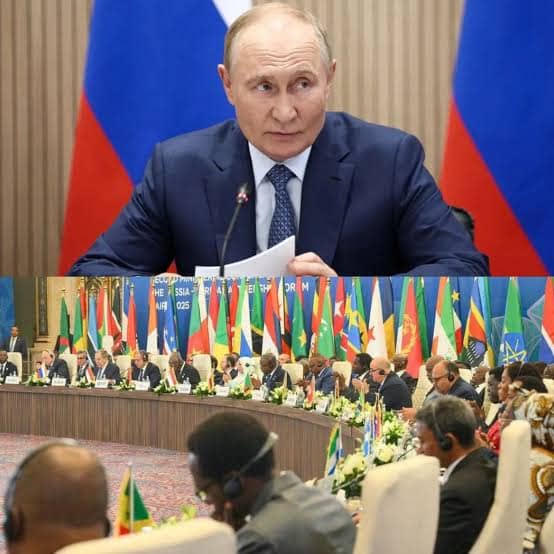
Minns made the observations in an analysis titled: “Can Russia Reach the Summit of Its Ambitions in Africa?”, following the third Russia-Africa Summit held in Moscow on October 28 and 29, 2026.

The summit, initially scheduled to take place in Libya, brought together 22 African heads of state, according to the Kremlin. Although this was an increase from the 17 leaders who attended the second summit in St. Petersburg in 2023, it fell significantly short of the 43 leaders who participated in the inaugural edition in Sochi in 2019.
The Kremlin attributed the lower attendance to what it described as “outrageous” Western pressure—a position Minns said might have some merit, though he questioned Moscow’s characterisation of the alleged pressure.
However, he argued that focusing on attendance figures missed the more critical questions of what African countries had gained from the gatherings and whether the engagements had produced sustainable partnerships.
According to Minns, Russia’s interest in Africa is driven by a desire to counter Western influence, build non-aligned partnerships, secure access to mineral resources and expand its defence exports. Yet Moscow’s ability to achieve these goals is constrained by limited economic investment, declining arms exports and the heavy resources required to sustain its military footprint on the continent.
Citing investment data, Minns noted that Russian capital accounted for less than one per cent of foreign direct investment into Africa, far trailing major partners such as the US, Europe and China. Furthermore, Russia’s global arms exports fell by 64 per cent between 2021 and 2025, leaving it ranked third behind the US and China in major arms supplies to Africa during that period.
On security, Minns said Russia’s deeper involvement in the Sahel had failed to deliver dependable security guarantees. He pointed to figures showing that annual deaths linked to violent extremism in the region surged from an average of 927 between 2016 and 2019 to 10,470 between 2022 and 2025.
This escalation, he said, raised doubts about the effectiveness of Russian security partnerships, particularly as Moscow struggles to sustain external commitments while fighting the war in Ukraine—a conflict that has resulted in more than 1.2 million casualties and stretched Russia’s military and diplomatic bandwidth.
Minns also identified the recruitment of African nationals into the Russian military as a major factor damaging Moscow’s image across the continent.
Citing a 2024–2025 Afrobarometer survey across 38 African countries, he noted that public perceptions of Russian influence were less favourable than those of the US, the European Union and China, with 72 per cent of respondents aware of the Ukraine war preferring their countries to remain neutral.
He further referenced an October 2026 report by the Hague-based group Journalists for Justice, titled: “The Death Contract: How Russia Recruits Africans to Fight and Die in Ukraine,” which documented 3,034 African citizens from 40 countries recruited into the Russian armed forces, often through deception and false promises of civilian jobs.
These concerns prompted African leaders to seek direct assurances at the Moscow summit. Kenyan President William Ruto secured an agreement with Russian President Vladimir Putin to designate Kenya a non-source country for military recruitment, and announced the appointment of a defence attaché in Moscow to coordinate the repatriation and compensation of affected Kenyans.
Similarly, Ghanaian President John Dramani Mahama raised the issue with Putin, prompting Ghana’s Foreign Ministry to announce that the Russian leader had agreed to bar Ghanaians from participating in the Ukraine war, even through voluntary enlistment.
While welcoming the agreements, Minns cautioned that their success would depend on strict enforcement and the ability of governments to stop recruiters from exploiting alternative channels, especially amid Bloomberg reports that Moscow is expanding recruitment efforts in countries such as Zimbabwe, Burundi and Sierra Leone.
Beyond recruitment, Minns described Africa’s broader engagement with Russia as “diversified non-alignment,” noting that African governments increasingly view Moscow as just one of several international partners through which to pursue trade, security and global representation, rather than an exclusive ally.
Ultimately, Minns argued, the true test of the Moscow summit lies not in diplomatic declarations, but in whether agreements yield measurable development and security outcomes.
“A summit in Moscow gives some idea as to the scale of Russia’s ambitions; it’s what follows that will reveal how far it can realistically meet them. As they say: talk is cheap,” Minns said.