Follow Us on Google

From Aidoghie Paulinus, Abuja
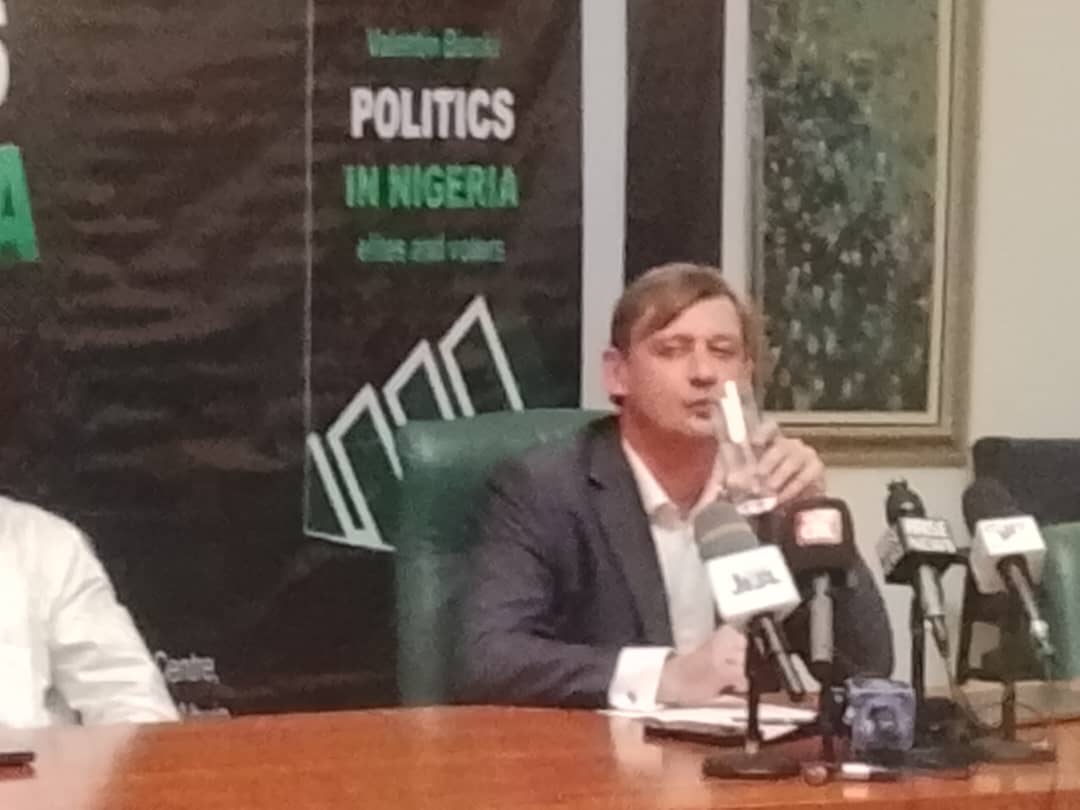
Russian political psychologist and campaign strategist, Valentin Bianki, has identified effective organisation and grassroots mobilisation as critical challenges facing opposition parties ahead of Nigeria’s 2027 general elections, warning that public dissatisfaction and online popularity alone cannot translate into electoral victory.
Bianki made the observation in Abuja during the presentation of the English edition of his book, Politics in Nigeria: Elites and Voters, which examines electoral competition, voter behaviour, democratic resilience and the relationship between political power and electoral outcomes.
Drawing on extensive electoral data and research into Nigeria’s political system, he argued that opposition parties seeking to challenge established political structures must develop the organisational capacity to convert public discontent into votes.
“Dissatisfaction is real; coordination is the scarce resource. Dissatisfaction is an emotion. Opposition is an organisation,” he said, stressing that the outcome of the 2027 elections would ultimately be determined by Nigerian voters.
Bianki noted that emerging political alignments, rivalries and alliances ahead of the next general elections were being shaped by the experiences and lessons of the 2023 presidential contest.
He described the 2023 election as Nigeria’s most open presidential contest since the return to civilian rule in 1999, noting that four major candidates attracted significant support across different parts of the country.
According to him, President Bola Tinubu won the election with 36.6 per cent of the votes, the lowest winning share recorded in a Nigerian presidential election since 1999.
The political psychologist maintained that Nigeria’s democratic development should not be assessed solely through conventional international democracy rankings, arguing that the country continued to demonstrate intense political competition despite relatively low scores in some indices.
He identified uncertainty in electoral outcomes, the ability of challengers to contest established power structures and the accommodation of competing political interests as important features of Nigeria’s democratic experience.
“Nigeria’s resilience is not the absence of conflict; it is an extraordinary capacity to live with conflict,” Bianki said.
A major aspect of his research examined the relationship between social media engagement and actual electoral performance, using an analysis of 5.9 million Twitter accounts and 2.3 million tweets during the 2023 election campaign.
Bianki said the findings showed that Peter Obi dominated significant portions of online political discussions but eventually finished third in the presidential election, underscoring the difference between digital visibility and electoral mobilisation.
He attributed the disparity partly to the geographical concentration of politically active Twitter users in Lagos and the South-West, participation by Nigerians in the diaspora who were ineligible to vote, and limitations in telephone and online polling methodologies.
With voter turnout recorded at 26.7 per cent, he argued that expressions of political support on digital platforms could not be treated as reliable substitutes for the organisational structures required to mobilise voters at polling units.
“Votes are individual. Mobilisation is not,” he said.
The book also examined the relationship between electoral outcomes, political appointments and the distribution of federal resources across Nigeria’s geopolitical zones.
Using a hand-coded dataset covering federal ministerial appointments since 2010, Bianki presented findings suggesting a correlation between the proportion of presidential votes contributed by a geopolitical zone and its subsequent representation in the Federal Executive Council.
His research further identified a relationship between cabinet representation and federal transfers across geopolitical zones, although the oil-producing South-South was excluded from that particular comparison.
According to the findings, the North-West’s share of cabinet positions declined from 27 per cent to 19 per cent following the 2023 elections, while its share of federal transfers fell from 16 per cent to 14 per cent.
The analysis raised questions about how electoral coalitions, regional political expectations and representation in government influence the distribution of political power and resources within Nigeria’s federal system.
Bianki also examined the geographical pattern of the August 2024 #EndBadGovernance protests, observing that demonstrations were concentrated in northern Nigeria, while the southern part of the country remained comparatively quiet.
He said the pattern offered further insight into the relationship between regional political expectations, public dissatisfaction and the management of Nigeria’s diversity.
The author maintained that Nigeria’s capacity to accommodate political disagreements while sustaining democratic competition remained central to the country’s political stability.
“My hope for Nigeria is simple: preserve stability without sacrificing democracy, and preserve democracy without sacrificing stability,” Bianki said.