Follow Us on Google

From Molly Kilete, Abuja
National Security Adviser (NSA), Mallam Nuhu Ribadu, has called for stronger global and regional cooperation, intelligence sharing and the responsible use of emerging technologies to combat terrorism and violent extremism in Africa.
He said terrorist groups were exploiting porous borders, local grievances, illicit financial networks, digital platforms, misinformation and online radicalisation to expand their operations across the continent.
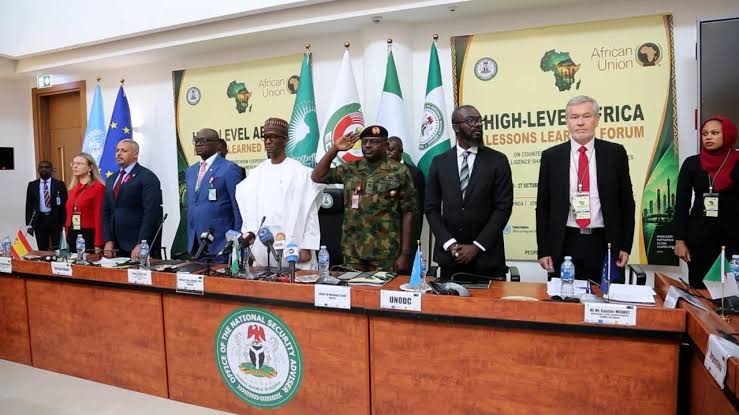
Ribadu made the call at the opening of the High-Level African Lessons Learned Forum on Counter-Terrorism Cooperation, Intelligence Sharing and Emerging Technologies in Abuja.
He said the evolving security threat required stronger intelligence coordination, sustained partnerships and practical cooperation among African countries and their international partners.
According to him, Nigeria’s experience over the past 15 years had shown that military operations alone could not provide a sustainable solution to terrorism.
He said the country had continued to adopt a whole-of-government and whole-of-society approach to counter-terrorism and the prevention of violent extremism.
“While security operations remain necessary, they must be complemented by intelligence coordination, law enforcement, financial intelligence, justice, strategic communications, prevention, rehabilitation, reintegration, reconciliation, community resilience, education, youth engagement, research, training and technology-enabled analysis,” he said.
The NSA said the forum followed the Senior Officials Dialogue on Counter-Terrorism in Africa held in Madrid in May 2026, which emphasised real-time intelligence sharing, improved coordination and the exchange of practical experiences.
He urged African countries to take the lead in developing solutions to the continent’s security challenges while strengthening cooperation with international partners.
“Our partners remain important, and we value their continued support. However, sustainable solutions must be rooted in African ownership, African priorities, African institutions and the lived experiences of our communities,” he said.
Ribadu said no country could effectively tackle transnational terrorist networks in isolation, given their ability to operate across borders, communicate through digital platforms and finance their activities through international channels.
He also highlighted the growing influence of artificial intelligence, encrypted platforms, drones and synthetic media on the security landscape.
According to him, although terrorist groups could exploit these technologies, they also offered opportunities for early warning, threat analysis, digital investigations, border security and the protection of vulnerable communities.
“Our task is to ensure that technology is used responsibly, lawfully and effectively in support of peace and security,” he said.
Ribadu described the National Counter-Terrorism Centre (NCTC), under the Office of the National Security Adviser, as a key component of Nigeria’s counter-terrorism coordination architecture.
He said the centre had strengthened its capacity in strategic threat assessment, intelligence fusion, research, training, policy coordination and technology-enabled analysis.
The NSA assured participants that Nigeria would continue to share lessons from initiatives such as Operation Safe Corridor and the European Union-supported disarmament, demobilisation, rehabilitation and reintegration programme for persons formerly associated with non-state armed groups in the North-East.
Other News
He, however, cautioned against presenting Nigeria’s experience as a perfect model, stressing that countries could learn from one another’s successes and setbacks.
“These experiences are not presented as perfect models. Rather, they are offered as practical lessons from which we can all learn,” he said.
He urged participants to focus on practical outcomes, including stronger institutional cooperation, professional networks, training opportunities and technical partnerships.
Ribadu also called for greater attention to the human dimension of counter-terrorism, emphasising the need to protect communities, uphold human rights, support victims and address the conditions that fuel violent extremism.
“Security is not only the absence of violence; it is also the presence of justice, opportunity, dignity and trust between citizens and the state,” he said.
He reaffirmed Nigeria’s commitment to working with African countries, the African Union, regional economic communities, the United Nations, the European Union and other international partners to strengthen collective security.
Earlier, the National Coordinator of the NCTC, Major General Adamu Laka, said the forum was designed to enable African countries to compare experiences, identify effective strategies and strengthen cooperation against terrorism.
Laka said terrorist groups were increasingly exploiting technology, illicit financial flows, corruption and criminal networks to advance their activities.
He stressed that military action must be complemented by prevention, rehabilitation, reintegration, criminal justice and community resilience.
According to him, Nigeria’s counter-terrorism efforts had also prioritised intelligence sharing, strategic communication, early-warning mechanisms and collaboration with local communities.
He disclosed that more than 1,200 convictions had been secured in terrorism-related cases through improved coordination among relevant agencies.
Laka acknowledged the support of the African Union, the European Union, the United Nations Office on Drugs and Crime and MTN Nigeria in convening the forum.
The two-day forum is expected to examine emerging terrorist threats, intelligence sharing, counter-terrorism financing, online radicalisation, technology-enabled prevention, and rehabilitation and reintegration strategies.
It is also expected to strengthen African-led cooperation and develop practical recommendations for addressing terrorism and violent extremism across the continent.
Also speaking, the Director of the African Union Counter-Terrorism Centre (AUCTC), Dr Lakhdar Idriss, called for stronger cooperation among African countries to address the growing threat of terrorism.
Idriss stressed the importance of intelligence sharing, the exchange of operational experiences and trust-building among security professionals to improve collective responses to terrorist threats.
He also called for approaches that prioritise justice for victims and ensure that lessons from past operations translate into more effective and coordinated action against terrorism.
He emphasised the need for African countries to learn from one another’s counter-terrorism experiences and develop practical solutions tailored to the continent’s security challenges.