Follow Us on Google
The legislature is usually the first casualty in any unconstitutional change of government. This alone should propel any lawmaker to fight and defend democracy with every arsenal in their possession. But it looks like members of the National Assembly of Nigeria (NASS) do not think along this line. They appear oblivious of the dangers inherent in some of their overt and covert actions.
On Wednesday, March 11, 2026, the House of Representatives amended the Electoral Act 2026 to criminalize dual membership of political parties. The amendment bill was listed for first reading that Wednesday. It subsequently scaled through second and third readings and passed the same day.
This was despite protests by some members. For instance, a member representing Jigawa, Fulata Hassan, drew attention of members to some aspects of the amendment that seem to contravene Section 40 of the Nigerian Constitution, which guarantees freedom of association at any time.
The amendment, sponsored by the House Leader, Julius Ihonvbere, introduces three new subsections, 8, 9 and 10, to Section 77 of the Electoral Act 2026, which is on political party membership. Subsection 8 stipulates that a person shall not be registered as a member of more than one political party at the same time.
Subsection 9 states: “Where it is established that a person is registered as a member of more than one political party at the same time, such dual membership shall be void and the person shall cease to be registered as a valid member of any political party pending regularization in accordance with the provisions of this Act and the constitution of the political party concerned.”
Subsection 10 states that any person who knowingly registers or maintains membership in more than one political party at the same time commits an offence and is liable upon conviction to a fine of N10 million, a two-year prison term or both.
On the face of it, the lawmakers mean well for Nigeria. They seemingly want to solve, through this amendment, the problem where certain people maintain affiliations with multiple parties so that when they lose primary election in one party, they move to another one as a candidate without formally resigning.
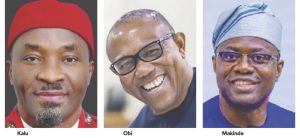
Hence, the amendment reportedly aims, among others, to enforce commitment by politicians to a single ideology or platform and to reduce post-election litigation that often arises from disputed membership of parties. It is also aimed at reinforcing party discipline, improving transparency in party registers and strengthening the integrity of Nigeria’s electoral process. As the Deputy Speaker of the House, Benjamin Kalu, put it, allowing politicians to belong to multiple parties undermines the credibility of Nigeria’s political system.
Good! But, why the rush to pass this bill within one day? Could the non-passage of the bill have derailed the 2027 election? Or is it that the lawmakers have become so patriotic and honest that having a credible political and electoral system now keeps them awake?
Well, a toad does not run in the daytime for nothing. Some analysts have posited that this amendment is targeted at some chieftains of the opposition parties, especially the presidential candidate of the Labour Party in the 2023 election, Mr. Peter Obi. It was Obi who popularized the Labour Party (LP) and almost won the presidential election on its ticket in 2023. This has not gone down well with the powers that be. They have been doing everything possible to stop him because they know that he has the capacity to upset the apple cart.
Since that superlative performance in 2023, the LP has been going through some engineered leadership crises. Different factions (some sponsored) have been laying claim to the leadership of the party. There are Juilus Abure, Nenadi Usman and Lamidi Apapa factions.
Other News
Though Obi announced joining the African Democratic Congress (ADC) in December 2025, it is not certain if he has formally resigned from the LP. So, the fear in some quarters is that, by April 2, when parties are supposed to submit their membership list, Obi’s name may appear in both the ADC and the LP. If this is the case, those after him will probably chant Eureka!
The ruling cabal is not sleeping. It will leave no stone unturned in its plans to retain power in 2027. It is still not satisfied even after passing and signing the 2026 Electoral Act (Amendment) Bill with some loopholes left for rigging. Nigerians raised objections to certain provisions of Clause 60(3) of the Act, but the President blocked his ears and swiftly signed the bill into law. The clause has to do with the mode of transmission of election results.
In the 2023 election, the law gave the Independent National Electoral Commission (INEC) the latitude to use either electronic transmission or manual transfer of election results. INEC had promised to use e-transmission. But midway into the collation of results, it announced ‘technical glitches’ and resorted to manual transfer of results. That was where some abracadabra was done to manufacture the presidential election results of 2023.
To avoid this type of thing and ensure that our elections are credible and transparent, many Nigerians clamoured for mandatory e-transmission of election results. This same House of Representatives passed the version Nigerians wanted. But the Senate’s version is with a proviso that manual transfer could be used in areas that have network challenges. At the harmonization level, the House cowered and went with the Senate version. Before Nigerians could raise further objection, the President swiftly signed it into law.
Obviously, the perception in some quarters is that any one of the different landmines planted on the route to the 2027 elections will blow up the opposition. If manipulating the process through manual transfer of election results did not work, the dual party membership law might work. Assuming these ones didn’t work; attacks on the leading opposition parties might frighten them out of the contest.
Look at what is happening to the ADC. In my intervention on this page last week, I reeled out a series of attacks on the opposition party in different parts of the country. The latest was in Rivers State where the secretariat of the party at Ubima in Ikwerre Local Government Area of Rivers State was set ablaze by suspected thugs. Ubima is the hometown of Rotimi Amaechi, a chieftain of the ADC. His convoy was also attacked by the hoodlums in the same area. There have been similar attacks against the party and its chieftains in Edo, Lagos, Ekiti, Kebbi and Kaduna states.
The Peoples Democratic Party (PDP) is not spared. Every spanner is thrown in the works so that the party will remain perpetually down. Like the LP, the PDP is sick and factionalised. One faction is loyal to a former Governor of Rivers State and Federal Capital Territory (FCT) minister, Nyesom Wike. The minister’s body is with the PDP and his soul with the All Progressives Congress (APC). The other faction is loyal to the Governor of Oyo State, Seyi Makinde.
The Makinde faction held its national convention in November 2025 amid litigation in two federal high courts in Abuja and the Oyo State High Court. The courts gave conflicting judgments in the cases brought before them. The convention held on the strength of the approval given by the Oyo State High Court. The Court of Appeal in Abuja has nullified that convention.
The faction loyal to Wike attempted to hold local government congress in Oyo recently. That appeared to be daring a lion in its den. Thugs disrupted the exercise, attacked party members and damaged some property, including vehicles.
While the leading opposition parties are going through variegated crises, the ruling party has become a behemoth. Currently, 31 of the 36 state governors belong to the party. The PDP, once touted as the largest party in Africa, has only two governors. Before last Monday, the Zamfara State governor, Dauda Lawal, was a member of the PDP.
In my piece last Monday, March 9, I stated that he was set to join the APC. As I predicted, he announced his defection to the APC that same Monday. Part of his reasons was that the Federal Government denied his state some intervention funds simply because he was not in the ruling party. He said he knew states that had received over N500 billion as palliatives to cushion the effects of the rising cost of living. But since he became governor in 2023, he had received none.
One wonders if this is how democracy is practised in some of those countries from where we copied this current system of government. In the United States, party membership is governed by ideology and politicians do not leave their party unless something fundamental happens. Here in Nigeria, anything goes. There is no ideology as politicians defect anyhow either to grab power or money.
Nigerians are watching with keen interest. If the shenanigans to shut out the opposition continue, many people will stay put in their houses on election day. They can as well announce whoever they wish as winner for all we care. But nothing lasts forever. One day, this cup will pass away.