Follow Us on Google

As the House of Representatives resumes plenary on Tuesday, next week, for the last lap of the 8th assembly, one of the key legislations the House may attend to is the bill seeking to return the country to a parliamentary system of government.
The proposed legislation is sponsored by 71 members of the House from across different political parties. The lawmakers in the bill, which was read for the first time in December, last year, before the House proceeded on its Christmas holidays is seeking a further alteration of the 1999 Constitution (as amended) to enable the country return to the parliamentary system of government.
At independence in 1960, Nigeria operated a parliamentary system of government up till 1966, when the first military coup occurred. Prior to the take-off of the Second republic in 1979, the country opted for a presidential system of government. Since then, the country has operated a presidential system.
Shortly after the bill was introduced in the House, Nicholas Ossai, who spoke on behalf of the sponsors had noted that their decision to champion the legislation is informed by their belief that the country is not making the anticipated progress under the presidential system of government.
According to him, “Our position in this legislation clearly points to compelling advantages of parliamentary systems of government to economic growth and development. Studies have shown that countries run by presidential regimes consistently produce lower output growth and more volatile inflation.
“Political and economic instability also pervades and there are countless empirical records, which show that output growth under presidential regimes is in zero point (negative). While out growth under Parliamentary systems clocks from one point and above (positive), in countries run by presidential systems, inflation is on average six percentage point higher than those under parliamentary regimes. Income inequality under presidential systems is worse when compared with that of parliamentary or hybrid systems of government. Presidential regimes consistently produce less favourable macroeconomic outcomes which prevails in a wide range of circumstances. “
He added that, “due to the excessive powers domiciled in one man under the presidential systems, consensus building that is often required for economic decision is always lacking. Economies of nations are known to thrive on the confidence of investors to the system and character of the government. “The level of instability and volatility of presidential systems makes it difficult to achieve these economic objectives. The over centralisation of government decisions that are prevalent in presidential systems obstructs economic development when compared to the parliamentary or hybrid systems. “
Regardless, the proposal has been generating mixed reactions in the polity. While a school of thought has dismissed the proposal as unnecessary, another school of thought thinks otherwise.
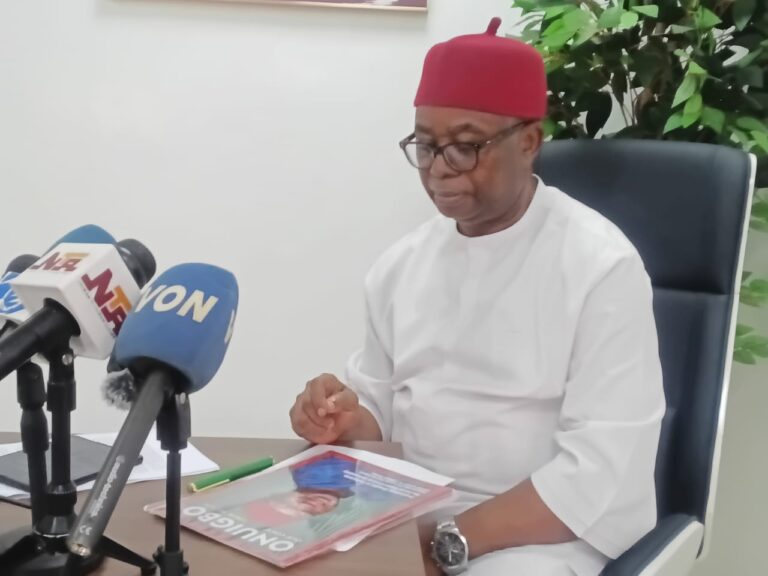
Former Minister of Foreign Affairs, Chief Dubem Onyia, told Saturday Sun that a return to parliamentary system of government, is not the main issue confronting the country at the moment. Onyia said what the lawmakers, as well as other Nigerians should be concerned about now, is the February 16 presidential election. He wondered why the lawmakers are just bringing the proposal, when the Committee on the Review of the 1999 Constitution has been in place since the inception of this current National Assembly.
According to him, “ it is not a question of saying that the country should go back to parliamentary system of government or not. Let us concentrate on what is before us now. That is the presidential election that is coming up on February 16. These things depend on constitutional amendment. And members of the National Assembly have not been able to amend the constitution to reflect what they are saying. The constitution amendment committee has been there for the past years. Whether we return to parliamentary system and remain in the presidential system is not the issue. The issue is that we have an election coming up. And we need to actually rescue this country. Nigeria is at the brink of disintegration. “
Onyia added: “it is when we have a responsible government that we go into this debate. That is why there is clamour for restructuring. We need to restructure this country, whatever system it is. That is the most important thing. That is the most critical thing. Let’s have a free and fair elections. Bring in a responsible government that will change the narrative, restructure the country, then we take it up from there.”
National Chairman of the Reformed All Progressives Congress (RAPC), a splinter group of the ruling party, Buba Galadima said the lawmakers seeking a return to a parliamentary system of government are entitled to their opinion. He said despite the inadequacies of the presidential system of government, it has brought stability to the country, which was one of the core objectives.
According to him, “that is democracy. It is their opinion. If they can muster enough people to do that, fine. But I just want to ask one question, if Nigeria was running a parliamentary system, can Buhari survive the parliament one week? Does he have the large heart, the intellect and the knowledge to face the parliament that will be asking him questions for one week?
“It is just frustration that they (lawmakers) are expressing that people are in places where they are not supposed to be. It is a message.”
Galadima told Saturday Sun, “we brought the presidential system. It has its inadequacies, but it brings about stability. If we have parliamentary system, we could have changed prime ministers severally.
“It has served its purpose. But the cost is too much.How do we reduce it? But for stability, which is the most important thing, it has provided that.”
However, elder statesman, Tanko Yakassai disagrees. While expressing support for the initiative of the 71 lawmakers, Yakassai said he is sure that a lot of Nigerians would equally support a return to parliamentary system of government.
He expressed dismay that hopes that a presidential system of government will better unite the various parts of the country has been dashed, as the country is more divided now than it was under a parliamentary system.
“ The parliamentary system of government is very good for Nigeria. We adopt presidential system of government thinking it will promote national unity with the President having the entire country as his constituency. But as things turned out, that is not the case. We are more divided in Nigeria under presidential system than we were under parliamentary system.”
The problem with the Presidential system, the way to remove the President -that impeachment process – is very difficult. It can hardly work in Nigeria, so whether the government is performing or not, there is nothing you can do about that. But in the parliamentary system of government, with a mere motion of no confidence, when it is passed, the government has to resign and a new government will be set up. Changing government will give way to a new government that will try to address problems. This is very important for Nigeria,” Yakassai told Saturday Sun.
Former Minister of Works, Seye Ogunlewe concurs. He told Saturday Sun that the only way the country can get out of its present quagmire was to return to the parliamentary system of government.
“That is the way out. It is cheaper. It is faster. It takes the legislature eight years, ten years to pass a bill (under the presidential system). In a parliamentary system, they pass bill in a day. We are not in a hurry to develop. That is our problem. That is why our legislators work on the Petroleum Industry Bill (PIB) for 16 years. Bills that can develop the country are never passed.
“In a parliamentary system, you pass bills in one day. That is the way out. It is less expensive, it is less cumbersome. We are running out of time. All the world are ahead of us. We are going to perish as a nation if we are not careful.”
Also expressing support for the initiative by the lawmakers, spokesman of pan Yoruba group, Afenifere, Yinka Odumakin told Saturday Sun that the presidential system is one of the reasons why corruption is so endemic in the country.
“It is a very laudable idea. They have put their fingers on one of the things that are actually wrong with this country. Presidential system has finished Nigeria in terms of corruption. You cannot stop corruption in Nigeria as long as we are in the presidential system. If you check the world today, the leading countries are under parliamentary system.
“Today, if you want to run a presidential election, you have about 1,1 99,73 polling units. If you have one agent in each of the polling units, and give them N5000 each, that will be N6 billion. Who can source that money without touching corrupt money?
“And once you come to power, you have to pay back and look for money for the next election. So, we can never solve the problem of corruption as long as we practise presidential system of government. Whereas in the parliamentary system, you contest in constituency and go and sort out the rest in the parliament if you want to lead the country. It is cheaper. It promotes inclusivity. If Nigeria wants to get out of corruption, we must stop practising the presidential system of government,” Odumakin stated.
Amid concerns that the bill may not be passed in the life of the current Assembly, the Afenifere spokesman said “even if it is not realised under this assembly, they have put the idea on the table and we must pursue it.”