Follow Us on Google
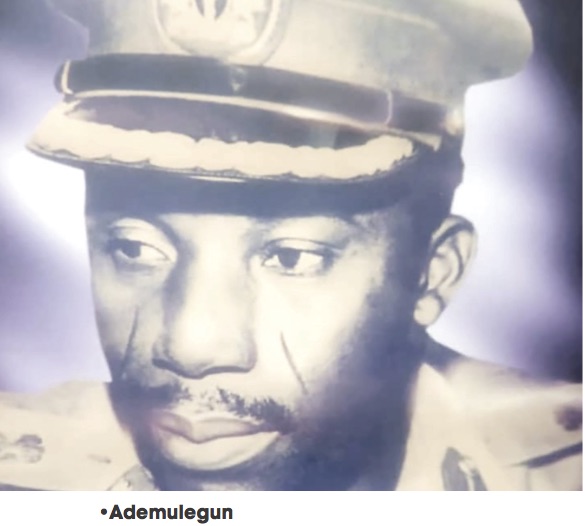
•Brig. Ademulegun deserves monument of honour, by patriots
There are many martyrs among the men and women of our Armed Forces, whose demise and unquantifiable contributions to our nation-building are worth celebrating. But what makes one a martyr is not death but the cause.
A source remarked: “The memory of the nation’s fallen heroes and veterans, recounting their sacrifices during the First and Second World Wars, the Nigerian Civil War and Peace Support Operations around the world who have paid the supreme price of keeping the unity of Nigeria.
‘Government of Nigeria has a curious attitude to the study of history. This has had a serious implication for young Nigerians and older ones as well. A study of history from the early education makes it possible for citizens, starting from very early age, to know almost every detail about their country, the peoples, their root, the wars the country has fought, the agreements and arrangements after such wars.
“Moreso, the diplomatic issues the country has had, the crises the country has passed through in every aspect of life, the major personalities that played important roles for the country, either positively or negatively, etc.
“Every citizen of a country usually knows through education, all the vital facts about their country. Such knowledge of history often defines the patriotic zeal of citizens. History which documents what transpired in the past often informs citizens on how to act in the future, against the backdrop of what has happened.
“Like many other countries, Nigeria has passed through some traumatic experiences in its history. There has been conflicts and difficult political and constitutional issues for the country. There were military coup détats and forced change of governments and political instability.
Furthermore, a good study of history would have thrown more light on the issues and personalities involved in the struggle for independence as well as in the most difficult period in the history of Nigeria.
However, the political crisis that started in the country few years after independence did not stop until it made room for bloody interventions of the military government.
Unfortunately, there are still many versions of what happened and how Nigeria found itself fighting a war against itself till date. Who are the dramatis personae in the various phases of the crisis and the civil war that eventually broke out?
“In a very recent effort to throw correct historical light on the very first coup d’état that opened the flood gate of military incursion into politics, Mike Ozekhome, a senior advocate of Nigeria, said it remains a distortion of history to label the first coup in Nigeria as a sectional coup, or particularly an Igbo coup as some have continued to call it so.
Ozekhome, who presented a historical fact to support his argument, stated that this particular coup was on January 15, 1966 and it was carried out by some young idealistic and disgruntled young officers.
“They were 21 in all and they were Igbo, Yoruba, Hausa/Fulani, Ijaw, Urhobo, Ishan and Middle Belt. The young officers ended up doing great damage and spoilt whatever was the basis of their grievances and disgrunt.
Also, he said in such cases, there are always heroes, some of who may not have gained big public attention, not to talk of appreciation. This is where the absence of teaching and studying history are costly for the country.
“One of the patriots and good guys who fell victim of the first coup in Nigeria because he insisted on being patriotic was Brigadier Samuel Ademulegun. He was the Commanding Officer of the 1st Brigade of Nigerian Army, Kaduna.
Ademulegun’s story is almost like that of Nigeria. His story had started so well, with so much promise and preparation. Born in Owo, Ondo State on October 20, 1924, Ademulegun first had a stint as a teacher, after which he joined the army in 1942. The army in Nigeria was then known as the West African Frontier Force. Of course, the British were very much in charge then and they formed the bulk of the officer corps of the West African Frontier Force.
“Brigadier Ademulegun started rising by dint of professional competence and training. One of the intakes into the army in those days who also rose to the top in the Nigerian Armed Forces later was Olufemi Olutoye, who rose to become a Major General, confirmed indeed that Ademulegun who was to become a Captain at the time he enrolled in the army, was the only Nigerian in the panel that interviewed him.
He had good memories of the smart, pleasant young officer, who had “the gift of the garb with a good command of the English language.” Gen. Olutoye added that it was obviously a reflection of the competence of Ademulegun that “he was invited to lead many official delegations to foreign countries”
“As at that time, the first set of Nigerian officers were commissioned into the Nigerian Armed Forces, just before Independence, Ademulegun was registered as number three. Brigadier Wellington Bassey held the number one spot, while General Aguiyi Ironsi had the number two spot. Ademulegun had military training at the famous Sandhurst Military Academy in United Kingdom.
He served in various locations of need as Burma, Congo and Tanganyika. He also served in the United Kingdom. There was so much camaraderie among the officers’ corps in those days and the division and parochial cleavages that later overtook, every aspect of life in Nigeria.
“Even when regional politics became hot after independence and later spilt across the country, the armed forces were insulated from politics to a very high level. Then the first coup détat happened in January 15 1966.
Unfortunately, Brigadier Sam Ademulegun, the soldier trained to be a professional and a patriot paid with his life for defending corporate Nigeria.
The coup d’etat, according to Mike Ozekhome’s explaination, was the brainwave of a group of radical, overzealous and disgruntled young officers, who thought that with guns they could reverse the disenchantment being felt across the country, as a result of the activities of the politicians.
“Among the young coup plotters were Chukwuma Kaduna Nzeogwu, Timothy Onwuatuegwu, Adewale Ademoyega, Captain Adeleke, Hope Harris Eghagha, Gibson Jallo, Emmanuel Ifeajuna, Sale Gambo, Ben Gbulie, Fola Oyewole and Atom Kpera, among others. They were 21.
In addition, as at 1966, Brigadier Sam Ademulegun was the Commanding officer, First Brigade, Nigerian Army, Kaduna. That was a sensitive military position.
Sadly, on the night of the bloody coup on January 15 1966, the coupists had reportedly marched into his house in the Government Reserved Area of Kaduna, went to his bedroom, where he was asleep with his wife, Latifat, who was eight months pregnant.
“The intruders who were mostly junior to the Brigadier asked for the key of the armoury for their operation, which was already on, but Ademulegun was unaware.
Reportedly, he bluntly refused to release the armoury keys, obviously considering it beneath his position as the Commanding Officer of the Brigade to do so.
“His pregnant wife, who was said to also be very familiar with the rampaging younger officers, who were all friends of the family, got up and stood between her husband and the officers who were demanding for the armoury key. She obviously expected that her pregnancy will soften the situation, especially as they all knew themselves. It did not help.
In a flash of tragic burst of bullets, Ademulegun and his pregnant wife were gunned down. They counted among the high-profile causalities of the night that changed Nigeria’s history for worse.
It has been 57 years since the tragic night of January 15, 1966. Nigeria has never recovered from the trauma of that incident and the subsequent equally dastardly acts and reprisals that followed. However, the country has tried to move on.
“Once in a while over the years, the government of Nigeria identifies and honours fallen heroes in various ways, patriotic citizens and servicemen who have diligently served the country well, in one sector or another.
“This is commendable. Such honour and recognition have a way of encouraging every citizen, especially the young ones and those still in service, to give their best to the country. Such identification of patriots who have given their best to their fatherland, is also a way of recording history and documentation for posterity, the account of citizens who placed country above personal interest.
“In very rare occasions, you could find such service to the country. Some citizens sacrifice themselves and give their lives for the good of all. Ademulegun proudly counts in this category. Any recognition given to him by Nigeria will surely be merited.
“Only recently, the Federal Government listed another round of Nigerians, dead and alive, who were honoured with airports named after them. These are heroes and patriots whose names are now etched in landmarks in the country. Their names will lead to younger generations and future generations asking who they were and what they did. There is indeed, no better way to honour those who gave their lives in the service of country.
“Incidentally, one of those who was recently honoured with an airport to his name is Brigadier Zakari Maimalari, who lost his life the same night Brigadier Ademulegun, the Commanding Officer of First Brigade Nigerian Army, Kaduna, also lost his life. The Gombe Airport now bears Maimalari’s name. That is a worthy honour to a good soldier. His name has now been etched in history for future reference. Nigerians would know that he served the country well, through the life time honour. Of course, apart from airports, there are various other major national landmarks with which eminent citizens who gave their lives or their best to the nation, are encrypted. It would be wonderful if in the next rounds of such naming of national monuments, Brigadier Samuel Ademulegun is remembered. He served the country well and paid with his life. Dying alongside his pregnant wife, because he insisted on guarding the keys of the armoury from those who needed to access the weapon to sack the government and prominent state officers. It is a mark of courage and patriotism. It is possible that if Ademulegun had chickened out and released the keys to the armoury, greater damage would have been done that very night, although the Brigadier would have saved his neck. But he was too much of a professional soldier and a patriot to accept that. He preferred to guard the armoury keys with his life. Unfortunately, his wife’s head also went with it.
“Ademulegun lived a life of a real soldier. He is a role model and exemplary of what a committed soldier should be. It is important that his likes are prominently honoured, so that young servicemen in uniform will look up with pride to the monument in their name and say, yes, this is how the country honours those who give their lives in her service.