Follow Us on Google
From Sola Ojo, Kaduna
Rafin Kunu is an isolated agrarian community in the belly of Kajuru Local Government Area of Kaduna State. It is less than a 30-minute drive from Kaduna, the capital of Kaduna State.
The village, which has a few thousand occupants, is blessed with good climatic conditions to grow a variety of crops, including maize, rice, beans, soybeans, tomatoes and pepper, among others, in commercial quantity.


However, the majority of the people in this village have eye problems, which now pose a serious threat to their survival and productivity, which they said subsided when they had a functional solar-powered borehole in the village. The problem resurfaced some 15 years ago when the borehole stopped working.
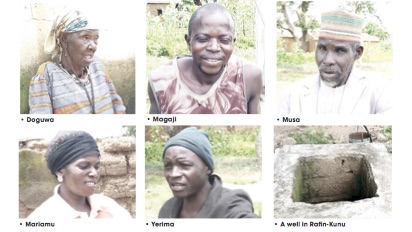
Findings revealed that the wells, which serve as the major water source for the people of Rafin Kunu, appeared contaminated. When this correspondent tasted water from one of the wells close to the disused solar-powered borehole, it was salty even though Kaduna is located 1,922 feet above sea level. According to the locals, the water used to be tasteless and colourless during the dry season when the water level must have gone down.
An optometrist report in 2022 revealed that about 300 million people are blind across the world and 90 percent of them are in developing countries, with Nigeria having about seven million blind persons, among its 200 million population (2006 population projection).
It was not clear whether the people of Rafin Kunu were captured in that report. Whatever the case may be, the eye problem affecting these locals may be among the 80 percent avoidable causes.
Mrs. Doguwa Aminizeh is an 85-year-old octogenarian who has been partially blind for 30 years. According to her, some of her children and grandchildren are also suffering from eye problems, thereby making it a generational issue that requires urgent solutions.
She said: “I have been partially blind for 30 years. In the past year, I have not been taking my medicine because there is no economic power to do so. I was taken to the National Eye Centre in Kaduna for treatment some years ago, but the issue has not been addressed.
“The thing also affected some of my children and I now have a two-year-old grandchild with swollen and itching eyes. We need help. I don’t want my grandchildren to continue in this manner.”
For Mr. Musa Wakili, 80, he has seen several of his kinsmen go down with blindness over the years without remedy.
“Due to my age, I have seen several people in this community go blind completely. I have lost count. Some are dead and some are alive. It has been a long-term issue.
“When the Federal Government gave us this borehole (pointing at the disused overhead water tank), the problem reduced drastically only to resurface 15 years ago after it stopped working.
“We have done all we could to make it work again but our efforts have not yielded the expected result. How I wish we had more than one safe water source at Rafin Kunu. If we have more than one, I believe all of them cannot stop working at the same time,” the octogenarian noted.
Giving insight into the development, a 53-year-old community leader, Mr. Yerima Simon, intimated that the name “Rafin Kunu” was given by their ancestors.
“The majority of us here are farmers. We contribute to the food people eat in Kaduna City. We are trying to catch up with development, which is why only a few houses have toilet facilities. The majority practice open defecation.
“The rocks provide great security cover for the people here and I think that was why our grandparents chose to be here. I’m saying this because we have vast land outside here but we only farm and do not live there.
“We have a primary school and health centre. Some of our children have to go as far as Kufana to attend secondary school. That is about three hours’ trek to and from the school. A lot of those you see here now could not finish secondary school while those that managed to finish could not proceed to higher institutions because their parents could not afford it.
“Electricity is far from here, though we have access to mobile network from nearby servers. Our problem is water. When this solar pump was put in place by the Federal Government several years ago, the community was not trained on how to repair it.
“As it stands, we don’t know why it stopped working. Some said maybe the batteries expired, but we are not sure. The bottom line is that we have a lot of us with severe eye problems. Some of us have gone as far as to the National Eye Centre in Kaduna but we are yet to see the end to this problem, especially in our young ones,”he explained.
Another resident with an eye problem, Mr. Bernard Magaji, 38, hinted that the economic capability of the affected locals was also an advocacy issue because they know where to go to seek help but were constrained by empty pockets.
“I don’t know what is wrong with my eyes. It started this year. I can barely see anything close to my eyes. We have this problem here. Many of us are affected. Some have gone blind completely. In my case, it started this year but because I cannot afford to travel to Kaduna to seek medical help, I’m just managing myself. We suspect our problem to be lack of access to safe water,” he said.
On her part, a middle-aged woman, Mariamu Paul, reiterated what others had said, suspecting a lack of safe water within the community.
“I suspect that our problem is water because we don’t have good water here. We want the government to come to our rescue. We have been complaining. Government needs to come to our aid. I have a lot of family members with this problem.
Although the eye issue in Rafin Kunu has not been confirmed to be glaucoma-inclined, a specialist with the National Eye Centre, Kaduna, Dr. Abdullahi Sadiq Muhammed, said though anybody, especially those in Africa, could develop glaucoma, a national eye survey conducted some years back revealed that the South East part of the country had the highest number of glaucoma cases in Nigeria.
“Glaucoma is a non-communicable disease and the number one causal agent of irreversible blindness in the world. Some people were born with a hereditary disposition to develop glaucoma later in life.
“Patients may not even know they have glaucoma until the symptom emerges. What I do tell people is that the moment you know one of your family members has glaucoma, it is important to have your eyes examined.
“Again, if you are 50 years and above, it is good to have your eyes checked at least once a year so that you can manage it early enough to prevent the irreversible blindness we are talking about.
“There was a national eye survey dating back to 2005-2006 that understudied causes of blindness in Nigeria where it was discovered that the southeastern part had more glaucoma than other parts of the country. We are more of a national health facility. So, we don’t have specific data about Kaduna.
“Being black alone is a risk factor and in a week we see about 50 glaucoma patients and that is because we give them appointments,” he said.