Follow Us on Google
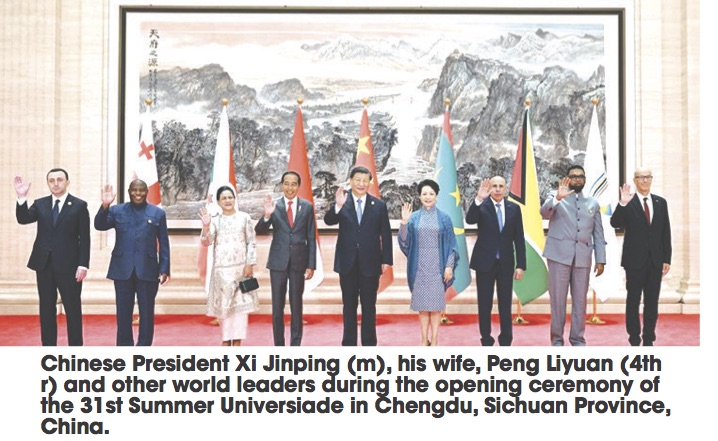

On the evening of July 28, 2023, China and the rest of the world witnessed the grand event of the Universiade and the composition of the chapter of youth. The 31st Summer Universiade opened in Chengdu, Sichuan Province, China. Chinese President Xi Jinping attended the opening ceremony and announced the opening of the current Universiade.

International guests who attended the opening ceremony included Indonesian President Joko Widodo and his wife, Iliana; Mauritanian President Mohamed Ould Ghazouani; Burundian President Evariste Ndayishmiye, Guyana President Irfaan Ali, and Georgian Prime Minister Irakli Garibashvili. The main executive committee members of International University Sports Federation (FISU) also attended the opening ceremony.
Eight outstanding Chinese youth athletes and volunteer representatives entered the arena holding the FISU flag. Accompanied by the song of the FISU, the flag of the FISU was raised slowly, flying high together with the five-star red flag. Athlete Tang Ziting and referee Liu Jiang took the oath on behalf of all participating athletes and technical officials.
Subsequently, the stylistic performance “Youth Chasing Dreams” was presented wonderfully. The performance is divided into three parts: “Light of Youth,” “Vigor of Youth,” and “Friendship of Youth.” “Light of Youth” shows young people’s eternal pursuit of exploring and flying towards the light with vigorous climbing; “Youth Vitality” presents the scene of young college students running hard and full of vitality, expressing the joy and passion that sports bring to people. In the chapter “Youth Friendship,” young college students and the cute “Friendship Envoy Giant Panda” dance to cheerful music and gain friendship in the youth gathering.
In the night, the main stadium of Dong’an Lake Sports Park was brightly lit and full of brilliance. Prior to the opening ceremony, college students from Chengdu presented energetic performances, which made the atmosphere very warm.
At 19:58, amidst the music of “Peace-Community of Destiny,” Xi, his wife, Peng Liyuan, and the Acting Chairman of the International University Sports Federation, stepped onto the rostrum and waved to the audience. There was a long and warm applause from the audience.
In the center of the venue, the Chinese cultural heritage symbol “Sun God Bird” rotated smartly, and twelve golden lights shone. The fireworks bloomed in the air and the countdown numbers were displayed, and the audience shouted in unison with the numbers. Amid the cheers, gorgeous fireworks bloomed in the night sky. The opening ceremony of the Chengdu Universiade officially began.
Along with the children of Daliang Mountain singing “The National Flag is Beautiful” and the chorus of youths from 56 ethnic groups singing “Ode to the Motherland,” eight guards of honour took firm steps to guard the national flag of the People’s Republic of China and walked into the scene. All stood up and sang the national anthem of the People’s Republic of China. The five-star red flag rose slowly and fluttered in the wind.
President Xi Meets Former US Secretary of State Henry Kissinger
On July 20, President Xi Jinping met with former United States Secretary of State, Dr Henry Kissinger, at the Diaoyutai State Guesthouse in Beijing. Xi noted that Kissinger has recently celebrated his 100th birthday and has paid more than 100 visits to China over the years.
Xi said: “These two 100s give this visit special significance. Fifty-two years ago, when China and the United States were at a crucial inflection point, Chairman Mao Zedong and Premier Zhou Enlai and President Richard Nixon and Dr. Kissinger, with their extraordinary strategic vision, made the right decision for China-U.S. cooperation and launched the process of normalizing the China-U.S. relationship.”
Xi also said the decision delivered benefits to the two countries and changed the world.
According to Xi, “The Chinese people value friendship. They never forget their old friend, nor your historic contributions to promoting the growth of China-U.S. relations and enhancing friendship between the two peoples.”
On his part, Kissinger expressed appreciation to President Xi for meeting him at Villa 5 of the Diaoyutai State Guesthouse, the venue where he had met Chinese leaders during his first visit to China. He stressed that the U.S.-China relationship is essential to peace and prosperity of the two countries and the wider world.
Wang Yi Puts Forward Four Proposals on Strengthening Cooperation Among Global South Countries
At the invitation of the Minister in the Presidency, Khumbudzo Ntshavheni, of South Africa and the Governments of Ethiopia, Kenya, South Africa and Türkiye, Member of the Political Bureau of the Communist Party of China (CPC) Central Committee and Director of the Office of the Central Commission for Foreign Affairs, Wang Yi, attended the 13th Meeting of BRICS National Security Advisers and High Representatives on National Security in Johannesburg, South Africa, from July 24 to 25, and visited Ethiopia, Kenya, South Africa and Türkiye before and after the meeting.
The Meeting of BRICS National Security Advisers and High Representatives on National Security is an important platform for BRICS countries to carry out political and security cooperation. China had in-depth exchanges of views with BRICS partners on the current international security situation and issues of mutual interest at the meeting, building up consensus and deepening cooperation, so as to provide positive energy for a world that is experiencing turbulence and transformation, and make political preparation for the BRICS Summit to be held in August this year.
During the visit, Wang said that independence is the defining political feature of the Global South, development and revitalization are the historical mission of the Global South, and fairness and justice are the common proposition of the Global South.
Wang also said as members of the Global South family and responsible members of the global village, all countries needed to work together to shoulder their responsibility for world peace and common development. He went further to canvas for the elimination of conflicts and the joint building of peace; called for the reinvigoration of vitality and promotion of development; openness and inclusion for common progress and unity and discussion of cooperation.
The Extraterritorial Effect of Hong Kong’s National Security Law Is Reasonable and Legal
Recently, the Hong Kong SAR Police wanted eight fugitive anti-China disruptors suspected of violating the Hong Kong National Security Law in accordance with the law.
According to the Chinese Government, “Some Western countries, including the United States, once again expressed their “concern” impatiently, falsely claiming that the SAR Police are forcibly enforcing the Hong Kong National Security Law outside the territory, which violates international law. This kind of fallacy confuses concepts, distorts legal principles, and is full of “double standards,” which once again exposed the evil intention of the United States and the West to see Hong Kong’s prosperity and stability. It is necessary to seriously refute this to set the record straight.
“It is necessary to be clear about the provisions of international law on extraterritorial jurisdiction. There are three kinds of national extraterritorial jurisdiction, namely: extraterritorial legislative, judicial and administrative jurisdiction. International law does not prohibit countries from establishing extraterritorial jurisdiction, but there are certain limits to its scope. In a nutshell, when a country establishes extraterritorial legislative jurisdiction, it should have “reasonable sovereign interests” or “substantial ties” with the subject of jurisdiction, including territory, nationality, substantial influence on the country, national security and other major national interests.”
China’s concern on the Disposal of Nuclear-contaminated Water
The Chinese Government has said it believed that the IAEA report should not be the “shield” or “greenlight” for Japan’s discharge of nuclear-contaminated water into the ocean.
The Chinese Government said: “Due to its limited mandate, the IAEA failed to review the justification and legitimacy of Japan’s ocean discharge plan, assess the long-term effectiveness of Japan’s purification facility and corroborate the authenticity and accuracy of Japan’s nuclear-contaminated water data.
Therefore, the conclusion is largely limited and incomplete. We noted that Director General, Rafael Mariano Grossi, stated that the IAEA conducted the review at the request of the Japanese government and the report is neither a recommendation nor an endorsement of Japan’s ocean discharge policy.”
Lekki Port: Nigeria’s Deepest Sea Port

Lekki Port is a BOOT project. The construction was completed by CHEC in October 2022. The concession spans over 45 years (three years’ construction included).
The shareholders of the port are: CHEC, Tolaram, the Lagos Government, and Nigerian Ports Authority. Lekki Freeport Terminal, a joint venture enterprise owned by CHEC and CMA-CGM, is the container operator for the Lekki Port.
Phase One of the multipurpose Port covers an area of 50 hectares, with two container berths and a total capacity of 1.2 million TEUs annually. The approach channel is about 11km long and 16.5m deep. The main breakwater is 1.9km long. Equipped with seven ship-to-shore cranes and 21 RTG cranes, the port began commercial operation in April 2023.