Follow Us on Google

By Steve Agbota
APM Terminals Nigeria has underscored the importance of efficient ports, modern infrastructure and stronger public-private collaboration in enabling trade, improving productivity and supporting Nigeria’s economic growth.
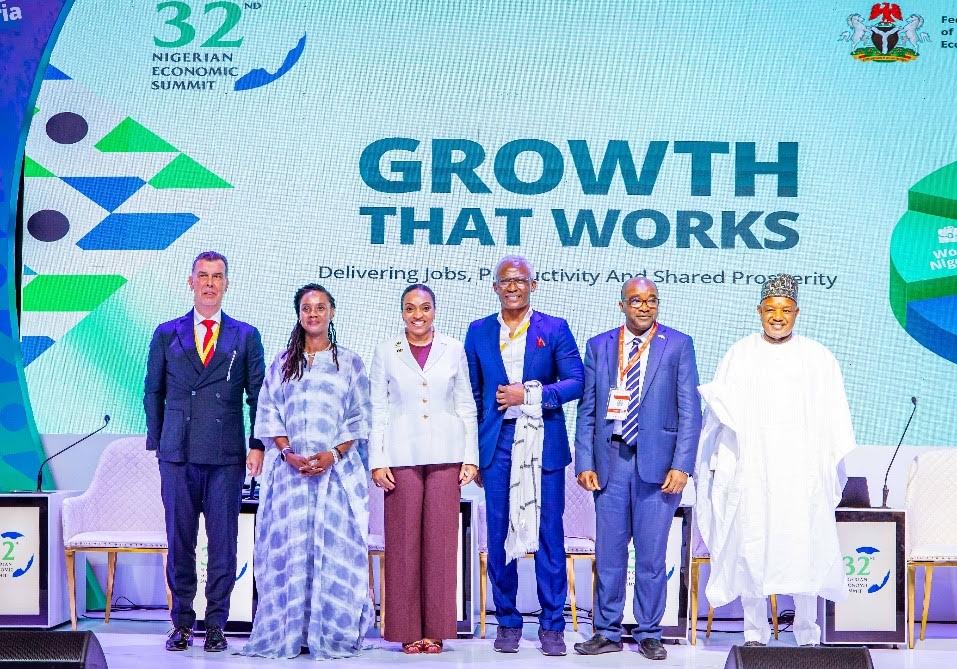
The call was made at the 32nd Nigerian Economic Summit (NES #32), held in Abuja under the theme “Growth that Works: Delivering Jobs, Productivity and Shared Prosperity”. The summit brought together leaders from government, the private sector and other stakeholders to advance conversations around Nigeria’s economic development.
Speaking at the summit, Vice President Kashim Shettima, delivering President Bola Ahmed Tinubu’s address, reinforced the importance of improving productivity to translate reforms into prosperity.
“Our pursuit of prosperity demands greater productivity from every worker, enterprise and investment. The government would continue efforts to ease regulatory burdens, strengthen transparency and policy predictability, and expand access to finance,” he said.
During a plenary session, the Chief Executive Officer of APM Terminals Nigeria, Koen De Backker, reinforced the critical role that ports play in facilitating trade and creating economic value.
“Our job is to facilitate trade, to be an enabler for cargo to move in and out of the port, and to create wealth and prosperity for the population of Nigeria,” he said.
Highlighting capacity constraints within ports as a key challenge, De Backker explained that containers remaining too long within terminals restrict the capacity required to keep cargo moving.
He stressed the need to diversify cargo evacuation beyond road transportation by expanding alternatives such as barging and rail.
He cited APM Terminals’ logistics centre in the Ibadan area, where export cargo is consolidated, stuffed into containers and moved by rail into the terminal, as an example of how alternative transport links can support cargo flows.
Other News
De Backker also emphasised the need to modernise Nigeria’s ageing port infrastructure, noting that technology, specialised expertise and investment are essential to increasing capacity and efficiency.
Rather than viewing private sector participation simply as privatisation, he described it as an opportunity for “professionalising the infrastructure, modernising, and getting experts in”.
He further highlighted collaboration with government agencies, Customs and clearing agents as central to achieving meaningful improvements.
Citing the deployment of cargo scanners, De Backker said collaboration with Customs had enabled containers to be scanned rather than relying solely on physical examinations, improving efficiency and security.
According to him, this contributed to reducing import container dwell time in the example discussed from 18 to 14 days, creating benefits through faster cargo availability and reduced costs.
The Chairman of the Economic and Social Governance (ESG) group, Olaniyi Yusuf, said the theme of NES #32, “Growth that Works: Delivering Jobs, Productivity and Shared Prosperity”, reflected the need for economic growth to create value, expand opportunities and improve living standards.
“So, the next phase of our reforms must prioritise lower production costs, reliable infrastructure, productive investment and more effective public expenditure,” Yusuf said.
The discussions at NES #32 underscored a shared imperative: Nigeria’s growth ambitions will require stronger partnerships, productive investment and infrastructure that enables businesses and communities to prosper.
For APM Terminals Nigeria, efficient ports remain fundamental to that journey, connecting businesses to markets, strengthening supply chains and helping unlock sustainable economic opportunities.