Follow Us on Google

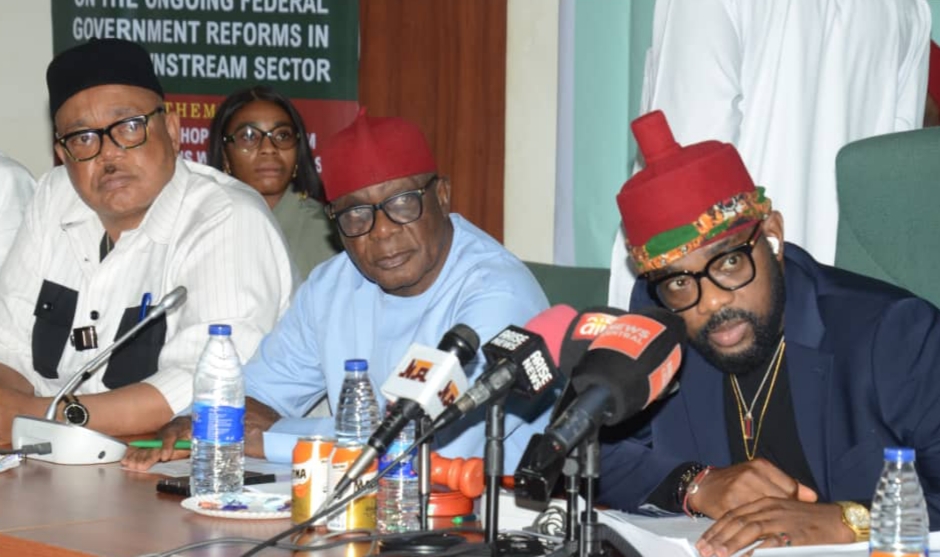
House of Representatives Committee on Petroleum Resources (downstream) has said it is taking steps to guarantee crude oil supply to domestic refineries in the country.
The chairman of the committee, Ikeagwuonu Ugochinyere, gave the hint while speaking at a meeting to consider the report of the Sub-Comnmittee on the amendment the f the Petroleum Industry Act ( PIA) 2021, amongst other issues.
Ugochinyere added that the proposed amendment would also provide for the regulation of importation of petroleum products and safeguarding quality, as well as strengthening regulatory oversight.
According to him, “We began this sitting with the report of our Sub-Committee on the Amendment of the Petroleum Industry Act 2021, which was inaugurated on Friday, 23rd October. Its mandate is not to dismantle the Act, but to refine, strengthen and future-proof it.
“The Sub-Committee will focus on four pillars: guaranteeing crude supply to our domestic refineries on fair, commercial terms; regulating imports and safeguarding product quality, so that Nigeria never becomes a dumping ground for off-spec fuel; strengthening regulatory oversight against monopolies and exploitative pricing; and securing downstream infrastructure, including the rapid expansion of CNG and LPG.”
Furthermore,the lawmaker noted that “I also briefed this House on the outcome of the technical report presentation at the Downstream Week 2026. The Technical Committee gave us four clear conclusions: there is no supply security without pipeline security; local refining has changed the national equation; importation must be a supplement for verified shortfall, not a permanent substitute for what we can produce at home; and the Domestic Crude Supply Obligation must be enforced, not merely recited.”
He added that “the work of the downstream sector in the last 12 months must be seen against the background of a very difficult global environment. The conflict in the Gulf has pushed the price of crude oil above 100 US dollars per barrel, almost 50 per cent above its level before the conflict.
“These are developments that are not of the making of the Federal Government, but whose effects reach every Nigerian at the pump. Since the removal of fuel subsidy, our petrol prices follow world prices. The real test of leadership, therefore, is whether the Government and its institutions can protect Nigerians from such shocks without returning to the waste and corruption of the old subsidy regime.
” On the evidence before this Committee, that test is being met. On the subsidy question, let me be clear. Nigerians use about 50 million litres of petrol a day. On the Federal Government’s own estimates, returning to the old pump price would cost over 20 trillion naira a year, close to everything the Federation Account shared among all three tiers of government in 2025.”