Follow Us on Google
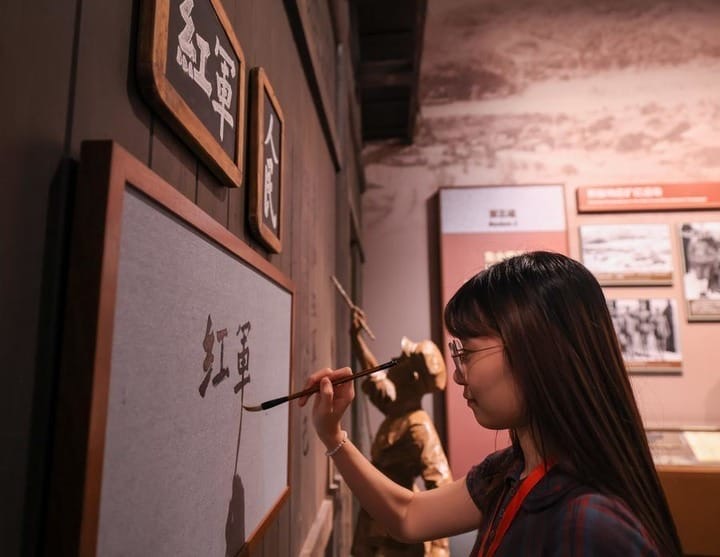
Artifacts exceeding 300 and historical documents related to the Long March, have been exhibited for the first time at a military museum in Beijing.
The exhibition, according to Xinhua News Agency, offered new details about an event that helped shape the history of the 20th century.
The exhibition came as China marked the 90th anniversary of the victory of the Long March, which concluded in October 1936 when the main forces of the Red Army broke through the siege of the Kuomintang forces and reunited in northwest China.
The exhibition covered around 3,300 square meters and features 875 artifacts, including individual pieces and sets, along with 186 historical documents – 1,061 items in all.
It also features 357 photographs and charts and 73 artworks.
Carefully designed displays recreated key episodes along the Long March, from the seizure of the Luding Bridge and the battle to break through Lazikou Pass, to a meeting held in Zunyi, Guizhou, in 1935.
The museum has previously staged three themed exhibitions commemorating the Long March, in 1996, 2006 and 2016.
For the first time, this year’s exhibition includes English-language descriptions.
It will remain on display as part of the museum’s permanent exhibition.
“The military odyssey of roughly 12,500 kilometers, which started in 1934, not only preserved the revolutionary forces, but also gave the Communist Party of China (CPC) a new foothold from which to grow the strength of the revolution, and a new starting point from which to carry the revolution forward to victory.
“One highlight of the exhibition is a collection of manuscripts recounting battles, radio communications, daily experiences and other aspects of the journey. Some were written by the individuals themselves, while most were compiled from their oral accounts.
“These manuscripts offer valuable first-hand records, while also displaying literary merit, said a guide at the Military Museum of the Chinese People’s Revolution, which is hosting the themed exhibition.
“Among them is a manuscript by a division commander, recounting how his unit tried to hold back enemy forces at the Xiangjiang River in late 1934,” Xinhua News Agency reported.
Historical records showed that the Central Red Army emerged from the campaign with just over 30,000 troops, down from more than 86,000 at the start of the Long March.
An exhibition curator at the museum said that the newly displayed materials, along with the personal belongings of those who died in battle, helped broaden knowledge of what happened in key battles during the Long March.
The curator further said the materials also provided valuable source material for research into military history.
“Over the past nine decades, the Long March has drawn journalists, writers and scholars from around the world to retrace its route and explore its history as a way to understand the CPC and China today.
“More than a strategic military maneuver, it is widely regarded as a saga of ideals, devotion, willpower and bravery.
“Another group of newly displayed artifacts offers a glimpse into how Red Army soldiers pushed the limits of human endurance in some of the most unforgiving terrain along the route.
“They include a blue, single-layer coat and a simple knitted blanket used by soldiers to keep warm while crossing snow-covered mountains, as well as everyday items such as a fire-starting tool and a first-aid pouch,” the Chinese state-owned medium stated.
According to information presented at the exhibition, the main forces of the Red Army climbed more than 20 snow-covered mountains, rising above 4,000 meters during the Long March.
Thin air, deep ravines and rapidly changing weather made the journey a constant test of endurance, even as some soldiers collapsed from exhaustion, while others froze to death.
“Hundreds of kilometers of marshland posed another formidable challenge for the Red Army. The terrain was so treacherous that it was described as a “death trap,” with hidden marshes that could swallow people and animals without warning.
“Many soldiers lost their lives there. Some died of illness or starvation, while others were poisoned by wild plants they ate in a desperate bid to survive. Others simply disappeared in the marshes.
“The exhibition in Beijing features newly displayed artifacts from this ordeal, including half of a belt, with the other half having been eaten by a soldier, a fishing line used by a senior officer to catch fish for food, and straw sandals reinforced with cloth that soldiers wore while crossing the marshlands,” the news agency explained.
Speaking about the exhibition, an International Relations Consultant and Vice President of the London-based 48 Group, Keith Bennett, said conviction, discipline and perseverance were the enduring values of the Long March, saying that they continued to inspire China’s modernization and its vision of multipolarity, global cooperation and shared progress.
Keith added that the spirit of the Long March remained a living force in contemporary China, guiding endeavors like poverty alleviation, rural revitalization, scientific innovation, ecological civilization and major national development goals.
“The exhibition’s new displays also turn to another part of the Long March story: the people who lived along the route. The objects offer a glimpse into the ties the CPC and the Red Army sought to build with local communities.
“Among these items are a tablecloth that Mao Zedong gave to a member of the Miao ethnic group in Guizhou, a volleyball soldiers left behind in Sichuan, and a pair of goggles presented to a guide in Yunnan. All three provinces lie in southwest China.
“Other artifacts include black ramie cloth and scissors given to people in Guizhou to show gratitude for their help, as well as a porcelain bowl presented to a family in Sichuan that took in a wounded soldier and cared for him as he recovered,” the news medium added.
Also speaking, a Dutch Sinologist who joined a group retracing the Long March this summer, Elsbeth van Paridon, said walking the route gave her a feeling similar to looking out over the beaches of Normandy and realizing what had happened there.
She described the objective of the Long March as “making it all about the people.”
She noted that the former revolutionary sites along the route now also serve as ecological parks, becoming part of a broader tourism economy that supports local development.
“That is how you see the spirit of the Long March live on,” she said.