Follow Us on Google
From Fred Itua, Abuja
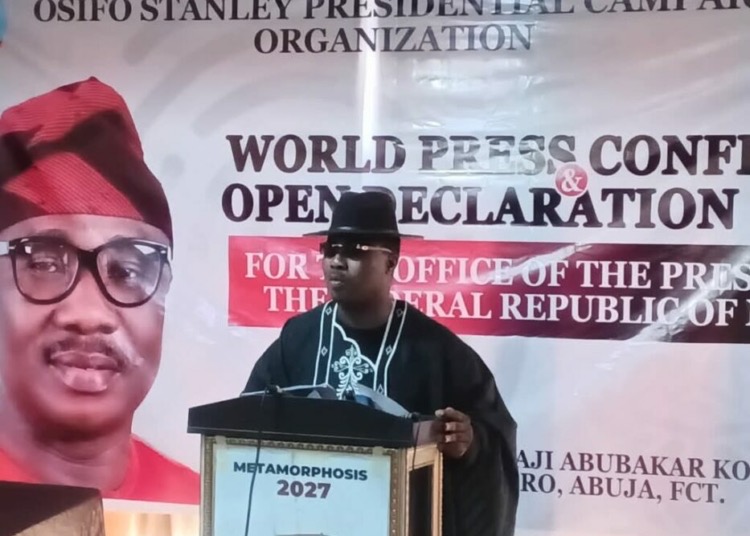
Entrepreneur and political figure, Osifo Stanley, has formally declared his intention to contest the 2027 presidential election on the platform of the All Progressives Congress (APC), unveiling an ambitious campaign programme he has christened ‘Metamorphosis 2027’.
The declaration, held in Abuja, marks the official commencement of Stanley’s campaign, which he flagged off from his ward amid supporters and party faithful.
Stanley presents himself as an international innovative entrepreneur with extensive experience spanning national and global economic engagements.
He describes himself as a patriotic Nigerian driven by a singular conviction, that Nigeria possesses every ingredient required for greatness and lacks only the leadership willing to activate it.
“My convictions on enhancing development and delivering quality service to Nigerians, Africans and the world at large is the driving force that makes me work consistently toward the growth and development of the Federal Republic of Nigeria,” Stanley stated in his declaration.
At the core of the Metamorphosis 2027 agenda are two central priorities that Stanley’s campaign identifies as the twin foundations upon which every other ambition must rest: economy and security.
“We are aware that economy encapsulates all human activities,” his declaration reads. “There is no sphere of human existence devoid of economic element. A sound economy is the harbinger of wealth. Similarly, a secured society is the foundation for sound economic structuring.”
On the economic front, Stanley is proposing sweeping reforms including the recapitalisation of the Bank of Industry (BOI) and the Bank of Agriculture (BoA) to strengthen support for micro, small and medium enterprises. He also plans to establish Free Trade Zones across all 36 states of the federation, working in collaboration with state and local governments to drive exports, attract foreign investment and create employment at scale.
He has further proposed the creation of Industrial Parks, to be preceded by thorough feasibility studies and engineering designs, as well as a special fund dedicated to supporting new businesses and stimulating private sector growth.
The ailing crude oil refineries, he added, would receive urgent attention with the option of private sector participation introduced to restore functionality.
Other News
On security, Stanley is advocating for extensive stakeholder dialogue across all geopolitical zones, underpinned by robust intelligence infrastructure that harnesses both human networks and Artificial Intelligence.
He has promised specific regional interventions for communities in the North East, North West, North Central, South East, South West and South South that have been ravaged by the activities of bandits, unknown gunmen and other armed elements.
For education, Stanley has promised financial and material support for institutions across the country, including the upgrade and construction of libraries, the payment of scholarship allowances and the sustained payment of the Federal Teachers Scheme Allowance and Consolidated Academic Tools Allowance to promote research.
His energy agenda calls for complete decentralisation of the power sector and the implementation of stringent policies to address the chronic power shortages that have hobbled industrial and domestic life for decades.
On agriculture, he is proposing rural road improvements, value chain development for agricultural commodities, and the provision of preservation and storage facilities to reduce the colossal waste of farm produce that currently bleeds the sector.
He also flagged plans for the rehabilitation of the Ajaokuta Steel Company and other steel facilities, improved water resource provision including the rehabilitation of dams and irrigation projects, and the development of a technology hub modelled after Silicon Valley to anchor Nigeria’s ambitions in science and innovation.
Addressing the political architecture of the country, Stanley pledged a firm commitment to the Federal Character principle, promising an administration in which all component states are constitutionally represented and in which nepotism has no place.
“The voice and will of the people of Nigeria must prevail in every political, governance and leadership consideration,” he declared, describing his vision of governance as a democratic enterprise of the people, instituted by the people and working, without exception, for the people.
He also committed to reining in Nigeria’s ballooning debt burden, describing it as an unconscionable weight on present and future generations, and outlined plans to adopt a Medium Term Fiscal Framework as the budgetary backbone of his administration’s spending and investment priorities.