Follow Us on Google
By Ngozi Nwoke
It is known that when an onion is sliced or diced, the onion’s cells release certain compounds into the air. When this occurs, the “enzyme” works to alter the amino acids into lachrymator compounds. This form of sulfuric acid irritates the nerves around the eyes, making them tear.

Nigerians are “crying” not just because of sulfuric acid released by onions, but because of the upsurge in the cost of onions. The rapid increase in cost is said to be caused by floods, which worsened the country’s farming situation.
Families are forced to buy onions at exorbitant prices as the most commonly consumed vegetable now costs from N50,000 to N70,000 for a big basket in some Lagos markets. Investigations showed that in the last few weeks prices have been on a steady rise as scarcity hits markets across the country.
Narrating the situation to Daily Sun, consumers and sellers larmented the surging price of onions and how it is affecting their food budget.
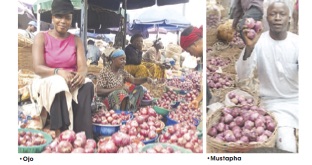
“Prices differ in different markets, depending on the location. The price of onions is usually higher this time of the year, November to December, because this is the time when farmers grow the crop. A bag of onions sold at the rate N20,000 before is now sold for N56,000,” said Abbas Mustapha, an onion dealer at Oyingbo Market in Lagos.
At Ojota Market, Lagos, sellers attributed the scarcity and hike in the price of onions to flooding, insecurity in the North and bad roads for trucks to transport them across the country.
Madam Eniola Bidemi, another onion dealer, said: “We are having onion scarcity and increased cost because of the insecurity in the farms in the North. The farmers are afraid to go to the farms because they may be attacked or kidnapped by terrorists. As at last year, a bag of onions was sold for N16,000. This year in January it was sold at the rate of N25,000 and now a bag is sold at N70,000. I have to sell according to how I bought to recover my capital and make gain.”
She urged the government to urgently address the insecurity challenge in the country, especially in the North.
At Mile 12 Market in Lagos, Sikirat Ojo said a bag of onions that was previously sold for N15,000 now costs between N40,000 and N42,000.
She said: “This period of the year, between November and December, there is usually onion scarcity. But it is worse this time because of flooding. The price has gone up from N24,000 to N60,000 now.”
Findings also revealed that, in Port Harcourt, Rivers State, a bag of onions, which was previously sold at the rate of N20,000, now costs N62,000.
At Dei Dei market in Abuja, a bag of onions sold for N19,000 before now costs an average of N59,000.
“There is no place to store our onions because of inadequate storage facilities, and this makes us to experience huge losses after harvest. Last two months, I lost up to five baskets of onions because, after harvesting them from my farm, there was no dry place to keep them, “Ishaya Umaru, a northern farmer of the crop based in Lagos State, said.
Umaru added that the livelihood of onion farmers has continued to nosedive owing to the huge post-harvest losses they record each year due to lack of storage facilities, stressing that billions of naira are lost in the process.
He appealed to the federal government to support farmers with the provision of storage facilities to preserve the perishable crop and save them from encountering more losses.
Timothy Adebiyi, who was at the market to buy onions, lamented that he could not buy N100 worth of onions due to the hike in price.
“There is no N100 onion in the market anymore. I just bought this onion I’m holding for N400. It’s not even up to 15 pieces. Before now, this quantity was sold at the rate of N200. I have observed that during this time that the festive period is approaching, there is an increase in prices amid scarcity of onions. I can’t understand the cause of it,” he said.
Another consumer who identified simply as Mrs. Adisa, said: “It is not only the flooding that causes scarcity of onions. The sellers also contribute to it because they use the opportunity to increase the price by themselves. We like to take advantage of every unfortunate situation in this country. Every trader wants to make plenty gains this season and it is unfair on us because we are forced to buy it at their inflated price, which is extremely high. Every thing is not caused by bad governance.
“We, the citizens, also contribute to the hardship we find ourselves in. During the ’ember months, all foodstuff are usually expensive. It’s not only onions. Check the price of a bag of rice today. You will discover that shops sell at different prices as it pleases the dealers. These dealers also contribute to the hardship by increasing the price of goods.”
Lagos-based food nutritionist, Mr. Andrew Odum, explained the types of onions cultivated in Nigeria, as well as health benefits of the crop.
He said: “Nigeria grows the two major types of onions – bulb and spring, which takes an average of three months to grow. The bulb onion is much more popular in the country and has three major varieties: red, white, and green, while the spring onion is mainly used for salad and fried rice.
“It offers excellent health benefits and a lucrative venture for any aspiring farmer. Regular consumption of onions helps to reduce the risk of cancers and it lowers blood sugar level, as it contains allyl propyl disulfide that helps to reduce the glucose level by increasing the amount of insulin as well as aids digestion.
“Onion, which belongs to the family Alliaceous, is one of the consumed vegetable crops in Asia and Africa, especially Nigeria. It is a perishable crop that cannot be stored for long after harvest in an ordinary state. Some of its numerous health benefits include lowering of cholesterol, blood sugar and blood pressure levels. It is used in the preparation of popular delicacies and almost every family in the country uses it as a major ingredient in their diet.”
A member of the Association of Economists and Statisticians of Nigeria (AESN) warned that the insufficient availability and circulation of onions in the market is a looming danger to food scarcity as the cost of other food stuff will take turns to increase.
She said: “Storage facilities and flooding are causing the scarcity and increment. Onion production is usually from February, March, April and May. During this period, farmers are unable to access their farmland due to the insecurity in volatile areas of the North. Even when they do, there is no place to store the crops and when they painstakingly manage to get a means to transport the goods across the country, the bad roads hinder their delivery operations.
“Nigeria cultivates approximately 1000, metric tons of dry onions. The country has an average yield per hectare of 16MT for dry onions and still records huge post-harvest losses in onions production owing to inadequate store facilities, insecurity and poor road network for transportation, which is costing the country $10 billion losses yearly.
“Post-harvest losses in Nigeria is estimated to range between five and 30 percent for grains; 20 percent for fish and as high as between 60 and 70 per cent for perishable crops.
‘’Due to our nature of weather here, onion production is done in the dry season, but farmers still produce during the rainy season but not at the large scale. Naturally, onions don’t need water, especially when they are harvested. Unfortunately, this year, many areas where onions were planted have been affected by the flood.
“Onion, being a is very perishable crop needs a dry facilities for storage. Unfortunately, farmers do not have a commercialised way of storing onions. But the government can provide storage facilities for the farmers and also empower the sector as they did for rice and in other sectors.”
According to her, Nigeria can cutb the yearly scarcity and increment of the prices of onions if there is a good storage facility for onions in the country.
Mrs. Lovelyn Akande, a certified nutritionist specialising in family nutrition, said: “It’s rich in antioxidants. Onions are packed with disease and free-radical-fighting antioxidants, which help repair and protect damaged cells in your body. They’re one of the best sources of flavonoids (including quercetin) and phytochemicals with powerful antioxidant properties.
“Onions contain at least 25 different flavonols. Red and yellow onions are richer in those antioxidants than other types of onions. In fact, yellow onions may contain almost 11 times more antioxidants than white onions.
“A diet rich in antioxidants can help reduce inflammation and thwart free-radical damage, which leads to a strong immune system and better overall health.
“Onions may reduce cancer risk. There’s been some interesting research conducted on how onions may play an important role in helping to prevent cancer. A study concluded that red onions, specifically, are most effective at reducing colon and breast cancer cells. This is once again due to the high levels of quercetin and anthocyanin (another type of antioxidant flavonoid).
“Eating onions helps support the immune system. When most people think of immunity-boosting foods, they think of citrus. But experts say that onions contain vitamin C, making them beneficial for the immune system as well. One cup of chopped white onion contains about 12 milligrams of vitamin C. For adults, it’s recommended to get between 65 to 90 milligrams a day, so incorporating a serving of chopped onions into your meal is a nice drop in the bucket toward reaching your intake goal.
“It improves heart health. Eating a large quantity can have a healthy impact on your cardiovascular system. Specifically, research has found that the polyphenol called quercetin that’s in onions helps reduce high blood pressure and triglyceride levels.Darker-colored onions, like red onions and chartreuse onions, contain the highest amounts of quercetin. Research from the American Chemical Society has also found that the “tearless onion” can help protect against heart disease.
“Onions are rich in antioxidants. They may not be overflowing with vitamins and minerals: One medium onion, which contains about 44 calories, provides 20% of your daily vitamin C needs, and between five and 10% of of the DV for B6, folate, potassium, and manganese.”
In Nigeria, onions are grown mainly in the northern part of the country, namely Kano, Kaduna, Sokoto, Jigawa, Plateau, Bauchi and Kebbi. And most of these states are affected by the floods this year.
Meanwhile, the national president of All Farmers Association of Nigeria (AFAN), Kabiru Ibrahim, empathised with farmers and retailers.
He reiterated the need for governments at all levels to provide direct subsidies on seeds, fertilisers and all farm inputs to boost food production in the country, affirming that the high cost of onion is caused by flooding and lack of storage facilities.
He stated this at the ‘2023 Agricultural Show’ organized by National Agricultural Foundation of Nigeria (NAFN) with the theme ‘towards the realization of the Presidential Declaration of Emergency on Food Security’, held in Nasarawa State.
According to him, incentivising the Small Holder Farmers (SHFs) as welll as adressing cases of insecurity that impede seamless access to farmland has become imperative, in achieving the nation’s food security mandate.
“There is a need to resuscitate the presidential fertilizer initiative and make fertilizer available and affordable to the small holder farmers. Like some products that sell at the same price in all states.”
He also advocated for the resuscitation of the National Food Reserve Agency (NFRA) and to make good seeds accessible and affordable to all farmers.