Follow Us on Google

By Sunday Ani
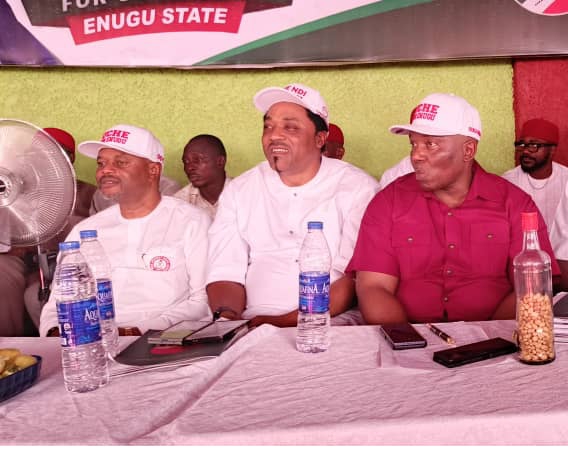
The Enugu State governorship candidate of the Peoples Democratic Party (PDP) in the 2027 election, Chief Uche Nnaji, has launched his campaign manifesto and inaugurated his campaign council, urging the members of the team to go back to their communities to sell the message of a renascent Enugu to every resident of the state.
He told those gathered at the party’s campaign office along Abakaliki Road, Enugu that although the party enjoys huge support of the people of the state, his desire was to raise the percentage of voters’ support to more than 80 percent.
Notable names on the 2,309-member council drawn from all the communities and wards in the state, as well as the diaspora include Charles Ndukwe, as the Director General of the Council.
Ndukwe was a Commissioner for Sports during the administration of the immediate past governor of the state, Ifeanyi Ugwuanyi.
Others include Ikem Okuhu as Director, Media and Strategic Communications, and Chinwe Mbah, former House of Assembly candidate and leader in Igbo Etiti Local Government Area,
Also on the list are Dr. Robert Ngwu, former Secretary of the All Progressives Congress (APC) in the state, Chief John Uche Ugwu, a US-based businessman; Chief Basil Ani, Pro chancellor, Coal City University; Jonathan Chukwuma, former Deputy Speaker, Enugu State House of Assembly; Chief Willy Agwu, CEO, BKG Group; Chris Nnadi, two-term member of the House of Representatives; Chief Okechukwu Agu, Director of Fundraising; Chief Favour Nwobodo, Director of Finance and Pastor Chinweike Amoke, Director, Campaign Operations.
Others include Chief Friday Agbodo, Coordinator, Rainbow Coordinator, Enugu State; Emeka Abba, Director General, Enugu North; Chief Uche John Ugwu, Deputy Director General, Enugu West and John Edeh, Deputy Director General, Enugu East.
The manifesto, themed, ‘Uche Ndi Enugu 2027,’ according to Nnaji, is more than a campaign theme as it captures the philosophy of governance for the government to be formed by the PDP when they win the election.
“It means placing the interests, welfare and aspirations of ndi Enugu at the centre of every decision, every policy and every public investment. It is our covenant to build a government that listens to the people, serves the people and measures success by the improvements it brings to the lives of our people,” Nnaji said.
The 147-page document captured Nnaji’s 100 commitments to the people of the state. The 100 commitments were grouped under 15 broad sector-specific headings, including open government; transparency and accountability; public service reform and institutional renewal; economic transformation, industrialisation and job creation; energy security, power development and green growth; agricultural transformation, food security and rural prosperity; housing, urban renewal, physical planning and smart cities development; education, human capital development and skills development; social protection, inclusion, gender equity, youth empowerment and community development and healthcare transformation, universal health coverage and human wellbeing.
Nnaji, who restated his intention to spend only one term as governor of Enugu State, reminded the large gathering that it shouldn’t take forever to fulfil his campaign commitments to the people and set Enugu on the path of sustainable prosperity and leadership.
“Any person who has spent close to four years in office should have measurable and demonstrable achievements to point to. If such a person comes back to you to campaign and starts telling you what he intends to do, boldly ask the person to show you what he has used the previous years to achieve, and if he cannot show you some notable achievements, flee from such a person because he does not mean well for you,” he stressed.
He emphasised the importance of healthcare to the social and economic wellbeing of every society, stressing that good and affordable healthcare is not a privilege for the wealthy, but a fundamental right and one of the most important responsibilities of government.
“A government that cannot provide accessible, affordable and quality healthcare cannot claim to have fulfilled its duty to the people,” he stated.
He tackled the current administration for saying so much about healthcare but doing so little, pointing out that although the state has 563 primary healthcare facilities, only 57 could be classified as functional level-2 primary health centres.
“While the government announced the construction of 260 Type-2 primary healthcare centres across the state, only about 30 have reportedly been completed and equipped. At the same time, many older and dilapidated facilities were left unattended. What citizens need is not the announcement of the presence of healthcare centres, what they need are accessible and affordable healthcare centres,” he stated.
He promised that when he becomes the governor of the state, no person from the age 70 and above would pay for any kind of healthcare service.
On his plans for industrialistion, he decried the prevalent classification of Enugu as a poor state, saying the state is not poor due to lack of potential, but rather because the enormous potential has not been translated into jobs, wealth and opportunities for ordinary people.
Speaking about his economic transformation plans, he vowed to focus on private sector growth and enterprise development; industrialistion and value addition; investment promotion and capita attraction; micro, small and medium scale enterprises growth and business competitiveness, innovation, technology and digital economy, as well as trade, logistics and regional competitiveness.
He also promised to maximise the agricultural comparative advantages of the state, saying it is lamentable that only 30 percent of the1.2 million hectares of arable land in the state was currently under cultivation.