Follow Us on Google
By Damiete Braide
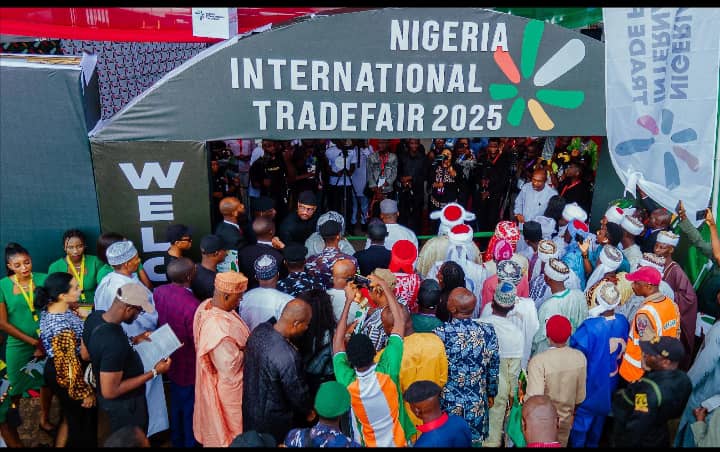
Organisers of the Nigeria International Trade Fair (NITF) 2025 has commended government officials, exhibitors and industry leaders for their participation, describing the even as a remarkable revival of the Lagos International Trade Fair Complex and a renewed commitment to repositioning Nigeria as a major hub for commerce in Africa.
Speaking at the closing ceremony, the Executive Director/Chief Executive Officer of NITF, Vera Safiya Ndanusa, expressed deep satisfaction at the success of this year’s fair. She recalled that the transformation witnessed at the complex was borne out of a vision conceived two years earlier, despite initial skepticism from many who doubted the potential of the facility.
“When we came on board, people said there was no other place to take me to but I saw potential. An appointment is not for what you will get but for what you will do,” she said.
She noted that with a committed management and staff, the fairground underwent a gradual but determined revival, beginning with a modest commercial and industrial fair the previous year. “This year has been awesome. It has been an amazing nine-day journey,” she added.
Ndanusa highlighted that the fair has grown beyond exhibitions to become a platform for partnerships, innovation and regional commerce, reflecting President Bola Tinubu’s Renewed Hope Agenda. According to her, the improved atmosphere and positive business interactions demonstrate that when the head is good, the body will be good.
She also celebrated the renewed continental relevance of the complex, which sits along the ECOWAS corridor, attracting exhibitors from Uganda, Tanzania, Cotonou, Ghana and other African countries. “Nigeria will soon reclaim its place as Big Brother in Africa. Lagos is the nerve centre of commerce and this trade fair complex is the melting point of trade,” she declared.
The Executive Director applauded the security agencies for ensuring incident-free activities throughout the event, describing their contributions as a sign of Nigeria’s improving security outlook.
She further expressed optimism about the prospects of the African Continental Free Trade Area (AfCFTA), insisting that the level of participation and collaboration seen at the fair indicates the continent was on the path to achieving seamless regional trade integration.
In his opening remarks, Dr Jani Ibrahim, National President of the Nigerian Association of Chambers of Commerce, Industry, Mines and Agriculture (NACCIMA), praised the Lagos International Trade Fair Complex Management Board for a well-executed event.
He stated that the fair had demonstrated the centrality of trade to Nigeria’s economic survival, showcasing the richness of the country’s productive sectors, including agriculture, manufacturing, creative industries and technology.
“The theme, ‘Trade, Technology and Transformation, Leveraging Digital Trade for Economic and Industrial Growth,’ has resonated through every exhibition hall. We have seen firsthand how digital technology is redefining the future of trade,” he said.
Ibrahim emphasised that emerging digital tools are creating new pathways for export competitiveness, connecting local producers to global markets and boosting innovation across value chains. He also noted that the ongoing development of the Lagos-Badagry corridor has strengthened the strategic importance of the complex as a limitless exhibition hub.
He stated that NACCIMA, with over 100 chambers nationwide, sees the revitalised fairground as a new frontier for collaboration and expanded participation.
Representing the Permanent Secretary of the Federal Ministry of Industry, Trade and Investment, Alhaji Aminu Dogon Daji, Director of Special Duties, lauded the fair as a testament to Nigeria’s economic dynamism and commitment to industrial growth.
He affirmed the ministry’s dedication to creating an enabling environment for enterprise development and export expansion, particularly under AfCFTA.
“We are deliberately positioning Nigeria not just as a participant but as the manufacturing and export hub of the African continent,” he said.
Dogon Daji urged exhibitors, especially SMEs, to leverage the partnerships and networks formed during the fair to scale their businesses and take advantage of government-provided incentives. He called on stakeholders to translate the week’s discussions into actionable outcomes, such as signed deals, policy frameworks and strengthened industrial collaborations.
He officially declared the 2025 fair closed, wishing all participants safe journeys and continued prosperity.
The successful hosting of the NITF 2025 has rekindled optimism about Nigeria’s future as a continental trade powerhouse and marked a significant step toward restoring the fair complex to its original vision as a vibrant centre of African commerce.