Follow Us on Google
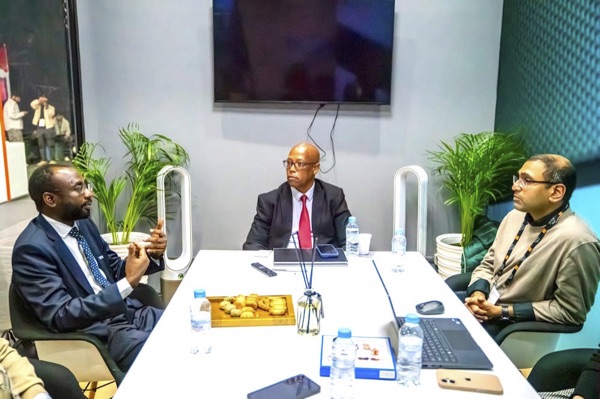
The Director General of the National Information Technology Development Agency (NITDA), Kashifu Inuwa, has warned African governments to build and control their own cloud infrastructure or risk long-term digital dependence, loss of economic sovereignty and the troubling consequences that will spring from that.
Speaking during the GITEX Africa 2026 summit in Morocco held from April 7-9, Inuwa said Africa’s current reliance on foreign-owned digital infrastructure leaves the continent exposed to external control, policy shocks and economic leakage.
He argued that the era of passive technology consumption must end, stressing that Africa must urgently reposition itself as a builder not just a user of digital systems.
“Digital is no longer optional; it is a way of life. And the cloud is the oxygen that sustains that life. The real question is: who controls that oxygen?, he said.
Inuwa described Africa’s digital position as a structural weakness, revealing that while the continent accounts for up to 19 per cent of the world’s population, it holds just about 0.6 per cent of global data centre and computing capacity.
According to him, this imbalance goes beyond infrastructure, it represents a deeper sovereignty challenge.
“This is not just a technology gap; it is a sovereignty gap. We are generating vast amounts of data, yet we have little control over where it is stored, how it is processed, or who profits from it”, he noted.
He warned that continued dependence on foreign cloud providers could undermine national security, weaken policy independence, and limit Africa’s role in the global innovation economy.
His message centred on cloud sovereignty, a system where African countries host, manage and regulate their own data within the continent.
Inuwa stressed that without local data centres and harmonised regulatory frameworks, Africa risks remaining vulnerable to geopolitical shifts and external disruptions.
He called for a transition from fragmented national efforts to a coordinated continental strategy, proposing a federated “cloud of clouds” model that connects multiple African cloud systems into a unified network.
“No single country can achieve this alone. We must collaborate, integrate, and build shared infrastructure that serves the entire continent”, he said.
Inuwa pointed to Europe’s Gaia-X initiative as a useful reference, noting that while Africa’s realities differ, the principle of building a trusted, interoperable, and self-determined cloud ecosystem remains critical.
Other News
He clarified that cloud sovereignty is not about isolation or protectionism, but about control and strategic independence.
“Sovereignty means having the power to make our own decisions, define our standards, and build systems that reflect our priorities,” he said.
Beyond security concerns, Inuwa highlighted the economic upside of building indigenous cloud infrastructure.
He said localising data and computing capacity could unlock new industries, create jobs, attract investment, and accelerate innovation across sectors.
It would also strengthen Africa’s position in emerging technologies such as artificial intelligence, big data, and the Internet of Things, all of which depend heavily on cloud computing.
Crucially, he noted that retaining African data within the continent would allow it to be used to train local AI models, rather than exporting value to foreign economies.
Despite current gaps, Inuwa expressed confidence in Africa’s potential, citing its youthful population, rising internet penetration, and rapidly growing startup ecosystem.
However, he stressed that time is of the essence.
Africa must act collectively and decisively to build its digital backbone or risk being locked out of the next phase of global technological advancement.
“The future will be defined by those who control data and computing power,” he warned.
Inuwa concluded that digital sovereignty is no longer a policy option but a strategic necessity.
If Africa fails to localise its digital infrastructure and harmonise its regulatory environment, it risks permanent marginalisation in an increasingly data-driven global economy.