Follow Us on Google

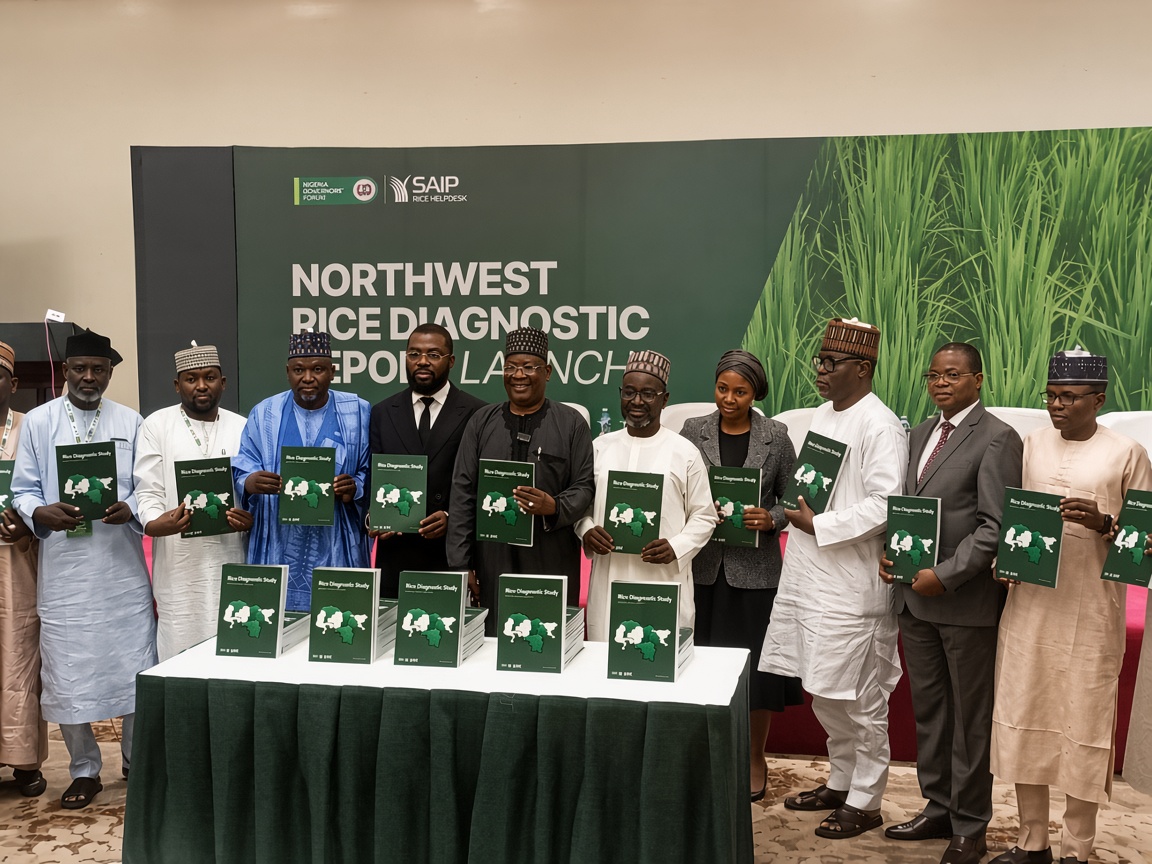
• NGF, SAIP launch Northwest Rice Diagnostic Report, identify insecurity, poor data, policy inconsistencies as major challenges
________________________________________________________________
From Juliana Taiwo-Obalonye, Abuja
Nigeria’s annual rice consumption has risen to 8.6 million metric tonnes, against domestic production of just 3.3 million tonnes, leaving a supply gap of about 5.3 million tonnes, the Director-General of the Nigeria Governors’ Forum (NGF), Abdulateef Shittu, has disclosed.
The NGF chief, who spoke on Wednesday in Abuja at the launch of the Northwest Rice Diagnostic Report, warned that the country must address persistent production challenges and policy inconsistencies to achieve food security and reduce dependence on imported rice.
He projected that national consumption could rise to 9.1 million metric tonnes next year, further underscoring the urgency of expanding local production.
The report launch, organised jointly by the NGF and the SAIP Rice Help Desk, brought together representatives of the seven Northwest states, financial institutions, rice processors and development partners to examine challenges confronting the rice value chain.
Speaking on the theme, From Diagnostic to Delivery, the NGF Director-General said Nigeria had the land, human resources and other requirements to become a net exporter of rice but needed better coordination and sustained commitment.
“There is no reason why Nigeria cannot be a net exporter of rice to African countries and even some parts of Europe. We have the land, we have the resources, we have all that it takes. We just need to coordinate our efforts,” he said.
He identified policy flip-flops, mismatches in government interventions, inadequate financing, low productivity and unreliable data as major obstacles to the development of the sector.
He said the NGF would sustain engagements with state governments and other stakeholders, stressing that the report was the beginning of a series of discussions aimed at finding practical solutions to the country’s agricultural challenges.
The Director-General also emphasised the importance of reliable agricultural data, disclosing that the NGF had established a dedicated department for data and encouraged states to establish their own bureaus of statistics to strengthen information gathering from the grassroots.
According to him, the aggregation of reliable data from states would provide a more credible basis for national planning and policy decisions.
Also speaking, the Director-General of the Rice Processors Association of Nigeria (RIPAN), Andy Ekwelem, identified insecurity, unreliable farmer records, poor-quality inputs and high energy costs as major constraints threatening the rice industry.
Ekwelem said the experience of previous government agricultural intervention programmes, particularly the Anchor Borrowers’ Scheme, demonstrated the dangers of financing farmers without adequate identification and monitoring mechanisms.
He said the sector needed a credible register of farmers, verified farmland locations and certified agricultural inputs to prevent the diversion of resources and improve productivity.
“The biggest challenge we had was that we didn’t have data. The second is that we had what we call ghost farmers,” he said.
He cautioned against relying on unverified claims of crop losses, insisting that farmers and their farms must be properly identified before financial and input support is extended.
The RIPAN chief also called for a security framework to protect rice-producing communities across the Northwest, particularly in Kaduna, Katsina, Zamfara and Sokoto states.
He said insecurity was preventing farmers from accessing their farms and disrupting the supply of paddy rice to processors.
Ekwelem disclosed that RIPAN had between 150 and 200 integrated rice millers in its membership, with about 98 registered mills, adding that their installed processing capacity was substantial enough to meet national demand if the industry received the necessary support.
He identified reliable paddy supply and affordable energy as two critical requirements for rice processors, warning that high production costs made it difficult for local mills to compete with imported rice from countries with long-standing agricultural subsidy programmes.
On financing, the Managing Director/Chief Executive Officer of the Bank of Agriculture (BoA), Ayodeji Sotinrin, disclosed that the bank had financed 25 aggregators during the previous wet season, who in turn provided input financing to more than 500,000 farmers.
He said the bank was targeting at least 700,000 farmers in the current wet season through its input-financing model.
Sotinrin explained that the bank had moved away from direct cash disbursements to farmers because of poor loan recovery and the high cost of monitoring small-scale credit facilities.
Other News
“We don’t give cash to farmers. That might be disappointing to some of you in the room. We do input financing,” he said.
He disclosed that the bank was also developing a guaranteed minimum price arrangement for farmers, which would be extended beyond maize to rice to protect producers against market fluctuations.
The BoA chief said the bank was exploring financing opportunities around 15 multipurpose dams, including the Bakolori Dam, to support farmers through partnerships with aggregators, cooperatives and water users’ associations.
He also disclosed that the bank was working with state governments on a Smallholder Support and Value Chain Fund, which would operate through matching funds established with participating states.
In his remarks, the Kaduna State Commissioner for Agriculture, Murtala Dabo, disclosed that the state was implementing a N10 billion agricultural financing facility with the Bank of Agriculture to support smallholder farmers.
He said the funds had already been paid into the state’s account, adding that the government was also pursuing mechanisation initiatives to expand access to modern farming equipment.
Dabo disclosed that about 2,000 tractors and 10,000 implements were initially available, with another 2,000 tractors and 14,000 implements expected.
He explained that the equipment would be deployed through mechanisation service providers rather than distributed directly to politically connected individuals or selected farmers.
According to him, the approach would enable each tractor to cultivate about 600 hectares annually, potentially covering 2.4 million hectares with 4,000 tractors.
He said the arrangement would also allow participating states to recover their investments through a revolving mechanism and acquire additional equipment.
Meanwhile, the Kebbi State Commissioner for Agriculture, Shehu Muazu, challenged existing agricultural production estimates, attributing discrepancies in reported figures to differences in data collection methods and sampling procedures.
He said some surveys failed to capture commercial and educated farmers, as well as farmers in remote communities, thereby producing figures that did not accurately reflect the realities of agricultural production.
Muazu called for a unified agricultural data framework involving federal and state governments and other stakeholders.
“Let all the stakeholders come and sit down together and say the responsibility of data, agricultural data, should be to so-so-so percent, so that anybody that is looking for information as far as farmers are concerned, or yield is concerned, knows where to go,” he said.
He announced plans to establish a dedicated rice desk, provide it with adequate staffing and a budget line, and convene a state-level rice stakeholders’ summit to develop a four-year development plan.
Earlier, the Executive Director of Programmes and Partnerships, Ahmed Abdulwahab, said the diagnostic exercise covered Jigawa, Kaduna, Kano, Katsina, Kebbi, Sokoto and Zamfara states.
He explained that the regional report consolidated state-by-state assessments of institutions, public finance, production, processing and agricultural data systems.
Abdulwahab said the initiative was designed to address the longstanding problem of agricultural decisions being made without reliable evidence.
“Distinguished guests, a diagnosis is only the beginning. Its value lies entirely in what we do with it,” he said, urging governments and development partners to translate the findings into measurable actions.
Also, the Programme Manager, Eghosa Omoigui, identified coordination, reliable data and competitiveness across the rice value chain as three priorities for moving the Northwest rice industry forward.
He said government programmes, development partners and private investors must work towards common implementation plans, while farmers and millers needed improved access to finance, mechanisation, extension services, affordable energy and reliable markets.
Omoigui also called for the deliberate inclusion of women and young people in agricultural financing, land access, machinery and market opportunities.
He said the success of the initiative would ultimately be measured by improvements in productivity, business opportunities and the livelihoods of people across the region.