Follow Us on Google
From Fred Ezeh, Abuja
A Nigerian artificial intelligence researcher, Mary-Brenda Akoda, has won the $100,000 Nigeria Prize for Science and Innovation for developing a technology she says can reduce Magnetic Resonance Imaging (MRI) scan time by up to 90 per cent.
Her innovation, GenScan AI, emerged winner of the 2026 competition organised by Nigeria LNG Limited (NLNG), which attracted 237 entries.
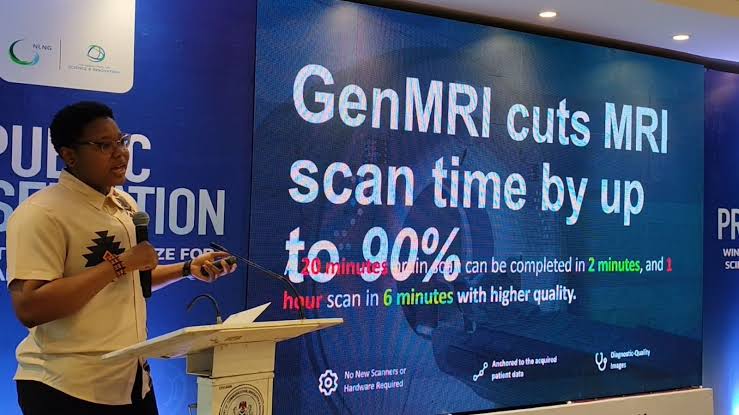
Presenting the technology to health, science and technology experts, policymakers and representatives of medical institutions in Abuja on Monday, Akoda said it could help hospitals examine more patients using their existing MRI machines.
She explained that GenScan AI could reduce a 20-minute scan to about two minutes and a one-hour examination to approximately six minutes, potentially easing diagnostic backlogs and reducing the time patients spend inside scanners.
Akoda said prolonged MRI examinations could be particularly difficult for patients who were in pain, anxious, elderly or unable to remain still.
“Patient movement can result in blurred images, thus requiring repeated scan sessions and, in some cases, sedation.”
She said the challenge was compounded by the limited availability and high cost of MRI machines, with high-quality scanners costing between $1.5 million and $3.5 million or more, depending on the model.
“Every second counts,” Akoda said, recalling a patient who needed an urgent scan but faced a long queue, deteriorated and subsequently died.
She said such experiences motivated her to develop GenScan AI, which reconstructs diagnostic-quality MRI images from substantially fewer acquired data points.
According to Akoda, the technology achieved up to 99.7 per cent similarity to conventional MRI images while reducing scanning time by 90 per cent.
She said a blinded assessment by a consultant radiologist at Buckinghamshire NHS Hospital in the United Kingdom also examined whether the reconstructed images retained their diagnostic value.
“The consultant radiologist scored the GenMRI images as diagnostically equivalent to the conventional scan in all the cases that were assessed.”
Akoda said the research had produced two peer-reviewed publications and two conference presentations, with support from Innovate UK, UK Research and Innovation and the NHS Clinical Entrepreneur Programme.
Other News
She added that clinical partners had been secured in the United Kingdom, United States, Kenya and Nigeria, while a Nigerian diagnostic centre was supporting a planned clinical pilot.
The next steps, she said, were regulatory submission and clinical trials, with commercial deployment targeted for the second half of 2027.
Akoda also cited a health economics case study which found that, even with a four-fold increase in scanning speed, the technology could enable more than 40,000 additional patients to undergo scans annually.
NLNG’s Executive Director, External Affairs, Dr. Sophia Horsfall, said accurate diagnosis was essential to effective treatment, stressing the role of diagnostic imaging in clinical decisions.
She said the prize sought to encourage research that addressed practical problems and delivered benefits to society.
Chairman of the prize’s Advisory Board, Prof. Barth Nnaji, said the 2025 competition produced no winner because none of the entries met the required standard.
He said the theme covering AI, ICT and digital technology was repeated for 2026, producing Akoda’s winning innovation. The competition, he added, was international, with winners selected on merit rather than nationality.
Minister of Education, Dr. Tunji Alausa, described GenScan AI as an example of research being translated into solutions to human problems.
He urged Akoda to protect the innovation’s intellectual property and said the ministry would facilitate access to teaching hospitals and Federal Medical Centres for her planned Nigerian pilots.
Alausa also called for the Ministry of Health’s involvement to support the process of clinical deployment.
Representing the Minister of Innovation, Science and Technology, Dr. Kingsley Tochukwu Uduh, the Director-General of the National Board for Technology Incubation (NBTI), Dr. Kazeem Kolawole Raji, said the government was committed to helping researchers move innovations into commercial use.
Raji said NBTI was connecting innovators with investors, adding that its NextGen Innovation Challenge attracted more than 5,000 entries this year and used a technology-readiness assessment framework to screen submissions.
Akoda appealed to diagnostic centres, health institutions and potential funders to participate in clinical studies and support pilot programmes for GenScan AI.