Follow Us on Google
From Juliana Taiwo-Obalonye, Abuja
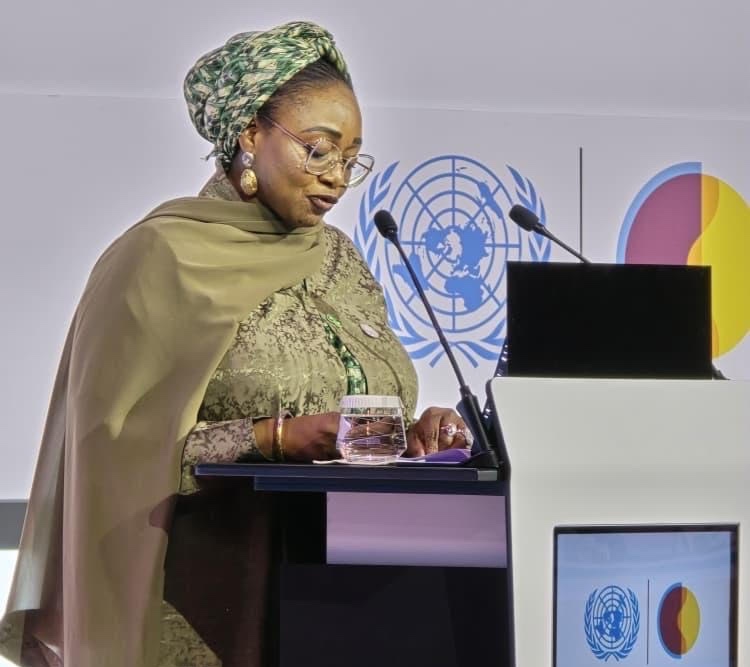
Minister of Women Affairs and Social Development Imaan Sulaiman-Ibrahim has reiterated Nigeria’s dedication to social transformation and inclusive governance during the Second World Summit for Social Development (WSSD) held in Doha, Qatar.
Speaking on behalf of President Bola Tinubu, she outlined Nigeria’s ambitious policies aimed at fostering opportunity, reducing poverty, and enhancing national unity.
In her address, she emphasised Nigeria’s alignment with continental and global development goals, noting, “Our vision for social development is guided by the Nigeria Agenda 2050 and anchored on the priorities of the Renewed Hope Agenda — focusing on people-centred governance, poverty eradication, human capital development, and inclusive growth.”
The Minister revealed the launch of regional development initiatives across Nigeria’s six geopolitical zones to promote balanced growth and emphasised efforts like Ward Development Initiatives to ensure no community is left behind.
Among the key reforms, she announced the formalisation of the National Social Investment Programmes as a dedicated agency, benefiting millions through cash transfers, youth employment schemes, school feeding, and enterprise support, all part of a “multidimensional prosperity” plan driven by a National Social Register.
In a move to improve governance and social inclusion, Nigeria has introduced an enhanced National Digital Identity Portal, ensuring better access to services, easier mobility, and targeted social protections.
Other News
Youth empowerment remains a priority, with programmes such as the Nigeria Youth Investment Fund (NYIF) and the Creative Economy Development Fund (CEDF) promoting innovation, especially among women, and strengthening investments in technical and vocational training and STEM education.
The government is also adopting a lifespan approach to social development, including Universal Child Grants, establishing a National Council for Social Work, and enforcing the Discrimination Against Persons with Disabilities (Prohibition) Act, 2018.
Under the Renewed Hope Social Impact Intervention 774 (RH-SII774), Nigeria aims to uplift over 10 million women within five years while bolstering family support and social care systems.
Healthcare, education, and environmental sustainability are also on the agenda, with scaling investments in primary healthcare, maternal health, early childhood education, clean energy, and climate action.
Sulaiman-Ibrahim concluded by stressing that, “In Nigeria, inclusive social development is not an aspiration but an obligation.” She called for strengthened international cooperation, reaffirming Nigeria’s support for the Doha Political Declaration and the 2030 Sustainable Development Goals, urging the global community to prioritise social protection as a universal right and measure progress by resilience, gender equality, and well-being.