Follow Us on Google
By Moses Akaigwe
With the global preference of gas as fuel of choice in the mobility sector rising by as much as 40 percent, the National Gas Expansion Programme (NGEP) Committee, the body officially entrusted with deepening gas utilistion in Nigeria, has described autogas as the most readily available and viable alternative to petrol and diesel.


Chairman of the NGEP, Dr. Mohammed M. Ibrahim, who confirmed this in Lagos on Friday, also stated that the use of autogas would lower the cost of transportation accross Nigeria on account of low operating costs and longer life of prime movers/vehicles.
Dr. Ibrahim’s submissions were contained in a presentation on the theme Fuel Subsidy Removal: Autogas/Electric Vehicles As Alternatives at the Annual Training Workshop of the Nigeria Auto Journalists Association (NAJA), which was held at the LCCI Conference & Exhibition Centre, Alausa, Ikeja, Lagos.
Dr. Ibrahim remarked, “Indeed autogas or the use of gas (LPG/CNG/LNG) as a fuel for the mobility sector is the immediately available alternative to the conventional white products. Globally, autogas as a fuel of choice for the mobility sector has risen over 40%. Autogas powers the largest number of vehicles running on alternative fuels.”
According to him, car manufacturers are switching to direct injection engines that produce substantially lower emissions, adding, “In fact, 8 of the 10 largest car manufacturers produce LPG cars. With the steady increase in the use of autogas, the question would be, how sustainable are the world reserves to meet demand?
“The global natural gas resource-base is vast and widely dispersed geographically. Conventional recoverable resources are equivalent to more than 120 years of current global consumption, while total recoverable resources could sustain today’s production for over 250 years.”
Ibrahim said Nigeria is endowed with vast natural gas reserves, and that the NGEP is conceived and designed to serve as a catalyst for adding value to the reserves.
He said, “Autogas is the only fuel that can act as a bridge between our existing oil habits and a cleaner, less oil intensive future. To begin with, it contains more hydrogen and less carbon, so it is both better for the planet and also more easily refined into hydrogen (for fuel cells).”
The NGEP Objective, he said, is “To reinforce and expand gas supply, as well as stimulate demand in the country through the effective & efficient mobilisation and utilisation of all available assets, resources and infrastructure in the country.“
On what they have done to deepen the utilisation of gas as a vehicular fuel, he said, “From the onset, the NGEP Committee recognised and facilitated the emplacement of enablers to deepen the penetration and success of the Autogas Programme, including: I. Review of existing regulations and removal of bottlenecks II. Carried out audit of existing retail-out for co-location of multi-fuelling system III. Fiscal Incentives (facilitate the speedy processing of Import Duty Exemption Certificate) IV. Established Partnership with Private and Government Institutions to build Capacity on Autogas conversion technicians V. Securing of single digit intervention fund for the construction of required infrastructure VI. Domestication of the Autogas conversion technology through reverse engineering.”
He said, “The huge gas potential of Nigeria clearly offers an opportunity for effective support of the economic sustainability of Nigeria; Accelerated optimisation of the extensive gas value chain is the key to unlocking the opportunities inherent in gas resource as an enabler for economic sustainability; NGEP schemes are being driven to eEnsure that gas is optimally used to provide cleaner fuels for a greener Nigeria; promote mitigation against climate change; secure Nigeria’s energy mix in the short to longer term basis.”
NGEP, he said, shall deliver all its strategic objectives through optimal performance of all the project schemes of the programmes, adding “The precarious and daunting situation currently experienced in the downstream petroleum sector is a bitter reality that requires the urgent attention of all us present in this hall and the only alternative in the short, middle and long term is gas. Nigeria being richly endowed with abundant natural gas can leverage on this resource as a catalyst for economic growth and the transport sector is not an exception.”
Ibrahim said, “The Autogas Scheme will generate millions of direct and indirect Jobs; Will lead to Economic Growth and Development; Technology Transfer for Autogas Conversion and … Conversion Jobs (500,000+) Kit Factory and Gas Supply Chain (5,000,000+) Services/Indirect Jobs (12,500,000+) 5.6 million Average Man-hours required per annum to convert Autogas vehicles.”
On how Nigeria compares in terms of readiness to deploy CNG for automotive applications, he said there are some enablers required from the government that include, “Regulatory: The establishment and enforcement of sound guidelines, codes and standards, as well as the use of legislative, regulatory and/or judicial mandates to help deepen penetration of NGVs; Fiscal: Fuel price differentials and credit lines, as well as custom duty and tax exemptions. Also, tax incentives to corporations to invest in the CNG programme; Widened price advantage by removal of PMS subsidy: Subsidy on gasoline erodes the long-term economic benefit of CNG.
“Globally, the price differential is a key success factor and ranges between 33% (USA) and 75% (Iran). 4. Infrastructure: Construction of domestic distribution networks, as well as CNG processing and fuelling infrastructures in strategic locations following the example of Argentina. A lot still needs to be done regarding CNG infrastructure deployment in Nigeria.”
He said the potential positive impact of NGEP on the Nigerian transport sector includes: FX savings, stating that increasing Gas utilisation will save the government Foreign Exchange and Ease Pressure on the Country’s Currency.
There are also economic savings, stating that “substituting traditional fossil fuels with Gas will save Trillions in Subsidy bills that can be used in developing critical infrastructure in the country.”
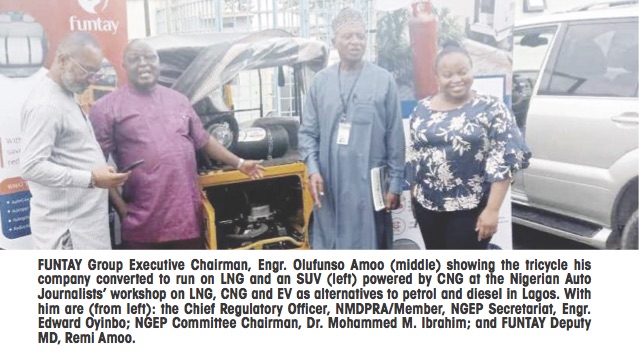
Dr. Ibrahim was accompanied to the journalists’ annual event by a stakeholder in the oil and sector and Executive Chairman/Managing Director, Funtay Group, Engr. Olufunso Amoo, who was accompanied by her daughter and Deputy Managing Director and Chief Operating Officer, Remi Amoo.
Like Dr. Ibrahim, Engr. Amoo also provided useful insights on the theme Fuel Subsidy Removal: Autogas/Electric Vehicles As Alternatives.
Also part of the NGEP team was the Chief Regulatory Officer Nigerian Midstream and Downstream Petroleum {NMDPRA/Member, NGEP Secretariat
Engr. Edward Oyinbo