Follow Us on Google
By Chinenye Anuforo
The Nigerian Communications Commission (NCC) has intensified efforts to promote digital inclusion among persons with disabilities by equipping participants with practical digital skills, cybersecurity knowledge and tools to participate more meaningfully in Nigeria’s digital economy.
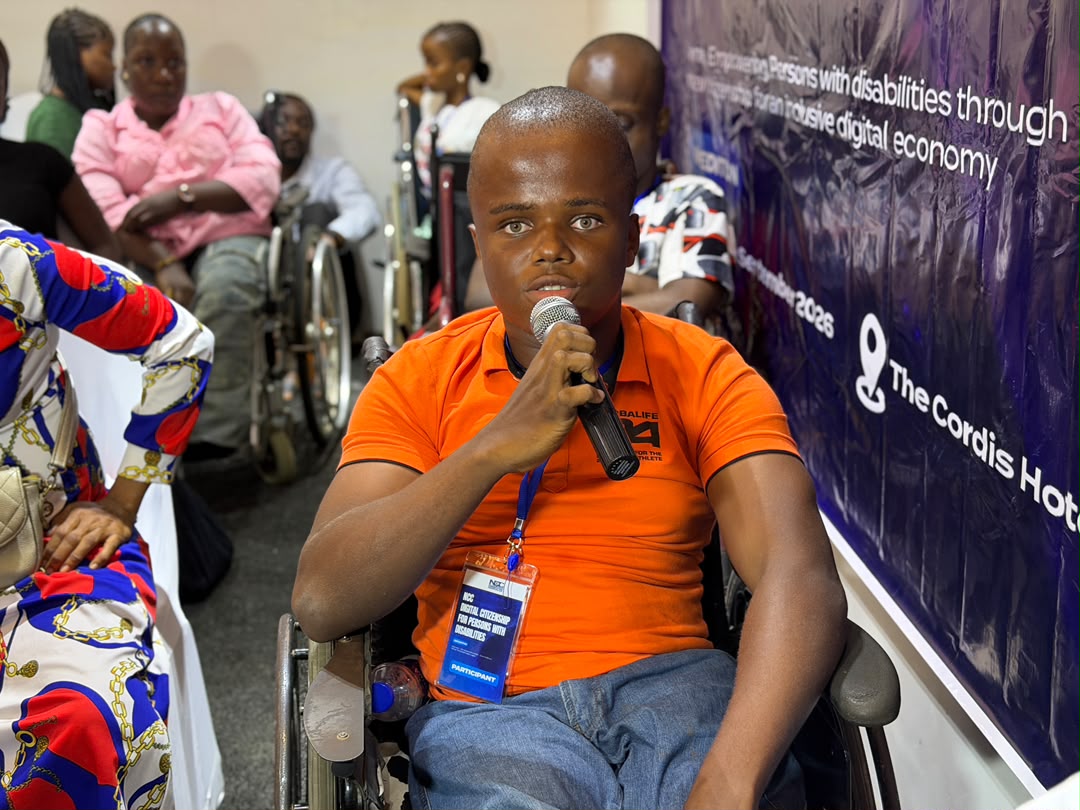
The two-day Digital Citizenship Training for Persons With Disabilities, held on September 9 and 10, 2026, at Cordis Hotel, Lagos, exposed participants to digital foundations, accessibility features on mobile devices, online safety, digital skills, professional networking and opportunities for earning income online.
The training was facilitated by Fornido Development Company, the lead consultant for the programme.
Lead facilitator, Binta Gali Agbonika, said the training was inspired by the need to address the exclusion of persons with disabilities from the digital space and enable them to harness technology for education, employment, entrepreneurship and economic participation.
According to her, many persons with disabilities were unaware that their smartphones and other digital devices already contained accessibility features that could make everyday tasks easier.
She said participants were taught how to use voice-to-text functions, text-to-speech tools and other accessibility settings to improve how they interact with their devices.
“We looked at digital foundations, which is mostly about how they can use their devices to their advantage. A lot of them didn’t even know that they had accessibility settings on their devices,” she said.
Agbonika, who described teaching and impacting knowledge as one of her passions, stressed that digital inclusion must go beyond providing access to devices and internet connectivity, noting that persons with disabilities also need the knowledge and confidence to use technology safely and productively.
A significant part of the training focused on cybersecurity and protection of personal information.
Agbonika said persons with disabilities could sometimes become vulnerable to fraud because they may depend on other people for assistance with certain digital tasks, potentially exposing personal or sensitive information in the process.
She said participants were therefore taught how to protect themselves both online and offline, identify digital risks and exercise greater caution when sharing personal information.
The training also addressed digital identity, online interactions and the need for participants to understand their rights in the digital environment.
One of the participants raised concerns about the unauthorised use of photographs and videos taken during events, prompting a discussion on consent and digital rights. The facilitator explained that individuals have the right to decide whether their images or videos should be used and can request that content featuring them be taken down where it has been published without their consent.
The discussion underscored the broader message of the training that digital citizenship is not only about knowing how to operate technology but also understanding one’s rights and responsibilities in the digital space.
The programme also connected digital literacy with economic empowerment, with participants introduced to free online learning platforms where they could acquire new skills and professional platforms where they could showcase their work and seek opportunities.
Agbonika specifically mentioned LinkedIn and freelancing opportunities, while also teaching participants how to improve their CVs and communicate professionally through email.
The objective, she explained, was to ensure that participants did not merely consume digital content but could use technology to build skills, market their abilities and create economic opportunities.
The response from participants suggested that many were eager to translate the knowledge acquired into practical opportunities.
One participant said the programme had helped clarify areas of digital learning that had previously been confusing, while another said the training had reinforced knowledge she had already acquired while pursuing digital marketing.
Agbonika said she was particularly impressed by the ability of participants to grasp and apply the lessons during the two-day programme.
“I was pleasantly surprised. These people are extremely intelligent,” she said, adding that some participants had already mastered several of the concepts introduced during the training.
She suggested that the level of knowledge demonstrated by the participants indicated a need for more advanced training.
“From yesterday to today, they’re already doing it. So it’s one of those things that you can say they have smart foundations,” she said.
For her, the experience demonstrated that persons with disabilities should not be viewed primarily through the lens of their limitations but recognised for their abilities and potential.
Participants also called for the programme to be expanded beyond Lagos and held more regularly to give more persons with disabilities the opportunity to benefit.
One participant asked whether the training would be extended to other states, noting that specialised programmes of this nature were often concentrated in Lagos and a few other locations. Another participant appealed for the training to be organised more frequently to allow others who were unable to attend to benefit.
The calls highlight the demand for sustained digital inclusion initiatives rather than one-off interventions.
Despite the success of the training, Agbonika identified physical accessibility at event venues as one of the challenges encountered.
She said venue providers did not always understand the practical requirements for accommodating persons with different disabilities, noting that issues such as inadequate movement space and inaccessible bathrooms could create unnecessary barriers for participants.
She stressed that accessibility should be considered from the planning stage of programmes involving persons with disabilities.
“The people that even arrange the venues have no understanding of what accessibility is,” she said, explaining that adequate space and accessible facilities were essential to enable participants to move around safely and comfortably.
Beyond technology, the training also provided a platform for conversations around dignity, self-confidence, discrimination and self-advocacy.
Participants shared experiences of being subjected to insensitive comments and inappropriate treatment because of their disabilities, while Agbonika encouraged them to develop confidence, understand their worth and speak up when they encounter inappropriate behaviour.
She also stressed the importance of educating the wider society on appropriate ways to interact with persons with disabilities, noting that some offensive behaviour could stem from ignorance.
“Learn to build your self-confidence from inside,” she advised.
The discussions further emphasised the importance of self-advocacy, with participants encouraged to speak up against inappropriate treatment while educating others about disability and inclusion.
Agbonika commended the NCC for supporting the initiative and expressed hope that the programme would be expanded to reach more persons with disabilities across Nigeria.
“NCC has done a fantastic job. I am very happy that I got to be part of this. This is just the beginning,” she said.
She added that with Lagos having hosted the programme, similar interventions could be extended to other states to empower more people.
Participants similarly expressed appreciation to the NCC, facilitators and other organisations involved in the programme, describing the training as an opportunity to acquire practical knowledge that could improve their personal and professional lives.
The programme ultimately demonstrated that meaningful digital inclusion requires more than connectivity. For persons with disabilities to fully participate in Nigeria’s digital economy, they need accessible technology, digital skills, cybersecurity awareness, economic opportunities, respect for their digital rights and physical environments that allow them to participate equally.