Follow Us on Google
By Philip Nwosu
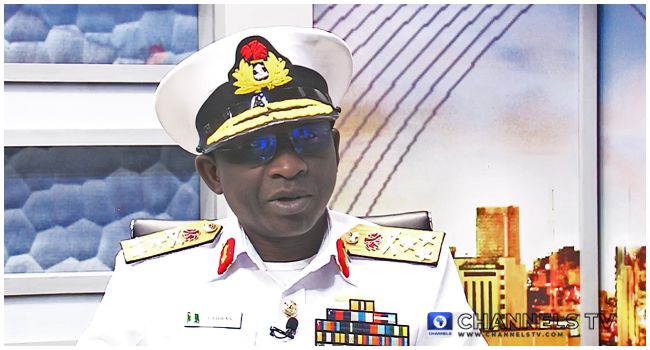
The Chief of the Naval Staff, Vice Admiral Idi Abbas, has revealed that the principal actors behind crude oil theft in Nigeria often remain beyond the reach of law enforcement agencies, while those arrested during operations are mostly low-ranking workers with little knowledge of the criminal networks they serve.
Speaking during an interview on Channels Television’s Sunrise Daily on Friday, Abbas said the sophisticated structure of oil theft syndicates has made it increasingly difficult to identify and prosecute the real masterminds responsible for the illicit trade.
According to the Naval Chief, security operatives frequently encounter individuals working at illegal refining sites who are merely hired labourers earning minimal wages, while the major beneficiaries of the criminal enterprise remain concealed.
“Most of the faces behind these thefts are not really known or are not the ones we always catch. The ones we get at most of the illegal refinery sites are just being given some paltry sum, while the big masquerades are the ones that make the real money,” he said.
Abbas explained that the challenge extends to the prosecution stage, as many of those arrested are unable to provide useful intelligence on those funding or coordinating the illegal operations.
“In trying to prosecute some of these people that we get, some of them don’t even know who they are working for. So, the network is a very delicate one,” he added.
Despite the obstacles, the Naval Chief said the Nigerian Navy has continued to strengthen its operational strategies in response to the evolving methods employed by oil thieves.
He noted that technology has become a critical tool in the fight against crude oil theft, enabling security agencies to improve surveillance, intelligence gathering and monitoring of critical infrastructure.
“As they are evolving strategies, we are also evolving new strategies. Like I keep saying, technology is the way forward. With that, we have been able to reduce the level of theft,” Abbas stated.
The Naval Chief said the Navy remains committed to protecting Nigeria’s oil assets and supporting efforts aimed at boosting crude oil production and national revenue.
Other News
Abbas also maintained that Nigeria’s coastal and riverine areas have become significantly safer due to sustained naval operations targeting maritime criminals.
He said the Navy has recorded notable successes in combating crude oil theft and sea robbery, resulting in improved security within the country’s maritime domain.
“As it stands today, I can say that our coastal areas and the riverine areas are relatively safe,” he said.
According to him, although isolated incidents of sea robbery and oil theft still occur, the Navy has largely succeeded in containing the threats through intensified patrols and enforcement measures.
The Naval Chief further advocated the establishment of a special court dedicated to maritime offences, arguing that the current judicial process is often too slow to effectively address crimes committed within Nigeria’s maritime sector.
He said a specialised court would accelerate the prosecution of offenders involved in crude oil theft and other maritime crimes while reducing the burden on the Navy.
“What we are pushing for is that we should have a special court that will try these maritime criminals,” Abbas said.
He explained that vessels seized during anti-crime operations often remain in naval custody for prolonged periods pending the conclusion of court proceedings, requiring substantial expenditure on maintenance and security.
“If we have that in place, I believe the dispensation of justice will be done much faster and then ease the burden of keeping and maintaining some of the arrested vessels, which will be taken off from us because we spend a lot to maintain those vessels under our custody,” he stated.
Abbas stressed that faster prosecution and stronger inter-agency collaboration would enhance efforts to curb crude oil theft, strengthen maritime security and safeguard Nigeria’s economic interests.