Follow Us on Google
From Juliana Taiwo-Obalonye
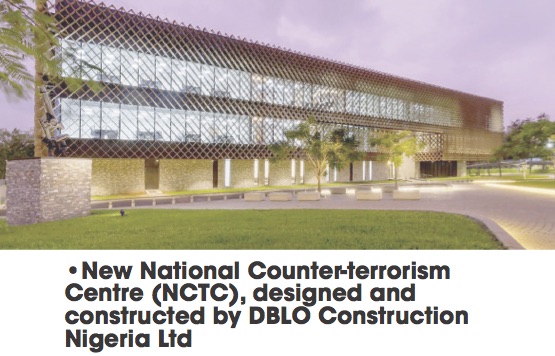
President Muhammadu Buhari last Tuesday commissioned the new Office of the National Security Adviser (ONSA) and National Counter-terrorism Centre (NCTC), where he said the two cutting-edge facilities would help to maximise efforts to address the nation’s security challenges, particularly terrorism and violent extremism. He also said the two world-class facilities would serve as a major legacy to provide the incoming administration with infrastructure to effectively coordinate national security and counter-terrorism efforts.
Mr Olu Olutayo the CEO of the construction and architectural firm, DBLO Construction Nigeria Ltd, an indigenous firm that designed and constructed the NCTC, spoke to Daily Sun on the record breaking architectural masterpiece., saying it was indeed a big deal for Nigeria. Excepts:
Background to DBLO Construction
DBLO is essentially a construction company with its foundation as an architectural practice and project management. We are a project enabling company that commands a wide array of internationally certified talented staff that are highly innovative in applying modern building technology to provide solutions and meet the needs of governments and businesses across Africa.

Well, the practice started in 2002 in the UK, and since then, we have grown steadily into property development. After some time, we began to take an interest in Africa, particularly Nigeria, in introducing cutting-edge, globally competitive architectural designs and locally attainable, given our background in general civil engineering construction and project management.
We have had several projects that showcase our trend of buildings that are both environmentally and maintenance-friendly and time-tested and cost-effective. That is our statement with the National Counter Terrorism Centre, which President Muhammadu Buhari just commissioned. The building is a showpiece of our many years of experience in precision building at a national scale which gave the Nigerian government the confidence in us, and I am very proud that we delivered according to all agreed standards and specifications.
How long it took DBLO to put the strucucture together
It has been a long journey. You have to remember that during this project we have had to deal with COVID-19, which effectively closed the world down for a year or so, a crisis in shipping with the tanker blockage of the Suez Canal, fluctuations in currency markets and energy prices from the war in Ukraine. Nigeria actually managed COVID-19 better than most, but because construction relies on a global market of materials and transportation of goods, it all had an effect. Our aim has always been to source materials from within Nigeria wherever possible, to limit these issues not to mention the encouragement of local production.
What can you say about this project as a Nigerian coming from abroad?
First of all let me say that I am an Igbobian (an old boy of Igbobi College Yaba, Lagos…A noble Nigerian!), of which I am proud and of course, as anybody would be, I am immensely proud to have achieved such an important facility. We have designed and built this building to international standards. It is the only facility of its type in Sub Saharan Africa. It is a highly technical building which can only be delivered by the kind of expertise that we possess in the laboratory testing of materials for security buildings and many other related fields which we put to bear. So how do I feel? I feel proud. I feel thankful for the fact that the Nigerian government, and in particular the National Security Adviser, Maj. Gen Babagana Monguno retd., who trusted us to do a good job and I can tell you that we far exceeded their expectations.
What were the other signature projects that secured you this contract
We have completed many office and residential projects in the UK for both private firms and Local Authorities over the years. So it was in our area of core competence to deliver on the NCTC, designed to accommodate the additional workforce and improved technological capabilities of the Centre given the increasing activities of countering violent extremism department and joint terrorism analysis branch.
As the NSA said, he was convinced that he could trust us with this and we have not disappointed, going by what he told Mr President during the commissioning.
What does Nigeria stand to gain as a country fighting terrorism and insecurity
I would like to say that the President was impressed. We shook hands and from his demeanour, I would like to think that he was happy with what he saw. It is in line with what he signed into law, that there should be a National Counter Terrorism Centre and now there is one and it will perform the function as far as terrorism prevention and insecurity are concerned.
The benefit to Nigeria is that we now have a centre that can collate intelligence in collaboration with world class laboratories, team rooms and operations crisis center to help make decisions more quickly, it is a more joined up system in the fight against terrorism.
So, therefore, for Nigeria as a whole, it’s a game changer. And for it to be completed, we’re actually sitting in it, just goes to show how far we’ve come. This is a building where the place you work gives you a sense of pride. When you watch the staff, as they walk in, it is with a sense of enjoyment and pride, you can see their posture changing. This is what great buildings and architecture can do. They are encouraged to perform. Even from our point of view as constructors and designers, you know if you’re given a responsibility, you have to perform. That’s basically why we are where we are today.
Before this interview began, you said this for you, is more of what Nigerians do. Can you elaborate?
Well, I think Nigerians are very talented, very educated. And we have a lot of Nigerians who are also very experienced in various fields. I think it is important that Nigerians know that such a building exists and that we designed in collaboration with the client to the requirements of their brief, and then we built it and we finished it. It’s complete and commissioned by the President.
It’s important that we know that we can do these things here in Nigeria. It is also important that we give the talented among us the opportunity to perform. There are many able Nigerians who are outside of the country. How do we encourage them to come back to contribute? This is my contribution.
We need to encourage ourselves, we need to understand that it’s not just looking to the outside world. Nigeria can be a difficult place to be, but we also have to be given the opportunity to do it. With good clients, such as the National Security Adviser, having that foresight to select the right people, people who can do something, who can contribute and get it right. So we have to have those clients and then they have to give Nigerians the opportunity to do it, so we see how things will change. Basically, I think that’s what’s important about this. There are opportunities for Nigerians to build Nigeria.
This project will sell Nigeria internationally. And so if we can do that, hopefully we will encourage ourselves and others. My peers are encouraged that we now have works in Nigeria. So maybe they might think, ‘I should come to Nigeria to see what I can do’. I can tell you that I know three like me. So if three like me get this kind of opportunity, there will be more buildings by Nigerians for Nigeria and so on, that’s how you effect change.
How much capacity did you build with this project? Secondly, with the experience you had with COVID where materials needed for the building were stock out there, do you think some of those materials could have been produced in Nigeria? What would be your advice to Nigeria in that regard?
It is important that we buy Nigerian, and we do buy Nigerian. It is important that products are made in Nigeria. It is important that we aim to produce goods to international standards. However, there are challenges with production in Nigeria. The main challenge being electricity. I know of factories that struggle, because of diesel costs which in turn push up the value of their goods.
Then we need to develop and maintain manufacturing standards, with our products made in Nigeria. You must have the foresight and tenacity to develop that company so that it will grow for the long term. These are some of the challenges.
You asked the question earlier, how many people were involved in this project? It is in the multiple hundreds. Lots of different disciplines have keyed in to make the project reality, whether at the consultant level, whether at the subcontractor level, whether at the manufacturing level, numbers wise, mainly Nigerian.
How many of those are Nigerian firms?
As I said it is important that we buy Nigerian, and we do our best to always look to buy Nigerian. Even if we can’t find exactly what we need, then we will discuss the work with Nigerian companies so that they give us what is required, then we can work with them. Sometimes we even buy the equipment required and give it to the person and say go and do it. The tiles were laid by a Nigerian subcontractor, a Nigerian subcontractor did the screeding and painting. The doors were fitted by a Nigerian company. The artwork in the building is Nigerian produced by Nigerian artists.
Where we struggle at the moment is with products that need to be certified to international standards, for example the doors. These had to be imported because they needed to perform a particular technical function within the fire protection strategy of the building. This building is built to international standards, so these fire doors have to be certified, which means testing to meet the standards. And the challenge with the local products is that they don’t have certification, as we don’t have the certified testing facilities for now.
Another example is the facade glass which needs to meet a particular set of thermal and strength ratings. Yes, there are companies that can give you glass and we’ve got some local glasses in the building wherever possible, but not when it needs to perform a particular function.
So that’s it, but otherwise it is possible. Why not?