Follow Us on Google
From Abel Leonard, Lafia
As 2027 draws nearer, Nasarawa State’s political landscape is already stirring with quiet but consequential activity. Away from public rallies, the real contest is unfolding in private meetings, strategic consultations and the careful repositioning of political structures ahead of the next governorship election.
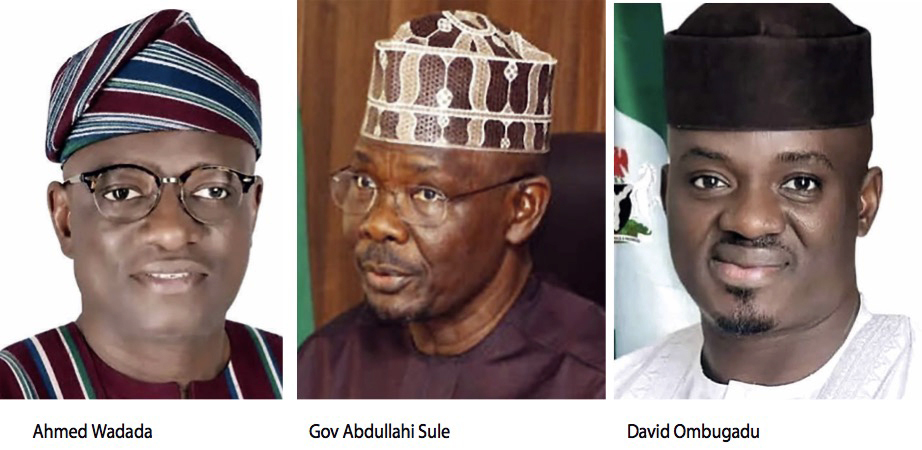
At the heart of this emerging battle stand several key figures. Senator Ahmed Aliyu Wadada carries the All Progressives Congress banner after a competitive primary. Former Inspector General of Police Mohammed Adamu, who also contested that primary, remains a significant presence. Rt Hon David Emmanuel Ombugadu continues to lead the Peoples Democratic Party’s opposition charge, while candidates from the Labour Party, the African Democratic Congress, the Nigeria Democratic Congress and others wait in the wings.
The deeper question facing the state is whether voters will opt for continuity under the ruling party or push for a fresh political direction. Since Umaru Tanko Al Makura’s victory over the then ruling PDP in 2011, the APC has dominated Nasarawa politics.
Governor Abdullahi Sule took over from Al Makura in 2019 and secured a second term in 2023 following a bitterly contested legal dispute. Many expected Wadada’s emergence as the party’s governorship candidate to settle succession questions within the APC, yet the primary process instead revealed simmering tensions inside the party.
Governor Sule’s open backing of Wadada was welcomed by supporters as a natural exercise of political influence, but critics argued the process should have been left to delegates without interference from senior figures. This disagreement has opened up a wider conversation about internal democracy and the extent to which party leaders should shape electoral outcomes. A political scientist at Nasarawa State University, Keffi, speaking on condition of anonymity, observed that a party’s challenge lies not only in producing a candidate but in convincing all participants that the process was fair, since a divided party can falter even with a formidable candidate.
Adding further texture to the story was former Governor Al Makura’s public support for Mohammed Adamu during the primary contest, a move that pushed against arguments from some quarters that zoning alone should determine the party’s direction. Al Makura instead maintained that competence and the capacity to deliver good governance ought to weigh more heavily than geographic considerations.
Adamu’s political future remains one of the most closely watched storylines heading into 2027. His national profile, security background and extensive political network gave the APC primary added significance, and although he did not win, his supporters insist his relevance has not diminished. Recent defections have only heightened speculation. Hon Mohammed Adamu Omadefu, representing Keana Constituency, and Hon Jacob Ajegana Kudu, representing Nasarawa Eggon East Constituency, have both left the APC for the Social Democratic Party, a development that has stirred considerable debate. A former party official suggested that when elected representatives abandon a ruling party, it sends a signal, not necessarily that the party is collapsing, but that unresolved issues demand attention.
APC loyalists counter that defections are commonplace in Nigerian politics and do not necessarily foreshadow electoral defeat, expressing confidence that reconciliation will unite the party well before the 2027 polls.
Wadada’s candidacy has also become entangled in a contentious debate over indigeneity, with some political actors questioning whether he fits the profile of candidate they wish to see govern the state and arguing instead for an indigene to take the seat. His supporters have firmly rejected this framing, insisting he is a genuine son of Nasarawa with a long record of political service.
Other News
Several observers have dismissed the row as unnecessary identity politics, arguing that the state’s diversity ought to be treated as an asset rather than a dividing line. Political commentator Abdullahi Awalu noted that while the indigeneity question carries strong emotional weight, elections are typically decided by a mix of factors, and identity must ultimately compete with competence, popularity, party organisation and economic realities. Whether it will shape voting patterns in 2027 remains an open question.
While the APC grapples with internal friction, the PDP continues to present itself as the opposition with the deepest historical roots and the widest structure in the state. Ombugadu remains its most prominent figure, having built a formidable political profile since his strong showing in the 2019 governorship race. In 2023, he again challenged Governor Sule in one of the closest contests in the state’s history, a race that wound through the courts after a tribunal initially declared him the winner before higher courts ultimately upheld Sule’s victory.
Despite that setback, Ombugadu has retained his political standing, with many attributing his resilience to consistency, strong grassroots ties and an ability to draw support beyond his core base. One analyst remarked that the PDP’s challenge is not visibility but unity, and convincing undecided voters to look beyond opposition politics. The party’s advantage lies in its experience and its continuing influence across all thirteen local government areas, though internal rivalries and leadership contests remain obstacles it will need to overcome.
The Social Democratic Party has emerged as an intriguing wildcard in the unfolding contest. Its surprise 2023 victory, when Wadada won the Nasarawa West senatorial seat under its banner, demonstrated that a smaller party could unsettle established structures given the right circumstances. With further political figures drifting towards the SDP ahead of 2027, the party appears keen to position itself as a home for those disillusioned with the APC.
Yet, analysts caution that attracting individual politicians is a different task from building a genuine statewide movement, which requires organisational depth, polling unit agents and effective grassroots mobilisation. Whether the SDP can replicate its earlier momentum on a larger scale remains uncertain.
The Labour Party, meanwhile, enters the race carrying residual energy from the Peter Obi movement of the 2023 presidential election, which drew considerable support among younger voters across Nasarawa. Analysts nonetheless warn that presidential popularity rarely converts neatly into governorship success, given that state elections tend to be shaped more by local structures and community ties. The party’s principal task is to convert that enthusiasm into a functioning political organisation capable of competing at state level.
The African Democratic Congress and the Nigeria Democratic Congress round out the field, each hoping to attract voters disenchanted with the two dominant parties. Their challenge, as with the SDP and Labour Party, lies in constructing organisational structures robust enough to rival the APC and PDP, since Nigeria’s electoral history suggests that smaller parties only become genuinely competitive when strong candidates are matched with effective organisation.
As the countdown to 2027 continues, alliances will inevitably shift, former rivals may find common cause and new political movements could yet emerge. But the final decision rests, as ever, with the electorate, who will weigh the contest against the realities of their daily lives: security, employment, education, healthcare, infrastructure and economic opportunity. The APC will make its case for continuity, the PDP for change, and the smaller parties for a genuine alternative.
Yet, it is Nasarawa’s voters who will ultimately determine which political structure earns their trust. The silent political war, as it were, has already begun, and its outcome will hinge not on the loudest name but on whichever camp can forge the strongest connection with the people of the state.