Follow Us on Google
By, Moses Akaigwe
The National Automotive Design and Development Council (NADDC) has called on private investors to increase investment in Compressed Natural Gas (CNG) refuelling and electric vehicle (EV) charging infrastructure to accelerate Nigeria’s transition to clean and sustainable transportation.
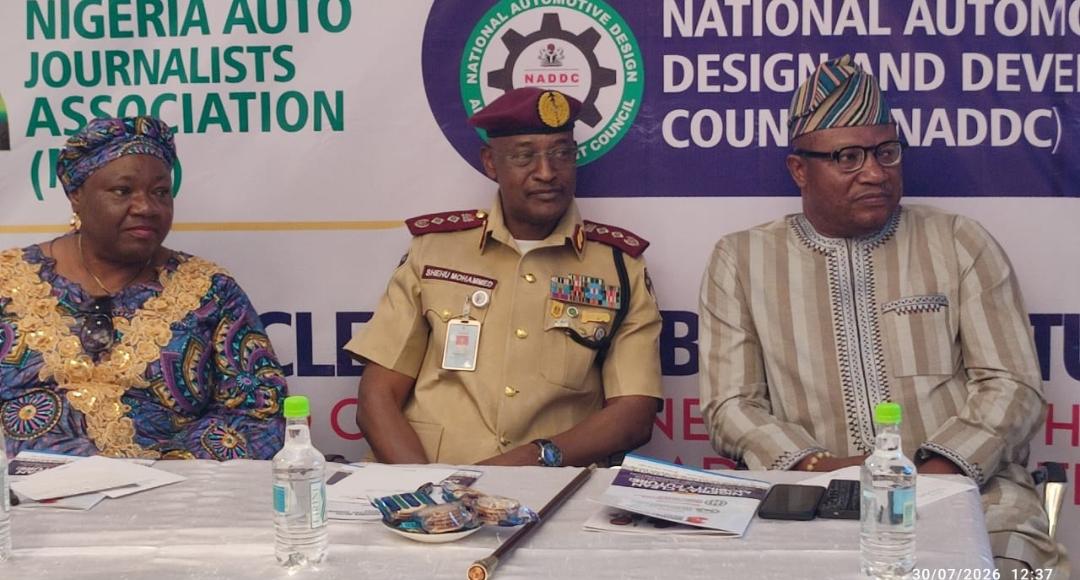
Speaking at the third Nigeria Auto Industry Summit (NAISU), themed “Nigeria’s Clean Mobility Future: The EV and CNG Journey Under the President Bola Tinubu Administration”, organised by the Nigeria Auto Journalists Association (NAJA) in Lagos on Thursday, the representative of the Director-General of NADDC and the Council’s Director of Public Relations, Mrs. Susan Bisong-Taiwo, said the council has spent more than two decades laying the foundation for Nigeria’s automotive transformation, with a strong focus on electric vehicles and alternative energy solutions.
According to her, the council’s commitment to clean mobility dates back to its early promotion of mechatronics, at a time when the concept of electric vehicles was still largely unfamiliar in Nigeria.
“More than 20 years ago, many people questioned our emphasis on mechatronics and electric vehicles. They asked, ‘What is mechatronics?’ My DG explained that this was where the world was heading—EVs and CNG.
“Today, the world has embraced clean energy, and Nigeria cannot afford to be left behind,” she said.
Bisong-Taiwo recalled that the NADDC supported the introduction of Nigeria’s first electric vehicle, the Hyundai Kona EV, despite widespread scepticism over the country’s electricity challenges.
“At the time, many people doubted that electric vehicles could succeed in Nigeria because of inadequate power supply.
“Today, electric vehicles are becoming increasingly common across the country,” she noted.
On the adoption of CNG, she disclosed that the council has certified 345 CNG conversion centres across Nigeria, ensuring that all facilities meet the required safety and operational standards.
“As of today, the council has certified 345 conversion centres nationwide, and we continue to monitor them to ensure compliance with established standards,” Taiwo said.
Other News
She described CNG as a cleaner, safer and more cost-effective alternative to petrol, noting that vehicles powered by CNG require less maintenance while contributing significantly to the reduction of harmful emissions.
Bisong-Taiwo, however, expressed concern over the limited number of CNG refuelling stations and urged investors to establish more facilities to improve accessibility and eliminate the long queues experienced by motorists.
“We want a situation where motorists can simply drive into a CNG station, refill their tanks and continue their journeys without delays. The council alone cannot achieve this. We need private sector investment,” she pointed out.
The NADDC representative also stressed the urgent need to expand Nigeria’s network of EV charging stations, explaining that inadequate charging infrastructure remains one of the biggest obstacles to the widespread adoption of electric vehicles.
Although the council has established some charging stations, she said they are still insufficient to meet the growing demand.
She noted that many electric vehicle owners are reluctant to embark on long-distance journeys because charging points remain scarce along major highways.
“In advanced countries, charging stations are available every few hours along highways. Motorists can stop, recharge their vehicles, refresh themselves and continue their journeys. That is the kind of infrastructure Nigeria should be building,” she said.
The NADDC Director of Public Relations maintained that expanding clean energy infrastructure would not only support the automotive industry, but also improve public health by reducing carbon emissions and environmental pollution.
She reaffirmed the council’s commitment to driving the development of Nigeria’s automotive sector while calling on investors to partner with the government in building the infrastructure needed for a cleaner, greener and more sustainable transport ecosystem.
“Our goal is to ensure Nigeria keeps pace with global developments in clean mobility while creating a healthier environment for present and future generations,” she added.