Follow Us on Google
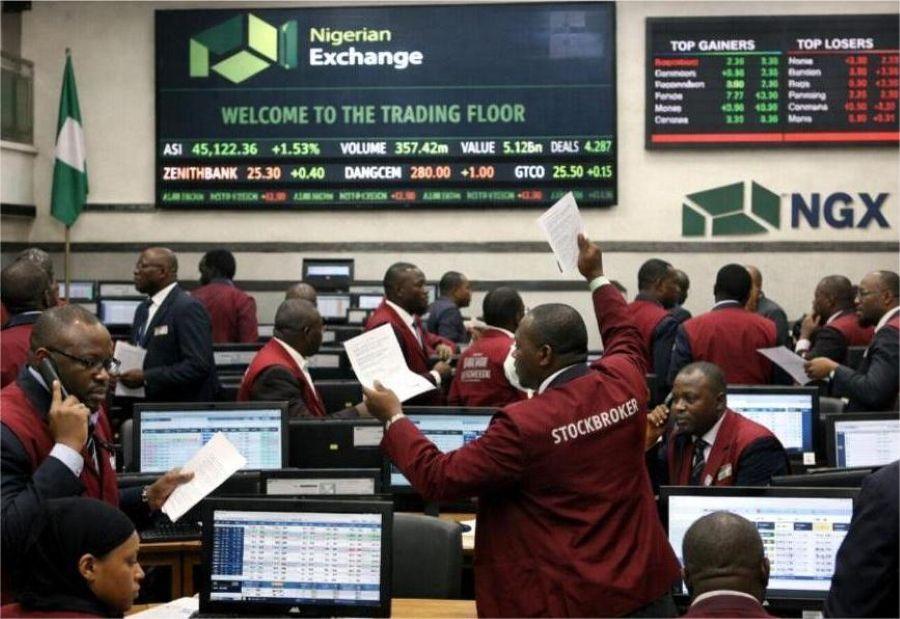
Nigeria’s stock market rally is increasingly challenging claims that its spectacular performance is little more than a naira illusion created by currency depreciation, with the Nigerian Exchange (NGX) emerging as one of the world’s strongest-performing equity markets even when measured in United States dollars.
The argument that the market boom reflects nothing more than higher nominal asset values following the naira’s depreciation has gained traction among critics of the Federal Government’s economic reforms. Proponents of the view contend that a sharp currency adjustment can make assets appear more valuable in naira terms without corresponding increases in production, employment or household welfare.
According to Dave Adekunle, a capital market analyst, “The performance of Nigerian equities in dollar terms, combined with the composition of market participation and the scale of fresh capital raised by companies, particularly banks, presents a more complicated picture.
“The NGX All-Share Index became the best-performing equity benchmark in the world in dollar terms on July 10, 2026, recording a year-to-date gain of about 67 per cent, according to Bloomberg’s comparison of 92 benchmark indices.”
Nigeria remained at the top for about five weeks before being overtaken following a strong recovery in South Korea’s KOSPI.
“By August 14, the NGX ranked third among the 92 markets, with a dollar-denominated return of 65.23 per cent. The KOSPI stood at 68.52 per cent, while Ghana’s GSE Composite Index returned 66.68 per cent.
“The significance of the performance lies in the fact that measuring the Nigerian market in dollars removes much of the argument that naira depreciation alone is responsible for the rally,” Adekunle added.
Currency depreciation generally reduces dollar returns for an overseas investor. Therefore, where a local equity index records a huge gain in naira terms while the domestic currency is simultaneously losing substantial value, much of the apparent increase in wealth can disappear when translated into dollars.
That was the experience of Nigerian investors during the sharp naira depreciation of 2023 and 2024.
However, the currency dynamics have changed.
The naira appreciated by roughly four per cent against the dollar in 2026, following an appreciation of about 5.9 per cent in 2025. Improved foreign-exchange liquidity, stronger external reserves and a narrowing gap between official and parallel-market rates have contributed to greater stability in the foreign-exchange market.
This means that, rather than eroding equity returns for dollar-based investors, currency movement has, in recent periods, added to them.
The implication is that the latest equity rally cannot easily be explained as the mechanical consequence of naira depreciation.
“If this is devaluation arithmetic, where is the devaluation?” is therefore becoming an increasingly difficult question for those dismissing the market’s performance as an illusion.
“Another feature of the rally that undermines the argument of a foreign speculative boom is the dominance of domestic investors.
“In the first half of 2026, domestic investors accounted for approximately 89 per cent of participation and transaction value on the Nigerian Exchange, while foreign investors accounted for about 11 per cent.
“The figures suggest that the rally is being sustained predominantly by Nigerian capital rather than a sudden flood of foreign portfolio money,” he stressed.
That distinction is important because foreign portfolio flows are traditionally regarded as more volatile and sensitive to global interest rates, exchange-rate expectations and emerging-market risk.
A market overwhelmingly supported by domestic investors has a different underlying structure.
The investor base has also expanded significantly through the banking recapitalisation exercise and a series of public offers and rights issues.
Approximately 500,000 new investors entered the market through bank public offers and rights issues between 2024 and 2026, many of them opening formal investment accounts for the first time.
Although the increase in retail participation does not eliminate the structural weaknesses of the Nigerian capital market, it indicates that the market is gradually attracting a broader pool of domestic savings.
The biggest structural development, however, has been the banking sector recapitalisation.
Over a two-year period, the Nigerian capital market mobilised about ₦4.65 trillion in fresh equity capital, helping 33 banks meet the Central Bank of Nigeria’s revised minimum capital requirements.
The significance of the exercise goes beyond the performance of banking stocks on the NGX.
Fresh equity represents permanent, loss-absorbing capital that strengthens banks’ balance sheets and potentially expands their capacity to provide credit to the economy.
Better-capitalised banks can accommodate larger transactions and potentially provide bigger loans to businesses operating in manufacturing, agriculture, infrastructure, power and other productive sectors.
This makes the recapitalisation exercise an important link between the capital market and the real economy.
A bank cannot lend money that it does not have the capital to support.
The market’s response to the recapitalisation process also provides evidence of genuine price discovery.
Banking stocks came under pressure as investors anticipated dilution associated with rights issues and other capital-raising exercises.
As the capital was subsequently raised and stronger balance sheets became clearer, banking valuations recovered.
That pattern — selling ahead of anticipated dilution and buying as the capital position improves — is consistent with investors repricing companies according to changing fundamentals.
It is difficult to reconcile such behaviour with the claim that the entire market is simply a speculative bubble detached from fundamentals.
Foreign capital has also played a role, although not in the manner suggested by the “hot money” argument.
Other News
Foreign capital inflows into Nigeria’s banking sector rose by 93.25 per cent year on year to $13.53 billion in 2025, accounting for 58.26 per cent of the country’s total foreign capital importation of $23.22 billion.
International investors also supplied more than a quarter of the capital raised during the banking recapitalisation exercise.
The distinction between portfolio speculation and strategic capital injection is crucial.
An investor buying shares for a short-term trade can sell almost immediately.
Capital injected into a bank’s balance sheet, however, becomes part of the institution’s permanent capital structure. A subsequent sale of those shares changes ownership but does not remove the original capital from the bank.
At the same time, concerns about Nigeria’s attractiveness to foreign investors remain real.
FTSE Russell continues to highlight concerns around market accessibility and the reliability of capital repatriation. These issues remain important constraints on Nigeria’s ability to attract and retain large international pools of capital.
Adekunle said, “The Nigerian market therefore still has considerable work to do before it can be regarded as fully accessible and competitive by global standards.
“The recent reforms nevertheless point to efforts to strengthen the market’s institutional framework.
“The Investments and Securities Act 2025 replaced the previous legislation enacted in 2007, strengthened enforcement provisions and expanded the regulatory perimeter to cover areas such as digital assets.
“The migration to a T+1 settlement cycle is another step towards aligning the Nigerian market more closely with international market infrastructure.
“There are also signs of renewed interest among international investors.
“S&P Dow Jones Indices has placed Nigeria on its 2027 watchlist for possible movement from standalone to frontier status, while some global fund managers have continued to identify value in Nigerian equities despite the substantial gains recorded this year.”
Yet the debate over the stock market cannot be separated from the broader condition of the Nigerian economy.
The critics are correct that a rising stock market does not automatically translate into higher living standards.
Market capitalisation does not reduce food prices. A rising share price does not create employment by itself. A strong banking index does not solve Nigeria’s electricity crisis.
Millions of Nigerians continue to face high living costs, inadequate infrastructure, expensive credit and weak purchasing power.
The economy also needs far more greenfield investment, manufacturing capacity, technology businesses and productive enterprises.
The dominance of financial services in the NGX remains another structural weakness. A deeper and healthier market would have a much broader representation of manufacturing, technology, consumer goods, energy and infrastructure companies.
The ultimate test, therefore, is whether the capital being mobilised through the market translates into productive investment and stronger corporate earnings.
That is where the stock-market debate should move next.
Nigeria does not need an artificially inflated stock market. It needs a market capable of mobilising domestic savings and directing them towards productive businesses.
It needs banks with sufficient capital to finance expansion.
It needs companies capable of raising long-term funding without relying excessively on expensive short-term bank credit.
And it needs investors who can earn returns from genuine improvements in corporate productivity rather than merely from inflation and currency movements.
The current evidence suggests that the NGX rally is more complex than a currency-driven mirage.
“Its strong performance in dollar terms weakens the devaluation argument. Its overwhelmingly domestic investor base challenges the claim that foreign portfolio flows are driving the market. And the ₦4.65 trillion raised during the banking recapitalisation demonstrates that the capital market has been doing more than simply transferring wealth between speculators.
“But neither does the rally prove that Nigeria’s economic problems have been solved.
“The stock market is a barometer, not the weather.
“It measures expectations about corporate earnings, interest rates, liquidity, capital availability and economic reforms. It does not create the conditions that determine whether those expectations eventually become reality,” he said.
The real test for Nigeria’s equity market will therefore be whether today’s capital mobilisation translates into tomorrow’s factories, loans, jobs, exports and stronger corporate earnings.
If that happens, the current rally will be remembered not as an illusion, but as an early market signal of a broader economic transformation.
If it does not, investors will eventually expose the difference between financial optimism and economic reality.
“For now, however, the evidence makes one conclusion difficult to avoid: Nigeria’s stock-market boom may be many things — expensive, volatile, vulnerable to correction and still disconnected from the daily experience of millions of Nigerians — but it is increasingly difficult to describe it simply as a product of naira depreciation,” Adekunle concluded.