Follow Us on Google
From Juliana Taiwo-Obalonye, New York
Amid Nigeria’s brutal counterinsurgency war, military and Police officers wives lie awake “wondering if my husband is alive,” National President of Defence and Police Officers’ Wives Association (DEPOWA), Mrs. Mernan Femi-Oluyede revealed at the United Nations, issuing a desperate global plea for funding and partnerships to tackle rampant untreated PTSD (Post-Traumatic Stress Disorder)—a debilitating mental health condition triggered by terrifying events—fueling family violence.
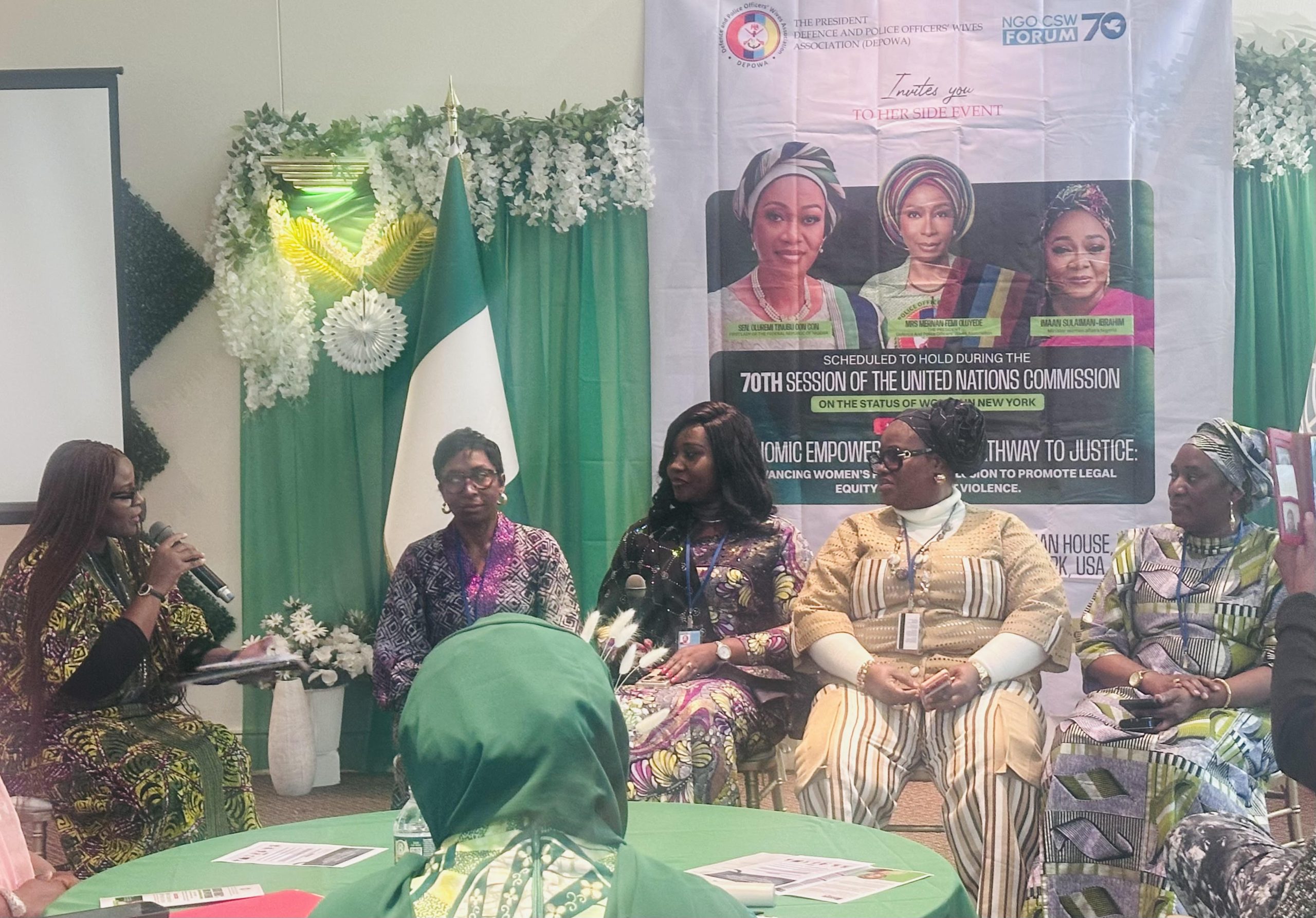
Hosting a pivotal side event at the 70th Session of the UN Commission on the Status of Women (CSW70), themed “Economic Empowerment as a Pathway to Justice: Advancing Women’s Financial Inclusion to Promote Legal Equity and Prevent Violence,” Oluyede positioned mental health as the linchpin: “Our husbands go to work. They come back home. We don’t resolve trauma. And there is a chronic shortage of mental health services.”
DEPOWA’s National President spotlighted these women (widows), children as “ground zero” of Nigeria’s insurgency since 2009, where husbands return with PTSD that unleashes “domestic, sexual, and gender-based violence, mental health challenges, and addiction” due to stigma. “We have sisters… whose husbands went to work and never came home, or came home without a limb, or in a coffin,” Femi-Oluyede said, targeting non-commissioned officers’ families hardest hit.
She said her administration wants to prioritise “enhanced psychosocial and mental-health services,” but she urgently seeks partners: “My ask is for help—financial, technical support to sector of mental health services, financial support to provide starter packs… and any other kind of engagement and collaboration will be welcomed.”
“My mission as DEPOWA president is to enhance the quality of life of military and police families by fostering education, economic empowerment, healthcare, psychosocial support and inclusive opportunities for women, children, widows and vulnerable groups through strategic partnerships, community engagement and sustainable development within and beyond the barracks. Economic vulnerability is a significant barrier to justice.
“Our asks are: Technical and financial o r other support for NMCS a newly established cooperative society for military wives.
“Technical and financial support as well a s donations of starter packs for DEPOWA Skills Acquisition Centre.
“Support to establish and inbed mental health services within existing structures in the short to medium term while planning and working towards establishing a state of the art service to cater for the needs of the military communities and beyond. Supports for our humanitarian and medical outreaches which include outreaches to IDP camp.”
She disclosed recent DEPOWA Skills Acquisition Centre graduates—130 strong, including widows—highlight economic empowerment’s role, yet Oluyede insists mental health funding is non-negotiable for justice.
Healthcare titan Dr. Philip Ozuah, one of the top 100 influential figures globally, present at the event echoed the crisis from his frontline experience treating PTSD (Post-Traumatic Stress Disorder): “This trauma, not silently, converts itself during military and law enforcement service… the scars of service come in many forms, but the spouses of grave service members could not be blamed for many of them.” Pledging resources, he linked women’s empowerment to stability: “Investment in women is a caveat to economic growth and social stability… Educational programmes, consciousness, wellness, skills acquisition—all fuel communities.”
Inspired by Oluyede’s vision, Ozuah committed “financial, technical support,” amplifying DEPOWA’s funding drive for mental health and economic programmes.
Other News
Minister of Women Affairs and Social Development Imaan Suliaman-Ibrahim aligned the push with President Bola Tinubu’s 2026 “Year of the Family and Social Development,” urging unity: “As women in Nigeria, what we need is engagement… The more we understand, the more we can accelerate action.” She shared a raw story of a woman becoming a “liability” without income, stressing: “This life is tough… We don’t know the weight on their (women) heads.” Honouring officers’ wives, she vowed: “We are here to ensure that the people who serve Nigeria have peace of mind,” framing mental health and economic aid as pathways to prevent violence.
Nigeria’s UN Chargé d’Affaires Ambassador Syndoph Endoni promised backing saying: “Partnership is the key and for those of us at the UN will continue to work with you to take the available resources from the UN system to support all that you are doing.”
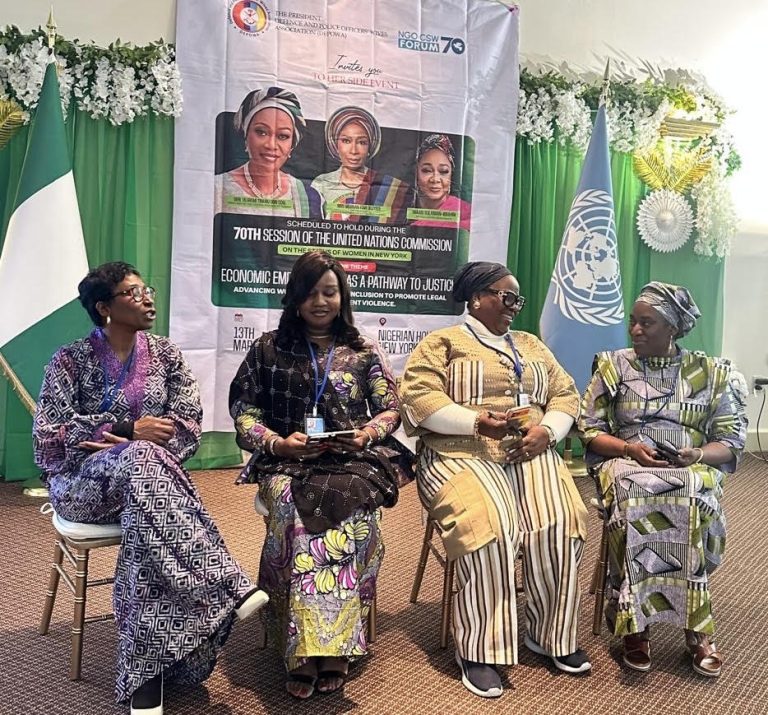
The high-stakes DEPOWA event also featured a panel discussion moderated by SheForum Africa founder Ms. Inimfon Etuk, unleashed powerful testimonies, amplifying calls for mental health funding, economic clusters, and partnerships to shield families from PTSD’s fallout and loan shark traps.
Helpline Foundation’s Jumai Ahmadu kicked off with a scathing expose of financial predators: “My work deals with women at the grassroots level. From experience, I can tell you the only challenge they have is lack of financial literacy. Most of these women are just surviving, detailing a rescue: “There was a woman given a 20,000 Naira loan and was expected to either pay the full amount within five months or be paying N500 to 1,000 monthly but it was a trap, these loan sharks latch onto the vulnerability and exploit them. This particular woman became depressed when she wasn’t meeting up with her weekly/monthly commitment by the time we intervene in Jikwoyi to rescue her, she had paid almost N70,000 in interest from their records. They exploit their ignorance.
“This experience informed the Helpline Non-political Revolving Loan Scheme where “We put them in clusters of 20 empower 10 while the remaining 10 serves as monitors, they meet monthly to contribute money from their profits for the next woman. This project Non-profit Revolving Loan Scheme has instill saving culture and financial discipline, we have over 20 clusters. The challenge these women face is lack of financial literacy, lack of savings culture, and ignorance of their rights.”
On digital empowerment: “The world is digital—if we don’t keep pace, we’ll be left behind. Train women in AI… An empowered woman has a voice in family and community.”
DEPOWA’s National President, Mrs. Femi-Oluyede reinforced: “Even for those whose husbands are just doing their job, they bear the wounds, especially non commissioned soldiers’ wives. We have a programme on skills acquisition. We train in gele tying, makeup, and equip them with starter packs to start businesses. This is central for widows of our fallen heroes.”
Seeking funds, she said: “We’re open to partnerships with NGOs, government, banks like African Development Bank… Collaboration lifts women.”
NAFOWA’s Mrs. Ngozi Aneke detailed holistic support: “Everything she said is what we do. We’re an NGO supporting service to humanity. Recently, we reached over 500 women for Armed Forces Remembrance Day. We run skills programmes, education in poor schools, cancer screening, mental health awareness. We have special schools for autistic children and disabilities—giving back to our core mandate.”
On mentorship she said, “We train on etiquette, hierarchy, skills like soap making, farming to empower so they don’t rely on their husbands and gain financial independence and voice… If you don’t have that voice in this society, you’re nothing.”
POWA’s Mrs. Oluwafunmilayo Disu in her contribution focused on home-front stability: “Keep the home front stable so they (their husbands) can deliver. Provide emotional and mental health support, pray for them. Economically, she said her association encouraged women to work—make beads, bags, among other things, adding that these relieve pressures.
Mrs Disu advised on health checks like prostate for men, blood pressure noting that some who do were promptly admitted where their blood pressure was high up to 200.” Seeking Nigerians support for the men in union, Mrs. Disu said, “Understand they’re doing their duty. Report crimes—‘if you see something, say something.’
Etuk concluded by saying: “These days, we hear women don’t support each other—can we stop that narrative? Collaboration is the currency for partnerships today.” The panel’s unified demand? Immediate funding for mental health services, starter packs, and anti-violence economic shields.
Also present were National President Naval Officers Wives Association (NOWA): Mrs. Aisha Idi Abbas, President Nigerian Army Officers’ Wives Association, Mrs. Safiyyah Hassan Shaibu, and National President, Nigerian Air Force Officers’ Wives Association, Mrs. Ngozi Aneke, delegates participating in the ongoing CSW70 as well as friends of Nigeria.