Follow Us on Google
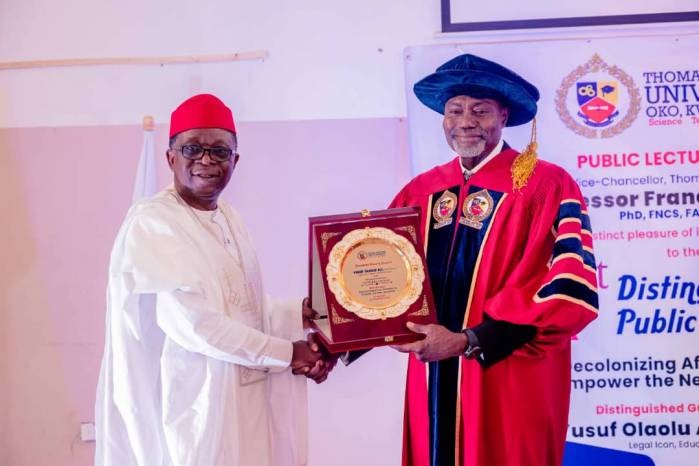
A legal luminary, Professor Yusuf Olaolu Ali, SAN, has advocated for brain decolonisation as a way of advancing African education to empower the next generation.
Ali made the observation at the maiden edition of a distinguished public lecture of the Thomas Adewumi University Oko, Irepodun Local Government area of Kwara State.
Speaking at the auditorium of the institution on the topic: “Decolonising African Education To Empower The Next Generation,” the legal icon said the context of African education is essential to comprehend the immediate need for its decolonisation, which will address the systemic challenges it faces today.
“The tout of African education is plainly marked by the influence of erstwhile colonial powers, leaving a heritage that advances Eurocentric biases and marginalises the long-standing indigenous knowledge system that forms an integral part of Africa’s culture tapestry.”
He said that Nigerian education was greatly impacted by the British colonial domination, adding that Africa leaders should promote the use of local languages for academic activities. “Rather than meeting the requirements of the native population, the British formal education system was designed to serve the interests of the colonial government.”
“The curriculum reflected the customs and ideals of the colonisers and was frequently Eurocentric. Native languages were marginalised because English became the language of instruction.
“During the colonial era, producing clerks, interpreters, and low-level administrative staff to support the colonial administration was the main objective of education. The goal of the educational system was to further the interests of the colonial authority rather than to empower the indigenous populace,” he said.
The legal scholar said that there is the need to decolonise “our brain thoughts, way, actions, outlook and work ethics.”
He, however, recommended that Africa should implement curricula revision that reflect African viewpoints, aimed at empowering indigenous languages in education, and foster culturally relevant pedagogy.
He said that it is important to de-emphasise educational certificates, adding that Africa should decolonise educational assessment and evaluation.
He also called for adequate funding to support research and policies geared towards decolonisation, adding that both teachers and students, “who are critical stakeholders in the education sector,” should be empowered.
“Decolonising professional development for teachers is critical, as recognising and valuing indigenous knowledge. Furthermore, assisting teachers in incorporating technology into school is critical for modernising the learning process.
“Decolonising educational spaces requires redesigning physical learning environments, establishing inclusive and secure spaces for marginalised groups, and fostering conversation and critical thinking in classrooms.
“Promoting African-centered research methodology, forming collaborative research relationships with African scholars, and addressing ethical concerns in African education research are all critical steps towards decolonising educational research.
“Promoting student agency and voice, eliminating gender inequalities, and expanding access to high-quality education for everyone are all priorities,” he said.
Also speaking, the founder of the University, Thomas Adewunmi, lauded the contribution of the lecturer, saying that he has set an enviable standard for future speakers in the distinguished lecture series.
The founder, who is the Asiwaju of Oko land, stated that most of the recommendations put forward by him would be put into practical use towards improving educational system in the institution.
In her remarks, the vice chancellor of the university, Professor Francisca Oladipo, appreciated the distinguished lecturer, saying that the event would help shore up the image and reputation of the institution among its contemporaries.
The event was witnessed by academics, traditional rulers, and legal practitioners, among others.