Follow Us on Google
By Bianca Iboma-Emefu
The Enachioken of Abiriba Kingdom and Paramount Ruler of the Abiriba people, His Royal Majesty, Eze Kalu Kalu, Ogbu IV, has warned that the erosion of integrity among traditional rulers and political leaders is deepening Nigeria’s leadership crisis.
The monarch declared that “integrity is everything,” challenging traditional rulers and politicians to restore the moral standards expected of those entrusted with the welfare of the people.
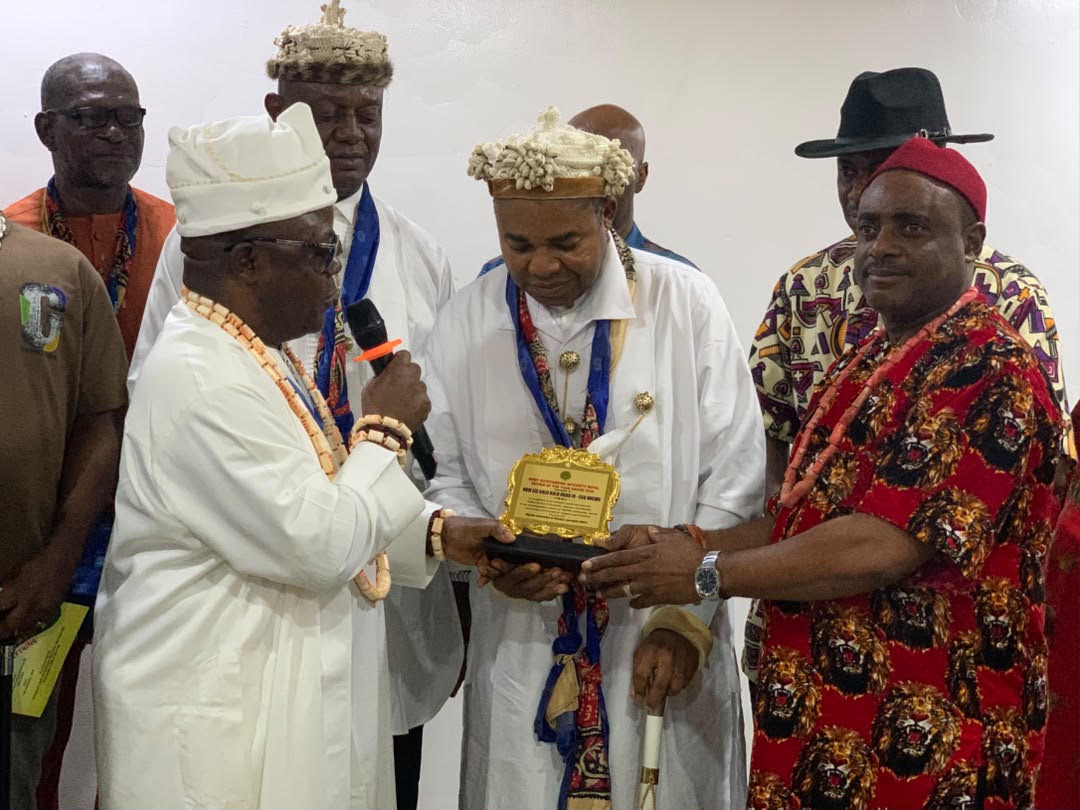
He spoke at the award ceremony organised by the Nigerian Association of Christian Journalists (NACJ), where he was recognised as the Most Outstanding Integrity Royal Father of the Year 2026. He received the award alongside nine others.
Eze Ogbu expressed concern that some traditional rulers had compromised the independence and dignity of their offices through excessive alignment with politicians.
According to him, the growing closeness between some custodians of traditional institutions and political actors risks stripping traditional leadership of the moral authority needed to speak truth to power and protect the interests of the people.
His intervention placed traditional rulers under the same ethical scrutiny as elected officials, making the leadership crisis a broader institutional and moral problem rather than one that could be blamed solely on politicians.
The monarch’s position resonated with other speakers at the programme, who argued that Nigeria’s challenges could not be overcome through political reforms alone without a corresponding transformation in the character of its citizens and leaders.
National President of the NACJ, Dr. Charles Okhai, said integrity must begin at the family level and extend into public life, insisting that public office holders should be particularly conscious of their responsibility to act honestly.
“Public office holders should be much more integrity conscious,” Okhai said, warning against a system where citizens are expected to offer inducements before receiving services or entitlements that should ordinarily be provided without payment.
He linked the country’s corruption and culture of impunity to a deficit of integrity and patriotism, stressing that both values must operate together if Nigeria is to make meaningful progress.
His Royal Highness Frederick Iyogun, the Iyogu II of Uneme- Osu in the Central Uneme clan of Akoko Edo, Edo State, described integrity as “the pillar for life”, arguing that the traditional institution itself must be founded on character and trust.
He said building men and women of integrity across society remained essential to national development, noting that integrity promotes progress, unity, love and trust.
Other News
The traditional ruler also rejected the notion that integrity should be demanded only from people occupying public offices.
According to him, ordinary citizens also have a responsibility because they interact with public institutions and officials daily and can either reinforce or undermine the values they demand from leaders.
The keynote speaker, Dr. George Moghalu, former Managing Director of the National Inland Waterways Authority, further challenged Nigerians to look beyond complaints about bad leadership and confront the character crisis at the individual level.
Moghalu said Nigeria was not short of talented people, land or natural resources, but lacked in sufficient measure citizens prepared to do what is right even when nobody was watching.
He argued that integrity must extend from the highest political office to homes, workplaces, religious institutions and communities.
Drawing from biblical examples including Joseph, Daniel, Nehemiah and Ruth, Moghalu defined integrity as consistency between a person’s private conduct and public claims.
He illustrated the concept with everyday acts: an employee reporting an accidental salary overpayment, an accountant refusing to falsify records or a store attendant reconciling accounts even when there is no supervisor watching.
Such seemingly small decisions, he argued, ultimately determine the character of institutions and nations.
Moghalu also distinguished patriotism from blind loyalty, describing it instead as honest service, prayer and a willingness to contribute to the nation’s good even when the country falls short of expectations.
Quoting Proverbs 14:34, he said righteousness remained a foundation for national elevation, while warning that no law or change of government could succeed without citizens committed to honesty and service.
The convergence of views at the programme underscored a central message: Nigeria’s leadership crisis is not simply about who occupies political office, but about the character of those entrusted with influence — including traditional rulers, public officials and ordinary citizens.
For Eze Ogbu, however, the responsibility begins with those who occupy positions of authority.
His call for traditional rulers to resist political compromise places the traditional institution at the centre of the national conversation on integrity, accountability and moral leadership — and challenges the custodians of culture to reclaim the independence and credibility of their offices.