Follow Us on Google

By Oluseye Ojo
Ahead of the 2027 general elections, the governorship contests in Lagos, Ogun and Oyo states are increasingly becoming battles over competing development visions, public service records, political experience as well as the capacity of candidates to deliver on their promises.
The unfolding contests are raising fundamental questions about governance, who has the clearest development agenda, whose record can withstand public scrutiny and who possesses the competence to translate campaign promises into tangible improvements in people’s lives?

Fillers showed that the stakes are particularly significant from the three states, which have different economic structures, political histories and development priorities.
In Lagos, the challenge is how to sustain economic growth while addressing the pressures of urbanisation, housing shortages, transportation, flooding, unemployment and the rising cost of living.
In Ogun, the debate centres on industrialisation, infrastructure, agricultural development, employment generation and the equitable distribution of economic opportunities.
In Oyo, the contest is increasingly about the direction of governance after Governor Seyi Makinde’s tenure, with infrastructure, insecurity, agriculture, education, healthcare, local government administration and economic development featuring prominently.
The Independent National Electoral Commission (INEC), following its review of complaints relating to the earlier governorship candidates’ lists, published an updated final list on October 31. The list identifies 17 candidates for Lagos, 13 for Ogun and 16 for Oyo.
A careful study of the ongoing campaigns in the three states showed that the 2027 elections may test not only the popularity of political parties but also the credibility of their development propositions.
Lagos: Continuity, accountability, alternative development models
Lagos presents one of the most closely watched governorship contests in the country.
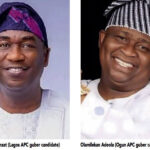
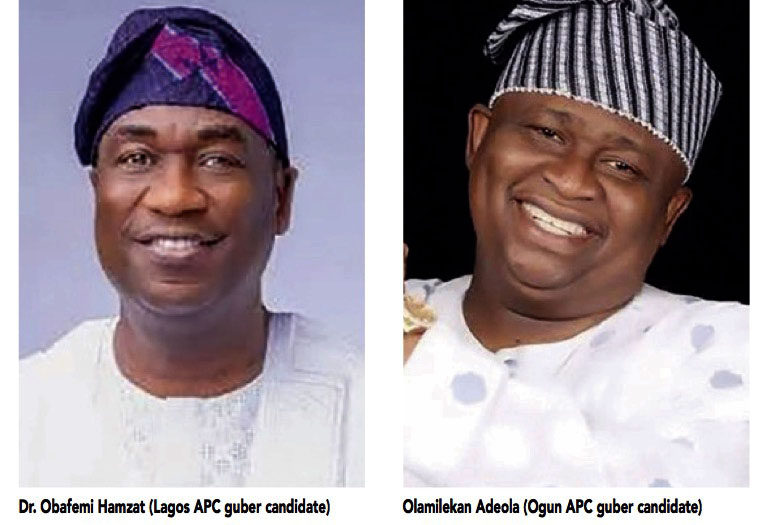
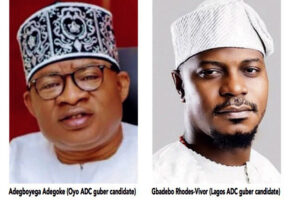
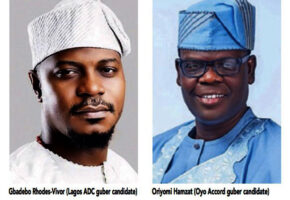
The All Progressives Congress (APC) has the incumbent deputy governor, Dr. Obafemi Hamzat, as its governorship candidate, while the African Democratic Congress (ADC) is fielding Gbadebo Rhodes-Vivour.
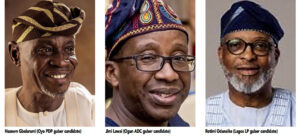
The Nigeria Democratic Congress (NDC) has Funso Doherty, while the Peoples Democratic Party (PDP) is represented by Adedeji Doherty. The Labour Party (LP) candidate is Oluwapemilerin Olurotimi Odunaike.
The APC’s choice of Hamzat places continuity at the centre of its campaign. Having served as deputy governor since 2019, he is positioned to draw on his experience within the administration of Governor Babajide Sanwo-Olu and present himself as a candidate familiar with the state’s governance structure and development priorities.
He had also served as Commissioner for Science and Technology in Lagos State. He was appointed in 2005 under Governor Bola Ahmed Tinubu, a position he retained until 2011.
Hamzat also served as Commissioner for Works and Infrastructure from 2011 to 2015 under Governor Raji Fashola.
He also served from 2015 to 2018 as Special Adviser/Technical Adviser on Works at the federal level under the Federal Ministry of Power, Works and Housing.
His 2027 gubernatorial manifesto, titled: ‘The Lagos Promise’ (Ileri Eko), frames his candidacy not as a political reset, but as an exercise in institutional consolidation. He anchored his 100-point development agenda around seven core pillars, ranging from urban renewal to civil service machinery.
He leverages his background as a former multi-portfolio commissioner and technical adviser to project technical competence over populist rhetoric.
His platform emphasises pragmatic continuity, explicitly targeting long-gestating infrastructure bottlenecks, such as the activation of the Fourth Mainland Bridge project and the integration of multimodal transit systems across rail, road, and water corridors.
The agenda seeks to institutionalise transparency within public service delivery through introduction of a structured Lagos State Service Delivery Office tasked with strict resolution timelines for citizen grievances, alongside a novel Performance Council and an independent scorecard for 87 core pledges.
Hamzat is also enjoying the backing of Governor Babajide Sanwo-Olu, and President Bola Tinubu.
For close to 28 years, the political structure around Tinubu has been producing governors for Lagos State. Tinubu was the governor from 1999 to 2007. He was succeeded by his former Chief of Staff, Mr. Raji Fashola (SAN) from 2007 to 2015. Mr. Akinwumi Ambode was also the governor from 2015 to 2019, and Mr. Babajide Sanwo-Olu became governor in 2019 till date.
The Tinubu political structure in Lagos has made many analysis believe that Hamzat has an edge over other governorship candidates.
They also believed that every governor that has governed Lagos since 1999 has been a great performer in a state where rapid population growth continues to place enormous pressure on transportation, housing, drainage, sanitation and public infrastructure.
For Rhodes-Vivour of ADC, the 2027 contest offers another opportunity to present an alternative to the APC’s development model.
Having contested the 2023 governorship election on the platform of Labour Party (LP), he has an established political profile and a previous campaign record against which his new proposals can be examined.
His policy priorities include affordable housing, transportation, urban planning and the protection of residents against intimidation by law enforcement personnel and political thugs.
He has also proposed an ambitious housing programme, including the delivery of 100,000 housing units during his first term.
During the 2023 general elections, the LP put up an impressive performance to the extent that the presidential candidate of the party then, Mr. Peter Obi, defeated Tinubu in Lagos. But APC still won the three senatorial seats in the state.
The surprise made by LP during the conduct of presidential and National Assembly polls unsettled APC and Rhodes-Vivor, was on his way to win the governorship poll then. But Sanwo-Olu was re-elected in 2023.
In the build-up to the 2027 gubernatorial election, Peter Obi has moved to NDC and Rhodes-Vivor has moved to ADC.
The separation of political affiliations between Rhodes-Vivor and Obi has, however, made some observers to believe that ADC may not go far in winning the poll, but it can spring surprises with the backing of former Vice President, Alhaji Atiku Abubakar, who is the ADC presidential candidate.
In the same vein, Funso Doherty of the NDC brings another development proposition into the contest.
His campaign has emphasised education, healthcare, public finance and improved accountability. He has pledged to make education and healthcare accessible free of charge within his first 100 days in office, if elected.
He is expected to mark a big mark with the support of Mr. Peter Obi, who is the NDC presidential candidate.
For Adedeji Doherty of the PDP, the task is to demonstrate how his programme differs from those of the other candidates and what practical solutions he offers to the state’s development challenges.
The distinction between the two Dohertys is important: Funso Doherty represents the NDC, while Adedeji Doherty is the PDP candidate.
Also, Oluwapemilerin Olurotimi Odunaike of the Labour Party also has an opportunity to present an alternative development agenda, particularly on employment, education, healthcare, transportation and the welfare of low-income residents.
The aggregate opinion from the public opinion poll in Lagos revealed that the fundamental challenge is no longer simply how to sustain the position of Lagos as Nigeria’s commercial hub, but how to make economic growth more inclusive and improve the quality of life of its residents.
Ogun: Industrialisation, jobs, battle over economic opportunities
The governorship contest in Ogun State is being shaped by its strategic position as an industrial and agricultural centre, its proximity to Lagos and its growing importance as a destination for manufacturing, commerce and residential development.
The APC has Senator Solomon Olamilekan Adeola, popularly known as Yayi, as its candidate, while the ADC is represented by Jimi Adebisi Lawal.
The INEC’s updated final list contains 13 candidates from 13 political parties.
Adeola’s candidacy provides the APC with an opportunity to present its development agenda for the state after Governor Dapo Abiodun’s tenure.
The senator, who represents Ogun West in the National Assembly, has an opportunity to build his campaign around industrial development, employment generation, agriculture, infrastructure, education and healthcare.
Adeola’s legislative experience and public service record is expected to form part of the assessment of his preparedness for the governorship.
Investigation revealed that out of four governors that have ruled the state since 1999 till date, only Otunba Gbenga Daniel is not from the progressives family then.
Chief Olusegun Osoba was the governor on the platform of Alliance for Democracy (AD) from 1999 to 2003. He was succeeded by Otunba Gbenga Daniel of the Peoples Democratic Party (PDP) from 2003 to 2011.
As a result of political expediency, the structure of Alliance for Democracy formed Action Congress (AC) prior to the 2007 general elections and metamorphosed to Action Congress of Nigeria (ACN) in the build up to the 2011 general elections. The ACN also merged with some political parties in the build up to the 2015 general elections and formed a mega party – All Progressives Congress (APC).
The ACN produced Senator Ibikunle Amosun as governor of Ogun State from 2011 to 2019. He was succeeded by the incumbent governor, Prince Dapo Abiodun, from 2019 till date.
Findings showed that the fact that the progressives have governed the state for almost 20 years, and the democrats have also ruled for eight years, might be a positive factor for Senator Adeola to also succeed Prince Dapo Abiodun.
For Lawal of the ADC, the contest offers an opportunity to articulate an alternative approach to managing the state’s economy and public institutions.
Stakeholders believed that his programme must address industrialisation, agricultural development, infrastructure, employment, education and healthcare, for him to pull critical strings.
Other News
But one significant development in Ogun is the absence of the Peoples Democratic Party (PDP) and its previously known governorship candidate, Ladi Adebutu, from INEC’s published final list.
The omission followed developments surrounding compliance with statutory requirements for party membership registration and candidate nomination. The party had disputed the circumstances surrounding the omission.
The absence of the PDP from the published governorship list is considered to be politically significant, given the party’s previous electoral strength and Adebutu’s role in the 2023 governorship contest.
The development potentially changed the configuration of the opposition and raised questions about where the party’s traditional supporters may direct their political allegiance.
The other parties fielding governorship candidates in the state, include the Allied Peoples Movement (APM), Action Peoples Party (APP), Social Democratic Party (SDP), New Nigeria Peoples Party (NNPP) and Young Progressives Party (YPP).
The central issue in Ogun, according to analysts, remains how the next governor intends to convert the state’s industrial and agricultural advantages into employment, improved infrastructure and better living conditions.
A resident of Ogun State, who introduced herself as Mrs. Funmilayo Badejo, an entrepreneur, said: “We the electorate will be interested in knowing, not just how many investors a candidate intends to attract, but how such investments will translate into jobs, improved incomes and opportunities for indigenous businesses.”
Oyo: Alli, Adekambi, Adegoke, Hamzat raise stakes
Oyo State presents a particularly consequential succession contest because the 2027 election will determine the direction of governance after Governor Seyi Makinde’s two-term administration.
The governor, who is constitutionally barred from seeking another term, leaves behind a development record that will inevitably become a major subject of political debate.
The candidates are competing not only for the Government House, Ibadan, but also over the interpretation of the outgoing administration’s achievements, shortcomings and unfinished development agenda.
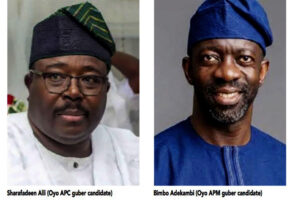
INEC’s updated list contains 16 candidates, including Bimbo Adekanmbi of the Allied Peoples Movement (APM), Senator Sharafadeen Alli of the APC, Oriyomi Hamzat of Accord, Taofeek Adegboyega Adegoke of the ADC and Hazeem Gbolarumi of the PDP.
Political history of the state showed that the governorship position of Oyo State has been alternating between political parties.
The Agodi Government House in Ibadan was occupied from 1999 to 2003 by the late Alhaji Lam Adesina of Alliance for Democracy (AD). He was succeeded by Senator Rashidi Ladoja of the PDP from 2003 to 2007.
He was impeached for 11 months before he was reinstated by the Supreme Court. His deputy. Otunba Adebayo Alao-Akala, served as governor during the period, while Alhaji Hazeem Gbolarumi was his deputy then.
After Ladoja was reinstated, Alao-Akala went back to his deputy governorship position, and Gbolarumi was out of government.
Ladoja was interested in seeking re-election and Alao-Akala was also interested in the poll. The PDP governorship primary for the state was held in Akure, the capital of Ondo State in 2006. The exercise produced Alao-Akala, who went ahead to win the poll. He governed the state as PDP governor from 2007 to 2011.
From 2011 to 2019, Senator Abiola Ajimobi was the governor on the platform of APC. He was elected on the ACN platform in 2011. The party merged with some other political parties to form APC before 2015.
The incumbent governor, Seyi Makinde, was elected in 2019 and re-elected in 2023 on the platform of PDP.
However, he formed an alliance with APM in May this year, due to internal crisis within PDP. Subsequently, the PDP structure in the state was moved into APM, which produced Bimbo Adekambi as its governorship candidate for next year’s gubernatorial poll.
Among the leading contenders is Senator Sharafadeen Abiodun Alli of APC. He has unveiled his manifesto, christened ‘My Pact’, in which has introduced a more detailed set of development commitments into the emerging debate.
The APC candidate has promised to grant local government autonomy from his first day in office, establish a N10billion youth fund, increase the state’s internally generated revenue to N150billion annually without imposing additional financial burdens on residents and businesses, and make Oyo one of the three largest state economies in Nigeria.
The manifesto, presented to representatives of community development associations, professional bodies, artisans, traders, politicians, labour leaders and other stakeholders in Ibadan, is built around seven pillars under the acronym OYO AHEAD.
The pillars cover local government autonomy, advancement of infrastructure, health reform, education and employment, agriculture and export, digital economy and security.
In the same vein, the contest, for Bimbo Adekambi of APM, offers an opportunity to present a development proposition anchored on his experience in public administration and his previous service as Commissioner for Finance under the late Governor Abiola Ajimobi.
He is enjoying the support of Governor Seyi Makinde, who is the presidential candidate of APM.
He pledged to increase the state’s internally generated revenue (IGR) without imposing additional tax burdens on residents, while promising to strengthen fiscal discipline, transparency and accountability, if elected governor in 2027.
He argued that the Supreme Court’s 2024 judgment on local government financial autonomy required legislative and executive action at the federal level. He added that a state governor could not independently deliver the autonomy being promised by some politicians.
The APM candidate said he would instead focus on addressing the practical challenges facing local governments under the existing financial arrangement, particularly the payment of salaries and pensions, transparency in the management of public funds and citizens’ participation in determining spending priorities.
According to him, the Joint Account Allocation Committee (JAAC) arrangement in Oyo State is linked to the financing of obligations, such as teachers’ salaries, pensions and other statutory responsibilities.
On revenue generation, Adekambi promised to consolidate the achievements of Governor Seyi Makinde’s administration by expanding the tax base, improving digital revenue collection and educating residents and businesses about their tax obligations.
He also promised greater use of digital technology and financial technology to block revenue leakages, harmonise tax codes and improve reconciliation with federal revenue systems.
“We don’t need to increase taxes on people. No, no, no. At least because of the hardship in the country right now, we can expand, enlighten, digitise and put more structure, and the tax will continue to grow,” he said.
He identified revenue stability, expenditure stability, budgeting, transparency and civic participation as five pillars of fiscal stability.
The APM candidate also pledged to strengthen judicial autonomy and improve the administration of justice through better funding, infrastructure and manpower planning.
On healthcare, Adekambi said he would consolidate the Makinde administration’s investments in primary healthcare facilities and community health workers.
He said the state had constructed more than 260 primary healthcare centres across its wards and recruited over 2,000 community health workers.
However, he identified coordination among federal and state healthcare agencies, improvements to secondary healthcare facilities and stronger engagement with tertiary institutions as areas requiring attention.
On education, Adekambi said his priorities would include classroom infrastructure, school security, teacher retention, digitalisation and reducing the number of out-of-school children.
He also identified youth development, the digital economy, civil service reform and capacity building as additional priorities in his policy framework.
On sports, he pledged sustained investment in Shooting Stars Sports Club (3SC) and the establishment of academies for different sporting disciplines.
Adekambi said his manifesto was designed to enable residents to assess his performance against clearly defined commitments.
For Accord’s Oriyomi Hamzat, the contest offers an opportunity to convert his considerable public recognition and media profile into a persuasive programme of governance.
His candidacy has attracted attention because of his grassroots engagement and public communication background.
An Ibadan-based public affairs analyst, Mr. Ola Ogunsola, said on Hamzat: “Political visibility and popularity are not substitutes for a comprehensive development strategy. He will need to explain his priorities for infrastructure, education, healthcare, security, employment and economic development.
“More importantly, voters will want to know what his first-year priorities would be, how he intends to finance them and what measurable improvements residents should expect.”
Also, Agboyega Adegoke of the ADC also has an opportunity to present an alternative approach to Oyo’s development challenges.
He has unveiled his nine-point SOLUTIONS agenda, covering security, organic agriculture, livelihood and job creation, urban renewal, healthcare and education, industrialisation and infrastructure, teachers’ welfare, technology, and socio-economic development.
Under his proposed security plan, Adegoke promised community-based policing involving traditional rulers, local leaders and youth patrol groups, supported by stipends, training, equipment and technology.
He also promised to rehabilitate at least 10 inner roads in each of the state’s 33 local government areas within his first 100 days, amounting to 330 roads.
On agriculture and industrialisation, he proposed improved seeds, more extension workers, better market access and measures to reduce post-harvest losses.
He said he had identified 64 moribund industries for possible revival, while promising to pursue gas supply to Ibadan, optimise the dry port established by the Federal Government around Moniya/Ijaye, and develop a 5,000-hectare cocoa project in Oluyole.
His infrastructure agenda includes a proposed three-phase railway connecting Moniya to Iseyin, Iseyin to Okeho, and Okeho to Saki, estimated at about $300 million. He said the project would require collaboration with the Nigerian Railway Corporation and relevant federal agencies.
Adegoke pledged to respect local government autonomy, ensure transparent council budgets and improve accountability.
He also proposed monthly stipends for residents aged 75 and above, arguing that the programme could be funded by cutting wasteful expenditure.
On electricity, he cited the Electricity Act 2023 as an opportunity for state-led power generation and distribution
He proposed an Oke-Ogun solar farm, a gas-powered plant for Ibadan and interventions involving Ikere Gorge Dam and Eleyele dams.
The chartered accountant and agricultural economist said his experience at Deloitte and Schlumberger, alongside 35 years of managing industrial relations involving NUPENG and PENGASSAN, had prepared him for governance.
He also cited his philanthropic interventions, including N20million for the rehabilitation of an agricultural farm at Obafemi Awolowo University, Ile-Ife, and scholarships for outstanding agriculture and physics students at Ladoke Akintola University of Technology (LAUTECH), Ogbomoso.
Also, the governorship candidate of PDP, Hazeem Gbolarumi, said he would offer a credible alternative.
He added that his programme would address infrastructure, education, healthcare, agriculture, security and employment.
The verdict belongs to voters
An editor with special interest in politics, Dr Taiwo Adisa, said during a recent training for journalists, organised by the International Press Centre (IPC) that the 2027 governorship elections and other polls would offer residents of Lagos, Ogun, Oyo and other states an opportunity to determine the political and developmental direction of their states for the next four years.
He urged the candidates to demonstrate that their programmes go beyond familiar campaign declarations.
Political parties, according to him, must explain what distinguishes their development models, while candidates with previous public service experience must be prepared to defend their records.
“For the media, the responsibility is to move beyond the routine reporting of political rallies, endorsements, defections and campaign exchanges to interrogate the substance of the candidates’ proposals.
“The ultimate test of leadership is not the number of promises made during campaigns but the capacity to translate public resources into measurable improvements in people’s lives.”