Follow Us on Google

From Taiwo Ogunniyi, Ilorin
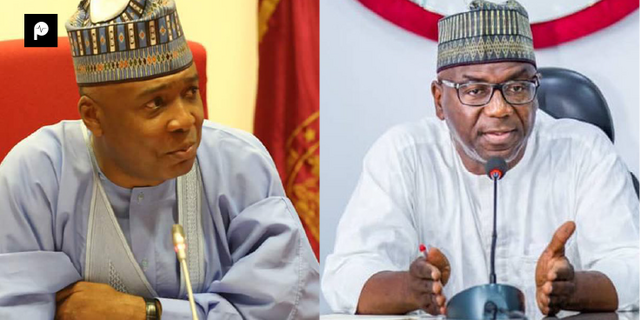
For more than two decades, the struggle for political supremacy in Kwara State has revolved around influential personalities, competing power blocs and the ability of political leaders to keep their followers together. But as the state approaches the 2027 general election, the contrasting experiences of former Governor Bukola Saraki and incumbent Governor AbdulRahman AbdulRazaq are raising fresh questions about godfatherism, party supremacy and the price of political control.
While Saraki who inherited a formidable political structure from his late father, Dr Olusola Saraki, eventually lost his grip on the state following the 2019 election, AbdulRazaq, who rode to power on the back of the anti-godfatherism movement, now faces complaints from party members over candidate selection, internal disagreements and the handling of dissent.
The emerging political contest suggests that the lessons of Saraki’s downfall may be shaping his approach to the 2027 election, even as AbdulRazaq confronts challenges that could test the unity of the political platform that brought him to power.
Saraki’s political journey offers a useful starting point for understanding the present situation.
His father was one of the most influential political figures in Kwara, building a formidable network of loyalists and allies that endured through successive political dispensations.
During the Second Republic, the elder Saraki established himself as a kingmaker by backing candidates for governorship elections under the National Party of Nigeria (NPN). When disagreements emerged between him and a sitting governor, he demonstrated his ability to redirect political support towards an opposition candidate, who won the 1983 election.
His influence remained evident during the aborted Third Republic, when his preferred candidate of the Social Democratic Party won the governorship election in 1991 and assumed office in January 1992.
The return to civilian rule in 1999 further demonstrated the elder Saraki’s political reach. His preferred candidate, running on the platform of the All People’s Party, won the governorship election, while the party secured a majority in the state House of Assembly.
However, the relationship between the political godfather and his anointed governor eventually deteriorated, setting the stage for another decisive contest in 2003.
That year, the elder Saraki backed his son, Bukola, against the incumbent governor, who had previously enjoyed his support. Bukola Saraki won the election, demonstrating that the family’s political machinery could survive a change of candidate and remain relevant to the state’s electoral calculations.
Saraki’s victory in 2007 consolidated his position. Having secured a second term, he increasingly emerged from his father’s shadow, positioning himself as a political force in his own right.
The defining moment came in 2011, when Saraki supported a governorship candidate against his father’s preference. His candidate won, while Saraki himself secured election to the Senate. The party also won the other National Assembly seats contested in the state.
The victory represented a decisive transfer of political authority from father to son. When the elder Saraki died in 2012, Bukola had already established the structure needed to assume leadership of the family’s political establishment.
By 2015, he had consolidated that influence. His preferred governorship candidate secured a re-election, while he won another Senate term and subsequently emerged as President of the Senate.
Yet, the political structure he inherited and strengthened would eventually become vulnerable to the same complaints that had shaped earlier struggles within the state.
Although both father and son exercised considerable influence over candidate selection, their approaches to managing political relationships appeared to differ.
The elder Saraki was widely regarded as a politician who maintained close personal relationships with party stalwarts and supporters, despite his considerable financial influence. His political network was built not only around electoral calculations but also around personal loyalty and a sense of accessibility.
His son, by contrast, faced allegations from some associates that he was less accommodating and too distant from party members. Critics also complained about the concentration of decisions on candidates in the hands of a single political authority.
Another source of discontent was the perception that some aspirants were encouraged to contest party primaries even when the preferred candidate had allegedly already been determined.
Such complaints, alongside dissatisfaction with the handling of minority interests, gradually contributed to resistance within the political establishment.
The revolt eventually crystallised in the Otoge movement, which means ‘enough is enough,’ became a rallying cry against the concentration of political power in the hands of one individual.
The message was captured in the expression, ‘A fe mi fun e mo,’ loosely translated as “We no longer want the practice of someone handing power to us or deciding for us.”
The movement brought together politicians who had opposed Saraki for years and others who had previously belonged to his political camp but had become dissatisfied with the existing arrangement.
Their alliance transformed the 2019 election into a referendum on Saraki’s political dominance.
AbdulRazaq emerged as the All Progressives Congress (APC) governorship candidate and defeated the incumbent, Abdulfatah Ahmed, who was backed by Saraki’s political structure.
The APC also secured victories across the state, marking a dramatic reversal of the political order that had prevailed for years.
The party repeated the feat in 2023, when AbdulRazaq won a second term and APC candidates secured victories in other contests. The results reinforced the perception that the Otoge movement had successfully established a new political order in Kwara.
However, the political challenges facing the APC ahead of 2027 suggest that the movement’s founding principles may once again be under scrutiny.
Complaints about candidate selection emerged prominently during the party’s preparations for the 2023 elections, when some members accused the governor of imposing candidates on the party.
Other News
The controversy has since deepened, particularly following the latest round of governorship primaries.
According to accounts of the exercise, AbdulRazaq announced his preferred aspirant shortly before the initial primary was scheduled to take place. The exercise was subsequently cancelled and rescheduled, after which a different candidate emerged as the winner.
The development angered some aspirants, including the candidate previously endorsed by the governor. They alleged that the eventual winner had been imposed on the party and called for their grievances to be addressed.
Although the party established a committee to examine the complaints, some aggrieved members remained dissatisfied with the outcome.
The controversy has revived concerns about the influence of political leaders over party primaries and the extent to which aspirants are allowed to compete on equal terms.
The allegations have also been accompanied by complaints about the distribution of other elective tickets, with some party members arguing that the governor’s political associates have benefited at the expense of other loyalists.
AbdulRazaq’s supporters may argue that leadership necessarily involves making difficult political choices. Nevertheless, the discontent among some party members presents a challenge for a party preparing to defend its electoral dominance.
Another issue concerns the treatment of dissenting opinions.
While some critics acknowledge that AbdulRazaq maintains relatively accessible personal relationships with party members, they complain that consultations do not always translate into action on the concerns raised by stakeholders.
The distinction is important in a political environment where the management of grievances can determine whether defeated aspirants remain within a party or seek alternatives.
The APC’s challenge is particularly significant because its victories in 2019 and 2023 were supported by a broad coalition of politicians and interest groups united by their opposition to the old political order.
If that coalition fragments, the party could enter the next election without the degree of cohesion that strengthened its previous campaigns.
Some aggrieved members have already left the APC for other political platforms, prompting renewed reconciliation efforts aimed at restoring confidence among those who remain in the party.
The success of these efforts may determine whether AbdulRazaq can lead the APC into the 2027 election with the same political strength that characterised its previous victories.
Meanwhile, for Saraki, the experience of losing power appears to have encouraged a different approach to coalition-building.
As he prepares to lead the Peoples Democratic Party (PDP) into the next electoral contest, the former governor has supported arrangements intended to attract influential politicians and strengthen the party’s chances across the state.
Unlike in the period when his political structure dominated Kwara, the current strategy appears to place greater emphasis on accommodating interests outside his immediate circle.
Some influential politicians who have defected from the APC have secured PDP tickets for senatorial and other elective positions, suggesting an effort to build a broader coalition capable of challenging the ruling party.
Saraki is also not personally contesting an elective position in the forthcoming election, leaving him to concentrate on the party’s overall electoral prospects.
His preferred governorship candidate emerged through a consensus arrangement. Although the candidate is not regarded as a veteran politician, his emergence has been interpreted as an indication that Saraki may be prioritising electoral viability and the capacity to contest the governorship rather than simply installing a political loyalist whose career depends entirely on his patronage.
Whether this approach will translate into electoral success remains uncertain. The PDP must still convince voters that it has moved beyond the political practices that contributed to its defeat in 2019.
Nevertheless, Saraki’s willingness to accommodate influential figures from outside his traditional political circle suggests that his experience has influenced his calculations.
The former governor’s challenge is to demonstrate that political leadership can be exercised through negotiation and consensus rather than the unilateral control of party structures.
AbdulRazaq, on the other hand, faces the task of sustaining the coalition that brought him to power while managing the competing ambitions of party stakeholders.
The two politicians, therefore, approach 2027 from different positions. Saraki is seeking to rebuild a political structure weakened by the Otoge revolt, while AbdulRazaq is attempting to preserve an established electoral advantage amid internal disagreements.
The irony is that the criticisms now confronting the APC leadership bear similarities to some of the grievances that fuelled the movement responsible for Saraki’s political setback.
Yet, the circumstances are not identical. The APC retains the advantages of incumbency, an established political structure and the electoral victories of 2019 and 2023. The PDP, meanwhile, must convert its emerging alliances into a credible statewide campaign.
Ultimately, the 2027 contest may test more than the popularity of individual candidates. It could determine whether political parties in Kwara can manage internal competition without alienating the very supporters whose loyalty sustains their electoral strength.
Saraki’s experience demonstrates that a formidable political structure can unravel when its members believe their interests and aspirations are being disregarded. AbdulRazaq’s current challenge is to ensure that the coalition that dismantled the old order does not become vulnerable to similar grievances.
For Kwara’s political leaders, the lesson is straightforward: electoral victories may establish authority, but the ability to listen, accommodate competing interests and maintain party unity could determine how long that authority survives.