Follow Us on Google

By Damiete Braide
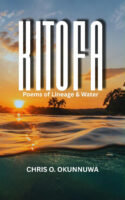
Chris Oriyomi Okunnuwa, KITOFA: Poems of Lineage & Water, Rayany Publishing, Aberdeen, UK. 2024
This collection of poems, divided into six parts, an epilogue (CODA), and a glossary, is deeply rooted in African literary imagery.
It draws raw, sensory patterns from ritual, water, land, and the oral traditions of the Ilaje (a Yoruba coastal tribe), carrying them directly into the modern diaspora. Yet, it does so with breathtaking simplicity and a deliberate, rhythmic cadence.
It is, above all, a journey through time.
Chris Oriyomi Okunnuwa, a Nigerian poet based in Manchester, builds KITOFA from vivid images rather than explanations. The collection follows a family’s trajectory from the Ilaje creeks to the UK diaspora, functioning as sustained imagist poetry in which ritual, cloth, fire, land, and water carry the weight of meaning.
KITOFA is a name with a journey inside it.
It is the Ilaje rendering of “Christopher”, a name the collection notes was alien to the soil, brought by the missionary tide, and bent by the poet’s people into something of their own. It belonged first to the poet’s grandfather, and his grandson carries it forward as Chris: “I carry, / though his time was never mine to know.”
As the title states, this is a collection of lineage and water. Instead of merely analysing inheritance, it forces the reader to bear witness to the aching, scarred weight of time. It beautifully bridges the sensory heritage of a coastal community with a contemporary diasporic experience where identity must be fastidiously woven from memory and fractured histories. Thus, it immerses the reader in a deeply moving, thought-provoking, and incredibly gripping narrative.
The imagery throughout is exact. In “The Drowned Ledger,” a colonial tax collector’s record is left scattered, its black ink dissolving in brown water, a striking image of imperial administration and authority being undone by the creek. In “The Man Who Didn’t Take Off His Agbada,” water runs from the sleeves of a garment of dignity, turning the physical body into a direct channel for the river.
The language remains spare, allowing the pictures to do the heavy lifting.
Other News
Okunnuwa deftly deploys various literary devices to convey his message. Prominent among these is a sensory, tactile use of personification and metaphor; an outboard engine holds a “lone, screaming note,” boat blades “slice” the black water, and the sun aggressively “bakes the concrete.” The structural forms shift fluidly with the subject matter. “The Scar” and “The Drowned Ledger” function as documentary narratives, utilizing plain, declarative lines and grounding the reader in specific, named places like Idumagbo and Abokisi. In contrast, “Before the Coffin Closed” turns toward the solemnity of an elegy, while “Adesewa” softens into tenderness.
The poet handles ritual imagery with remarkable control. Cultural elements like blood, salt, fire, yam, cloth, drumming, and prayer are never used merely for exotic effect; instead, they anchor profound social and spiritual meanings.
To preserve this linguistic authenticity, Yoruba and Ilaje words sit unexplained directly within the lines, though a glossary is provided at the back for readers who wish to look deeper.
The collection’s sharpest irony sits just beneath the surface. The original Kitofa meets the Crown’s collectors with fierce refusal: “I am paying no shishi to any colonial master.”
His grandson carries his name, yet has complied with the tax obligations his grandfather rejected and has worked within the British state, the very authority his ancestor resisted and fled. Okunnuwa never explicitly argues this contradiction; he simply lets an image hold it. In “Holding the Line,” the speaker is a prince of the creek stewarding a King’s coronation: “Rain slid off the velvet, struck my vest instead.”
The velvet is shielded while the servant gets wet; rank, inheritance, and service at Westminster Abbey meet in a single downpour.
The range of the collection is real, though not every poem sustains it perfectly. Some narrative pieces occasionally explain what a further image might have shown, and personification, the book’s favourite device, can sometimes arrive a little too frequently. These are small lapses, however, in a book whose core methodology is incredibly sound.
The coda, “The Same Current,” gathers the book’s motifs into a powerful final lament: “An ocean lies between the cradle and the bone. / The tide washing my shoes here is cold, / the water of the creek is ever warm.” Here, water holds the entire collection together as an emblem of memory, passage, loss, and return. When Kitofa finally turns his canoe home, the empire is gone, and the poem ends plainly, beautifully, and permanently: “The river remained.
This collection of poems, divided into six parts, an epilogue (CODA), and a glossary, is deeply rooted in African literary imagery.
It draws raw, sensory patterns from ritual, water, land, and the oral traditions of the Ilaje (a Yoruba coastal tribe), carrying them directly into the modern diaspora. Yet, it does so with breathtaking simplicity and a deliberate, rhythmic cadence.
It is, above all, a journey through time.
Chris Oriyomi Okunnuwa, a Nigerian poet based in Manchester, builds KITOFA from vivid images rather than explanations. The collection follows a family’s trajectory from the Ilaje creeks to the UK diaspora, functioning as sustained imagist poetry in which ritual, cloth, fire, land, and water carry the weight of meaning. KITOFA is a name with a journey inside it.
It is the Ilaje rendering of “Christopher”, a name the collectio the reader to bear witness to the aching, scarred lone, screaming note,” boat blades “slice” the black water, and the sun aggressively “bakes the concrete.” The structural forms shift fluidly with the remained.