Follow Us on Google

By Damiete Braide
Joshua Alabi’s two-hander from Lagos played a university lecture hall in London and a festival stage in Liverpool within three weeks.
Taken together, the two engagements show a play that works both as argument and as drama.
Waterside begins with an act so small it risks sounding like a joke: two boys kill a chicken. In the world Joshua Alabi builds, however, the bird is a family totem belonging to a respected elder, Pa Barclays, and its death is an offence against the order that holds a community together.
The play’s central achievement is to take the gap between what the act means to a child and what it means to a village, and make that gap carry an entire drama.
Written and directed by Alabi for Kininso Koncepts, Waterside: The Sea of Broken Dreams is set in the Niger Delta and follows Osarume and Oghenovo, childhood friends who return to the waterside where the incident lies buried. Memory is the engine. The return drags old events back into view, and the play lurches, deliberately, between humour and tragedy as it does so. It premiered at the MUSON Centre in Onikan, Lagos, in December 2023, and in March 2025 it reached Britain.
The most interesting decision in the writing is what Alabi withholds. He does not allow the conflict to settle into a question of right and wrong. A play that sided with the boys would read as a rebuke to belief, and one that sided with the elder would read as an apology for it.
By keeping both claims alive, Waterside asks its audience to weigh personal freedom against communal responsibility, and then to ask who wrote the rules in the first place, and who pays when they are broken. Tradition is treated as neither wholly sacred nor entirely disposable, a position that is harder to dramatise than either extreme and more honest than both.
Around that core the play gathers the weight of the region, poverty, environmental degradation, oil exploitation and the search for opportunity among young people. Any work that loads a personal story with so much social freight runs the risk of turning its characters into case studies. What reporting on the production suggests is that Waterside guards against this by keeping the friendship at the centre.
The Delta’s troubles arrive as the conditions of two lives rather than as speeches delivered at the audience, and the question of home, what it means and what it costs, binds the personal and political strands together.
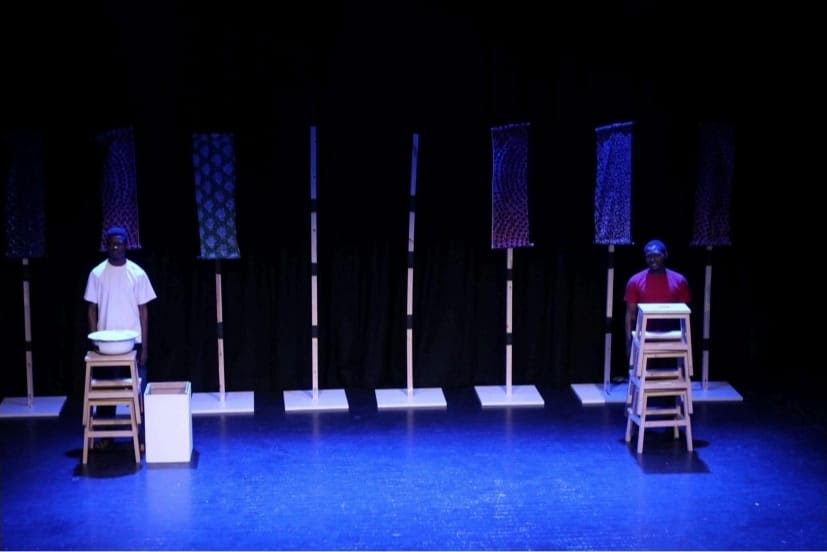
The form is as demanding as the content. Stanley Okeke and Edgar Eriakha carry the whole play between them, moving through multiple characters with movement, gesture and voice, supported by music, sound and a storytelling style that leans toward the poetic. With minimal props, the burden of making each new person legible falls on the body.
Liverpool viewers noticed as one of the audience members in a social media video feedback called it “a very powerful performance, very emotionally charged”, and praised transitions so smooth that they did not interrupt the story. Another audience member found the physicality “really phenomenal”, observing that with very little in the way of props the pair told “such a compelling story, embodying different characters”.
A two-hander looks effortless only when the machinery around it is exact, and the production credits read best as an account of that machinery. When scenery is pared back, clothing becomes grammar, the means by which an actor announces that a new person has entered, so Joy Akrah’s costume design, assisted by Kafilat Afolabi, did more than dress the stage, it underwrote the carefully defined character changes that audiences praised.
Sound plays a similar role. Eniayo Oluwaseyi’s sound design, with Blessing Okunlola leading technical delivery and Yemi Adeojo and Samuel Alabi assisting, supplied the cheapest and most flexible form of place-making available to a show that gives up a set, letting the waterside exist in the ear. Behind the performers, stage manager and assistant David Adewusi and Isreal Audu held the rhythm that keeps rapid transitions from tipping into confusion.
The less visible work mattered just as much to a production that had to travel. As producer, Angela Peters held the project together across two countries and three kinds of events: a workshop, a rehearsed reading, and a full staging.
Chinenye Chukwudi’s administration and the logistics handled by Oloyede Aribilola, assisted by Nnamdi Agbo, Augustine Obende and Uche Onah, turned that ambition into a schedule that could be kept. This further evidences the ensemble way of working for the Kininso group, as experienced through their many performances. Over time, performers and team members learn and build the capacity to work in other production arms. This is what theatre making in Nigeria entails.
And a final group made sure the work reached beyond the rooms it played, Qoyyum Areoye on content, Caleb Ihenyen and Omosede West-Erhabor on communications, Emmanuel Joseph on media and post-production. Okunlola, notably, was also the photographer of the group portrait from the London workshop.
London came first, on 4 March, at King’s College London, as part of Africa Week run by the university’s African Leadership Centre, organised by Dr Ella Parry-Davies of the Department of English with support from the Global Cultures Institute.
The day opened with a workshop in which participants, from undergraduates to professors, artists and producers, played physical drama games, learned songs together and turned their reflections into short pieces of poetry and music on migration, climate and coloniality. It was an unusually direct demonstration of how Kininso makes work, drawing on lived experience and group exploration rather than treating theatre as something delivered from a stage.
The performance that followed was a rehearsed reading, which is a stern test for any play, it strips away staging and leaves text and voice to do the work. Okeke and Eriakha improvised around the limits of a lecture hall and, by the account of the university, conjured a fraught family dynamic through several characters and held the room. That a play built on physical storytelling survives in such conditions says something about how much of it lives in the writing.
The panel that followed read the play from outside theatre, and its most perceptive contribution came from Dr Clement Sefa-Nyarko of the African Leadership Centre, who argued that humans must see themselves as “of the environment, not outside of it”, and who found that view reflected in the play’s animism. It is a good reading. A totem is, among other things, a statement about how people relate to living things, so the offence in Waterside is not merely social but ecological, and the oil-ravaged setting gives the idea bitter irony. Raidat Karim, a PhD student, drew attention to the bonds of friendship and youth-led movements in Nigeria, which the play also stages.
Dr Adelene Buckland read a South African poem on gold mining and its toll in pollution, illness and bereavement, placing the play in a wider literature of extraction. The chair, Annabel Ali, a King’s PhD student, kept these strands in conversation. Alabi said the exchange contributed immensely to the development of the work, and Dr Jarad Zimbler of the Global Cultures Institute called it exactly the kind of event the institute was created to support.
Liverpool came on 23 March, at the Capstone Theatre, Liverpool Hope University, as part of the Angel Field Festival, and was billed as the play’s international premiere. Where London pulled Waterside toward argument, Liverpool pulled it toward feeling, and the audience comments are telling. The audience member who said that, although the story belonged to the past, it “still tells the story of Nigeria today”, identified the play’s real reach, it is rooted in a specific place and a specific set of beliefs, yet it does not read as a period piece.
Seen together, the two engagements describe a play that is still in motion. The scholars in London heard an ecological parable and a study of youth solidarity; the festival audience in Liverpool heard a living account of a country.
That one text can sustain both readings is a sign of its density, and the fact that Alabi credits the London discussion with feeding the work’s development suggests it remains unfinished business for its makers. It is the right condition for a play that is about unfinished business, the memory that will not stay buried, the rule that will not stay unbroken, and the community left to decide what it owes to both.
For Kininso Koncepts, the British stops belong to a continuing commitment to telling stories rooted in African experience while making room for exchange across cultures. Waterside leaves its audiences with questions rather than verdicts. Who determines the rules by which a community lives, what follows when a child breaks one, and who bears the cost when things fall apart? They are not questions that stay in the Niger Delta.