Follow Us on Google
By Mallam Usman Jubril
Governor Uba Sani of Kaduna State deserves a second term. He’s earned it. His achievements so far, eloquently recommend that he should be voted for a second term in office. He is not a politician for the sake of being one. He is a politician who knows the meaning, value and how to deliver service to the people. Already, he has emerged as the All Progressives Congress (APC) candidate for the February 6, 2027 gubernatorial election in Kaduna State by securing 459,393 affirmation votes at the party’s May 2026 primary. He was the sole aspirant, a development that speaks to the high level of cohesion and unity within the party in the state.
He will, therefore, be going into the contest as an incumbent with a huge assets of positive record of achievements in the last three and a half years that he has been in the saddle as the governor. His administration has been flaunting its performance in roads construction, reopening of schools, upgrading of health facilities, unprecedented increase in agricultural investments, social and welfare programme initiatives, peace and security policies, fostering socio-political and ethno-religious harmony across the state among many other achievements. The administration and the party have strongly advanced the argument that Governor Sani deserves re-election for a second term in office. It is the right call.
Perhaps, the most consequential part of the Sani story is the efforts at restoring something without which no other project can have lasting value: peace and security.
When the administration assumed office in May 2023, Kaduna was neck deep in a serious security crisis. It was being buffeted from all sides by banditry, kidnapping and communal tensions. The administration therefore placed safety and security at the centre of its seven-point development agenda. Its approach has subsequently become known as the Kaduna Peace Model. Through it, the incidences of violent crimes of banditry, kidnapping and such like crimes have drastically reduced to a level never expected. The distinctive feature of the model is that it does not treat security exclusively as a military or policing problem. The governor has consistently argued that sustainable peace requires a combination of intelligence-led operations, inter-agency cooperation, community engagement, dialogue, justice, economic opportunity and social inclusion.
In April 2026, the governor described the Peace Model as an approach anchored on inclusivity, intelligence-led operations, inter-agency coordination and community ownership, saying it had shifted the state’s posture from reactive containment to proactive prevention.
That philosophy is reflected in practical measures. Working with the Office of the National Security Adviser and military authorities, the administration established new military bases in high-risk areas including Giwa, Birnin Gwari and Southern Kaduna. It also reported the deployment of more than 150 operational vehicles and 500 motorcycles to security agencies, alongside the creation of a Joint Task Force in urban areas.
The administration has also institutionalized peace dialogues, established local peace councils and introduced early-warning mechanisms designed to identify tensions before they escalate. It has also pursued rehabilitation and reintegration as part of its non-kinetic strategy, emphasizing skills acquisition rather than simply financial inducement.
As a result, more than 20,000 hectares of previously inaccessible farmland have been reclaimed, allowing farmers in places including Birnin Gwari, Giwa and Kargarko to return to productive activity. The government has also reported the resettlement of more than 1,000 displaced persons and targeted support for more than 117,000 internally displaced persons, particularly women and children.
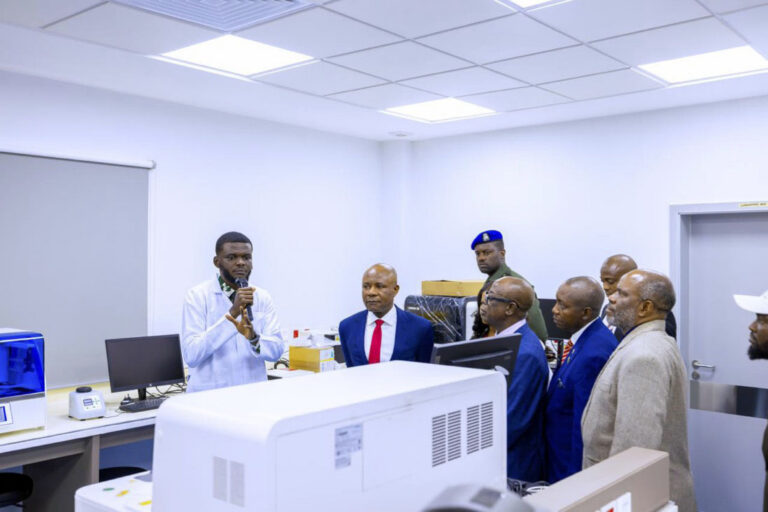
The administration has further established what it describes as the first forensic laboratory in Northern Nigeria and introduced the Kaduna Incident Report Centre, or KAD-IR, as a 24-hour emergency-response platform. According to the governor, these measures are complemented by early-warning systems designed to detect and defuse tensions before they become full-blown conflicts.
Interestingly, the Kaduna Peace Model has attracted attention beyond the state. In May 2026, the National Institute for Security Studies commended the progress achieved through the Kaduna Peace Model.
Even more significant was the establishment in May 2026 of the Kaduna State Disarmament, Demobilisation and Reintegration, Peace and Security Committee. This is first of such state-level committee to be inaugurated in Nigeria under the national DDR framework facilitated by the Office of the National Security Adviser and the National Counter Terrorism Centre. The initiative is intended to address the circulation of arms, dismantle violent structures and facilitate the reintegration of individuals willing to abandon violence.
Today, the governor’s Kaduna Peace Model stands as one of its kind in the country as a policy initiative for the restoration of peace and security in a hitherto beleaguered state.
Another very visible achievement of the Sani administration has been in infrastructure development. According to figures presented by the state government and independently verified, the administration has undertaken about 140 road projects covering approximately 1,335 kilometres, with 64 already completed by the end of 2025.
In a state as geographically extensive and economically diverse as Kaduna, roads determine whether farmers can move produce to markets, whether rural residents can reach hospitals and schools, and whether businesses can move goods efficiently between communities. Besides, Governor Sani has also ensured that work continues on inherited projects, while pursuing new road corridors across the state’s 23 local government areas.
This is particularly relevant to rural Kaduna, where the connection between agricultural production and transportation infrastructure is crucial. Today previously inaccessible farming communities are being reconnected to markets as security improves and roads are
opened.
Additionally, Governor Uba Sani has performed so well in his commitment to the agricultural sector. Official figures show that the allocation to agriculture rose from about N1.48 billion in 2023 to N23.40 billion in 2024 and N74.02 billion in 2025, before rising above N100 billion in the 2026 budget. It is the first state in Nigeria to exceed the 10 percent agricultural budget benchmark associated with the Malabo Declaration. The state allocated 11.65 percent of total expenditure to agriculture and food security in the 2026 budget.
The administration has also maintained large-scale fertiliser distribution. In July 2026, Governor Uba Sani announced the distribution of 500 trucks of free fertiliser and tractors to 150,000 smallholder farmers across the state’s 23 local government areas.
More than 100,000 farmers have reportedly been enrolled in agricultural insurance schemes, while the state is implementing the $510 million Special Agro-Industrial Processing Zone with support from the African Development Bank (AfDB).
Yet another sector in which Governor Uba Sani has done well is in education is another area in which the administration He ensured the construction of 736 classrooms, renovation of more than 1,200 existing classrooms, recruitment of 10,000 teachers and training of more than 33,000 education personnel.
The government has also reported a substantial reduction in the number of out-of-school children, from an estimated 550,000 to 187,720 within two years. The figures deserve attention because Kaduna’s educational challenge is not simply about constructing buildings. It involves access, teacher quality, enrolment, retention and the capacity of the education system to prepare young people for employment.
The administration’s establishment of the Institute of Vocational Training and Skills Development is therefore significant. Training in areas such as ICT, mechatronics and renewable energy reflects an attempt to connect education with the requirements of a changing world economy.
Another sector where the records will speak eloquently for Governor Uba Sani is in healthcare delivery. In Kaduna State as we speak, all 255 primary healthcare centres are being upgraded to Level-2 facilities, while 23 Centres of Excellence have been established, one in each local government area. It has also completed the 300-bed specialist hospital which remained unfinished for years in the Millenium City Square in Kaduna and named it after President Bola Tinubu.
The government has also embarked on the rehabilitation and remodeling of general hospitals and the allocation of ₦1 billion towards health insurance for vulnerable residents. The significance of primary healthcare cannot be overstated. For the average resident, the quality of healthcare is often judged not by sophisticated policy documents but by whether there is a functioning facility within reasonable distance, whether medicines are available, whether qualified personnel are present and whether emergency cases can be handled.
One important thing Governor Uba Sani has embarked upon in Kaduna is what could be called political positioning. His choice of Jerry Adams, the Executive Chairman of the Kaduna State Internal Revenue Service, as his running mate has already generated considerable attention. Adams, from Southern Kaduna, is a Christian, and his selection changes the religious composition of the APC governorship ticket from the Muslim-Muslim combination used by the party in the 2019 and 2023 Kaduna governorship elections.
Without a doubt, that decision is bound to produce real political benefit that cannot be dismissed with a wave of the hand. It is the epic demonstration of what has been his systematic and deliberate policy of inclusion, equality, fairness and justice in the running of the affairs of the state, a policy designed to de-escalate tension and known division along ethno-religious and political lines.
All things considered, Governor Uba Sani has recorded substantial success in infrastructure, agriculture, education, healthcare, transportation, peace and security, and above all, creating a new atmosphere of inclusivity, justice and fairness in the state. Therefore, Governor Uba Sani has every reason to feel positive about February 6, 2027. The record is sufficient to secure for him another mandate to be the executive governor of Kaduna State for another four years.
• Mallam Jubril, an Islamic scholar, equal rights preacher and political analyst, writes from Kaduna