Follow Us on Google
By Jude Dangwam, Jos
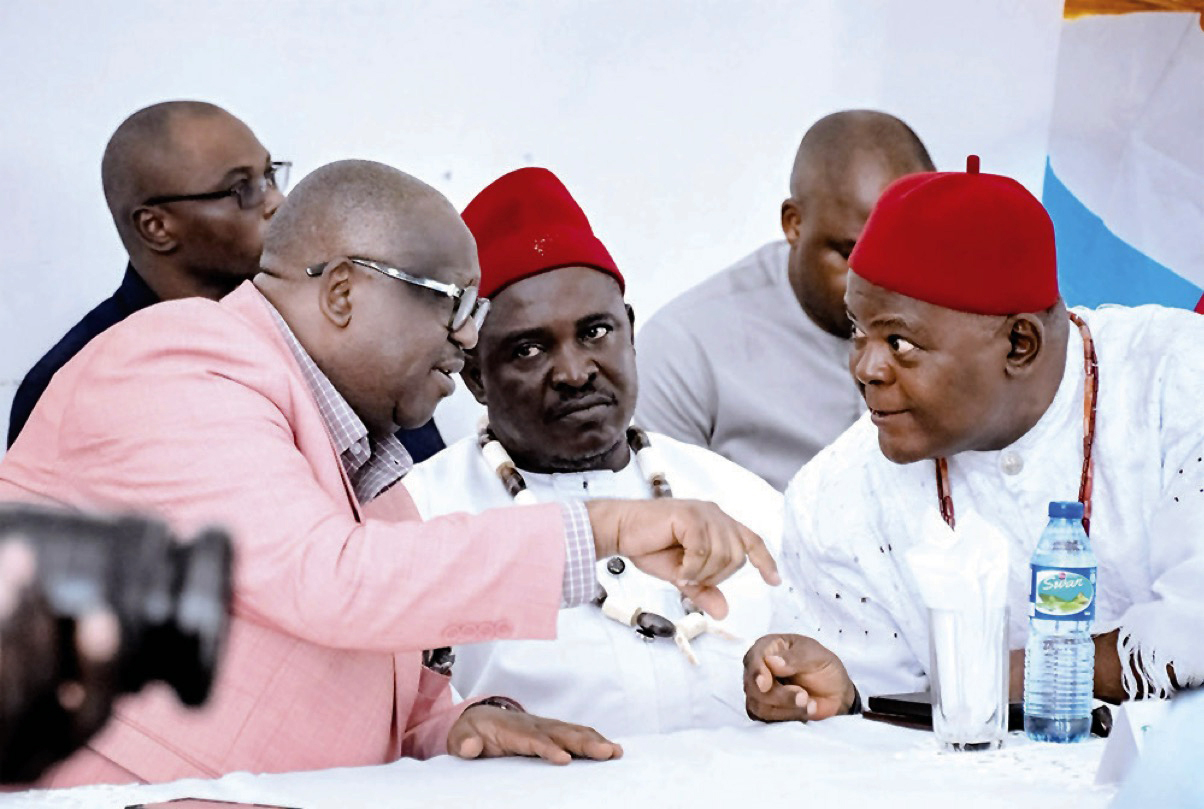
Governor Caleb Mutfwang did not have to host the leaders of Plateau’s Igbo community this week. Yet there he was, welcoming delegates from all seventeen local government areas into Government House in Jos, thanking them for coming to seek what he called blessings and prosperity, and reminding them, unprompted, of a history that stretches back to the civil war. The optics mattered as much as the words, and in Plateau politics, optics rarely happen by accident.
Plateau State has never fit neatly into Nigeria’s ethnic map. Long before the current political order took shape, it became a rare refuge for Igbo families displaced by conflict, and later a magnet for Igbo traders chasing commercial opportunity across the Middle Belt. Mutfwang leaned hard on that history at Tuesday’s meeting, telling his guests that Plateau treated the Igbo far better during and after the war than they experienced elsewhere.
It was a line calculated to do more than flatter. It let him frame his outreach as inheritance rather than invention, a governor simply honouring an old debt rather than shopping for new votes eighteen months before the state next goes to the polls.
But the votes were never far from the surface. Mutfwang thanked the community directly for the overwhelming support they gave him in the 2023 governorship election, gratitude that reads less like nostalgia and more like an opening bid for round two. Plateau’s elections are rarely won by wide margins, decided instead by the fine calibration of ethnic and religious blocs across its central, southern and northern zones.
A governor who locks down a commercially powerful bloc of voters early, well before campaign season forces his hand, buys himself room his rivals will not have. It is no small thing that Mutfwang chose to make this appeal in person, in his own official residence, rather than through a proxy or a written statement. Symbolism of that kind tends to be remembered longer than any press release.
There was also a note of quiet flattery aimed at the Igbo community’s economic weight in the state.
Mutfwang praised their resilience, their enterprise, and what he called their contributions to commerce, industry and wealth creation across Plateau, describing them as brothers and critical stakeholders in the state’s development. This was not simply courtesy. Igbo traders and investors are woven into the commercial life of Jos and the wider state in ways that make their goodwill genuinely consequential for any governor trying to project an image of a peaceful, business friendly Plateau to the rest of the country. Mutfwang’s pledge to protect every law abiding resident and to keep the state secure for investment was aimed as much at that broader audience of prospective investors as it was at the room in front of him.
Other News
Land, inevitably, complicated the mood. Mutfwang told the gathering he had personally closed out one of Plateau’s lingering post war disputes, paying full compensation for property government had seized decades earlier. It was meant to sound like resolution, a governor tying off a loose thread from a painful history and inviting his guests to move forward with him. Instead, it opened the door.
Community leaders used the very same meeting to raise yet another unresolved compensation claim, over property acquired by the state government, ostensibly in the overriding public interest, from one of their members. It was a reminder that these disputes do not stay buried. They simply wait for the next occasion to resurface, and a governor’s public generosity on one file has a way of inviting immediate pressure to repeat the gesture on the next.
Mutfwang’s response, a promise that justice would prevail once legal and administrative processes concluded, was carefully vague, and deliberately so. He is not in a position to fast track land claims in a state this sensitive about who owns what without risking a very different kind of backlash, from indigenous constituencies who watch closely whenever land moves in any direction. Plateau’s politics have, for decades, been shaped by exactly this tension, between welcoming migrant communities whose commerce the state needs and protecting the land rights that indigenous populations regard as non negotiable. Mutfwang’s studied vagueness was not evasion so much as an acknowledgment of how narrow the path actually is.
It was left to Chief Chidi Onah, the Igbo community’s president -general in Plateau, to say out loud what everyone in the room understood. We are Plateau people, he told the governor, but we are not indigenous. I will not answer Pam. I will answer Eze. Delivered with a laugh, the line still landed as a statement of fact rather than a joke, a reminder that in much of Nigeria’s Middle Belt, acceptance and indigeneship are not the same currency. You can be embraced, do business freely, even swing an election, and still not hold the one status that unlocks full rights to land and, in some cases, political office. Onah’s willingness to say this so plainly, in front of the governor and the assembled press, suggests a community that values the relationship enough to be candid about its limits rather than pretend those limits do not exist.
Other community leaders who spoke echoed the same message of loyalty, thanking Mutfwang for sustaining what they described as an inclusive atmosphere in which every ethnic group in Plateau enjoys a sense of belonging. Coming from a community that has, in living memory, faced real uncertainty about its place in the state, that kind of public affirmation is not something any Plateau governor can take for granted, and Mutfwang’s decision to convene this meeting suggests he understands exactly how much work such affirmations require to maintain.
Mutfwang left the meeting having achieved most of what he came for. He reassured a community whose money and votes matter to him, borrowed the credibility of a history that predates his own government, and managed, without actually resolving, a land grievance that could otherwise fester into resentment. He also secured, at least for public consumption, a fresh declaration of loyalty from a community whose support proved decisive in his first election, at a moment when Plateau’s political temperature will only rise as 2027 approaches.
Whether any of it holds when Plateau next goes to the polls will not be decided by the warmth on display in Jos this week. It will be decided by whether the due process he promised on the outstanding land claim actually delivers a result the Igbo community regards as fair, and by whether the governor can maintain the same balancing act with the state’s indigenous constituencies who will be watching just as closely to see whether their own land concerns receive the same public attention. In a state where history, land and belonging remain so tightly interwoven, a single cordial meeting in Government House is unlikely to settle much on its own. What it does is buy time, and in Plateau politics, time bought early is rarely wasted.