Follow Us on Google
From Mohammed Abubakar, Dutse
The Jigawa State Government took another step towards concretising the development of its Tsangaya education system with the conduct of qualifying examinations for teachers who are expected to teach in the Tsangaya schools across the state
Towards achieving a strong and effective take off of the programme, code named:J-Tsangaya, the state government approved the recruitment of 500 teachers to teach both Qur’anic and western model education to run concurrently in its 140 Tsangaya schools spread across the state, comprising 250 Alarammas (Qur’anic teachers), 150 National Certificate in Education (NCE) and 100 degree holders
The breakdown of the existing Tsangaya schools in the state includes three Mega Tsangaya schools located in Dutse, Kafin Hauwa and Ringim, seven Model Tsangaya schools and 130 Integrated Tsangaya schools.
The J-Tsangaya programme forms part of the state government’s ongoing efforts to reform, strengthen and modernize the Almajiri education system. While ensuring that learners receive improved and quality education outcome.
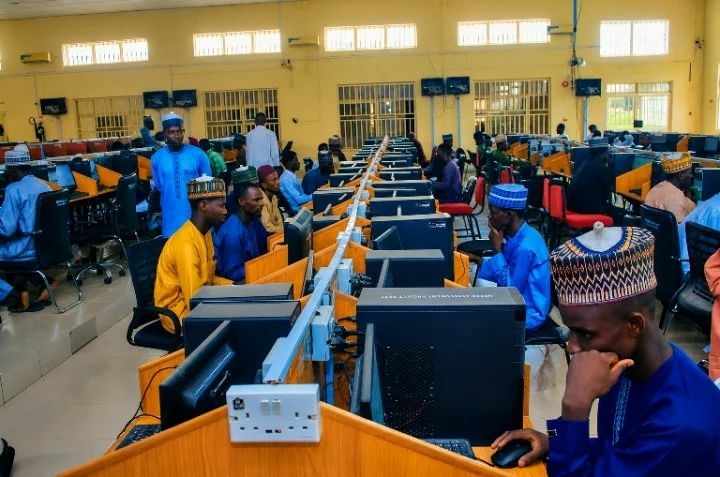
The examinations, anchored by the Jigawa State Tsangaya Education Board were conducted simultaneously in three designated cenred through the Computer Based Test (CBT) method. The centres are the Federal University Dutse (FUD), Dutse a total of 718 candidates sat for the examination, the Jigawa State College of Education, Gumel (JCEO), 961 candidates participated in the exercise and While at the Bilyaminu Usman Polytechnic, Hadejia where a total of 691 candidates sat for the examination
The Executive Secretary of the Board, Dr. Hafis Maje Abubakar,in an interview with newsmen during the monitoring of the examination, said the exercise represents a significant milestone in the state’s continuing strive to build a more organized, inclusive and sustainable Tsangaya education system.
He noted that the board adopted the use of CBT method in order to ensure that only competent and credible candidates were recruited to execute the state government’s reformative agenda of the revival of Tsangaya education system in the state.
He confirmed that on a statewide, 900 candidates applied for the only 500 vacancies, out of which, 3159 candidates were screened and selected. However, the figures from the three centres were 2,370. The examination was conducted peacefully and in an orderly, transparent and well-coordinated manner.
According to him, the 500 teacher’s would be divided into categories of those to teach conventional subjects such as Mathematics, English Language, Computer Science among others while the Alarammas, who are expected to teach the Quran based on Tsangaya settings.
“But for the later category, there wouldn’t be CBT, rather we’re going to conduct screening in order to ensure that the have acquired the relevant knowledge to teach our younger ones”
Maje, who underscored the seriousness of the state government to pursue the revival of the Tsangaya schools system said the state government had demonstrated enough commitment to that purpose, citing the many innovations introduced by the Jigawa state government.
His words, “Indeed, beyond reasonable doubts, Jigawa State government is taking sustainable viable measures to show that the system has come to stay. For instance, look at the transformation that the government is providing by building Tsangaya schools. And even, I can confirm to you that next year we’re going to embark on the construction if new model Tsangaya schools in each of the 27 LGAs in the state, with the approval of the state governor”.
Asked what would be the fate of the unsuccessful candidates in the current exercise, Dr. Maje said, they would be offered another opportunity alongside new ones when the similar exercise would be conducted next year. According to him, “That is the essence of data. Their data has been captured and stored. So, we’re gonna to conduct CBT examination, we’ll give them the opportunity to participate.”
With the successful conduct of the exercise, the ES believed the programme was as good as taken off because every school needs teachers, the learners and the tools, noting that with over 4800 learners on its database, all the ingredients that would make up a school were on the ground.
He projected a brighter future for the Almajiri system in the state, noting that any Almajiri that had access, not only to Qur’anic education, but combined with modern education and a skill to match, could compete with their counterparts in any part of the country.
“Besides, it will go a long way in reducing street begging by our younger ones, because we believe that if a parent realizes that his child/ward could acquire Qur’anic and western education with a skill, they’ll definitely remove them off the street and that’s why we’ve created what we call the Almajiri Free Zone to ensure that only confirmed Almajiris are enrolled into the schools and we’re seriously collaborating with the Alarammas to ensure we achieve that and i can tell you that they’re fully cooperating with us even beyond my expectations.”
He warned that if they are denied access to the schools they’d be forced to go back to the street for begging again, “which means the aim reason for the establishment of the schools would have been defeated from the inception.