Follow Us on Google

I had been woken up by the alarm clock at 4: a.m. Nigerian time, shaking away sleep, tuning fast to the television only to hear the announcer reporting excitedly how Ryan Garcia shook the world by stopping Conor Benn in a spectacular fashion in Round 2. The T-Mobile Arena in Las Vegas was still roaring through the screen. On the screen, a jubilant, dancing 28-year-old American was celebrating his fastest knockout victory in six years. It took him just 85 seconds of the second round to completely dismantle an unbeaten, dangerous challenger.
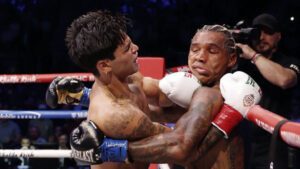
As I sat on the edge of my bed in the quiet morning hours, watching the slow-motion replays of Garcia’s blistering right hand dropping Benn heavily, one massive question flashed across the screen and immediately took over social media: Is Ryan “KingRy” Garcia the next Muhammad Ali?
To old-school boxing fans in Nigeria, comparing any modern fighter to the legendary Muhammad Ali sounds like an absolute abomination. Ali was not just a boxer; he was a god of the ring, a global icon who stood up against governments, and a man who fought through the golden era of heavyweight boxing. To put him in the same sentence as a young man who spends half his life making TikTok videos and fighting wars on Twitter seems ridiculous.
Yet, if you step back from the modern internet drama and look closely at the way Ryan Garcia operates, you will realize why this heavy comparison keeps coming back. Whether you love him or hate him, Ryan Garcia is bringing back a type of psychological entertainment and excitement that boxing hasn’t seen since the days of the “Louisville Lip.”
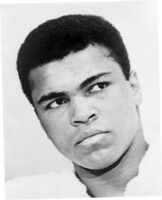
Let us start with the confidence and prediction. Before the fight, Garcia boldly told everyone that he would not need more than five rounds to put Conor Benn to sleep. It sounded like standard noise to sell tickets. It reminded many of how a young Cassius Clay (before he became Muhammad Ali) used to mock his opponents and tell the exact round they would fall to the canvas. When Ali fought the terrifying Sonny Liston in 1964, the entire sports media thought he was a loudmouth clown who was secretly trembling with fear. They even brought in doctors to test his heart rate because they thought he was having a nervous breakdown.
In reality, Ali was playing a psychological game. He was getting inside Liston’s head, making the champion angry, reckless, and unfocused. Ryan Garcia did the exact same thing to Conor Benn. In the weeks leading up to this WBC welterweight title defence, Garcia acted incredibly erratic online. He skipped face-offs, made strange jokes, and had pundits openly wondering if he was mentally fit to even step inside a boxing ring.
Benn walked into that ring expecting an unfocused, soft social media influencer. Instead, he ran directly into a trap. The moment the bell rang, Garcia was a cold, sharp, and brutally fast assassin. He timed Benn’s aggressive rushes perfectly, caught him flush with a right hook that Benn never saw coming, and then closed the show with a devastating flurry against the ropes. Garcia weaponized his own public image to make his opponent underestimate him—a classic page straight out of the Muhammad Ali playbook.
There is also the matter of understanding the media. Muhammad Ali was the king of the television age. He knew exactly how to look into a camera lens, shout a catchy poem, and make sure that every single person in America either paid to see him win or paid hoping to see him get knocked out. Ali knew that in show business, being quiet means you go broke.
Ryan Garcia has perfectly translated that formula for the 21st-century digital world. With tens of millions of followers across his personal platforms, Garcia doesn’t need traditional sports TV networks to promote his fights. He is his own television station. A single late-night live stream or a viral video from him gathers more crowd and financial attention than a multi-million dollar corporate marketing campaign. Like Ali, Garcia understands that modern sports fans don’t just want to watch an athletic contest; they want to buy into a dramatic story.
However, this is where the comparison between the two men hits a massive brick wall.
Ali’s loud mouth and wild predictions were anchored by a deep, unbreakable moral sacrifice. When Ali spoke, he was speaking for Black Americans fighting for civil rights, and he was speaking for oppressed people all over the world. When he refused to fight in the Vietnam War, he sacrificed his titles, his money, and the absolute prime years of his career because of his personal beliefs. He was a revolutionary who used boxing as a platform to change human history.
Garcia’s public battles, unfortunately, often feel small and deeply chaotic by comparison. His drama is usually internal, played out across the internet through mental health struggles, messy public breakups, and constant fights with his own promoters and boxing management teams. While Ali challenged the most powerful governments on earth, Garcia’s online rebellions are usually aimed at securing more lucrative contracts or complaining about boxing judges. His platform is arguably just as large as Ali’s was, but it is built on the unstable ground of internet clickbait, where any attention—even if it is toxic or destructive—is treated like cash.
We must also look at their ring achievements. Ali became the greatest because he survived the most brutal, terrifying heavyweight era in history. He didn’t just win belts; he took the best punches of monsters like George Foreman, Joe Frazier, and Ken Norton, and somehow found a way to win.
Ryan Garcia is an incredibly gifted fighter with hands that move like lightning. Bouncing back from his loss to Gervonta Davis to capture the WBC welterweight title from Mario Barrios, and now defending it so easily, proves he belongs at the top level of the sport. But his resume is not yet legendary. To even sit in the same room as Ali, Garcia cannot just stop contenders.
If he wants history to truly respect him, his next move must be historic. Fresh out of the ring, Garcia has already screamed his next target into the microphone: WBA champion Teofimo Lopez. A unification blockbuster with Lopez is the easiest mega-fight to make right now. Lopez, who recently grabbed his belt by defeating Rolando “Rolly” Romero, is the only member of the modern “Four Kings” that Garcia has never faced. “KingRy” has openly declared Lopez’s defence is overrated and has promised another early knockout.
But if Garcia really wants to chase Ali’s legendary status, the ultimate mountain at welterweight remains Terence “Bud” Crawford. Crawford is widely regarded as one of the finest pound-for-pound technicians of this generation. While a fight with the slick, dangerous Lopez will test Garcia’s explosive power, a showdown with an elite master like Crawford is the kind of brutal, high-stakes legacy defining fight that Ali thrived on.
So, as the morning sun rises over Nigeria and we argue about this fight, the big question remains: Is Ryan Garcia the next Muhammad Ali?
The plain answer is no. He is, according to a boxing expert, “a young man who has cracked the code of our chaotic digital age, mixing elite, God-given boxing talent with the non-stop, unscripted drama of a reality TV show.”
Ryan Garcia is not the next Muhammad Ali. He is the first and only “KingRy”—and that is more than enough to keep people like me awake at 4 a.m.