Follow Us on Google

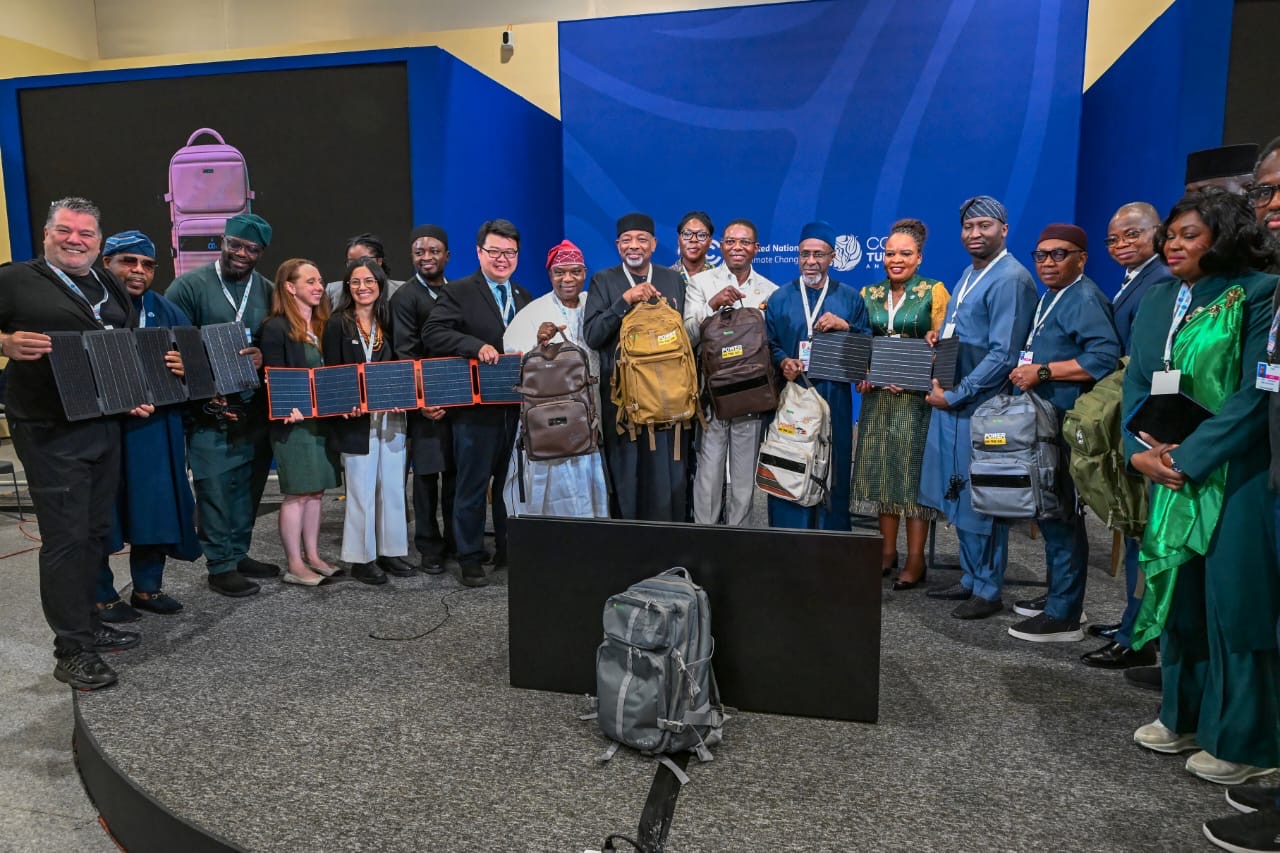
Innovative Renewable Energy Storage Solution (iRESS Ltd), the clean energy subsidiary of RKK Group, has unveiled its Solar Inverter Backpack at the UN Climate Change Conference (COP31), alongside a major call for global action to expand access to clean, affordable electricity across Africa.
The twin launches took place at a high-level event tagged Power in Motion, where iRESS Ltd and RKK Group introduced the Antalya Call to Action on Mobile and Distributed Clean Energy, urging governments, investors, development finance institutions, UN agencies and private-sector players to support six commitments aimed at powering Africa’s underserved communities.
The event was convened by Dr Aderemi Rasheed Kilaso, founder of iRESS Ltd and Group Chief Executive of RKK Group, at Special Event Room 4, Perge Theatre, Antalya EXPO Center.
The gathering combined a demonstration of the innovative solar technology with policy discussions on financing, regulation and partnerships needed to accelerate the deployment of portable solar power, mini-grids and battery storage.
Delivering the keynote address, Nigeria’s Minister of Agriculture and Food Security, Senator Abubakar Kyari, CON, declared that “there is no food security without energy security.”
Kyari stressed that reliable electricity was critical to agricultural productivity, particularly for irrigation, crop processing and preserving farm produce. He also called on stakeholders to endorse the Antalya Call to Action.
Other prominent Nigerian officials at the event included the Minister of Environment, Hon. Balarabe Abbas Lawal, and the Minister of State for Foreign Affairs, Ambassador Sola Enikanolaiye, who expressed pride in the Nigerian innovation.
Ms Damilola Ogunbiyi, Chief Executive Officer of Sustainable Energy for All, also delivered a goodwill message, alongside other distinguished international participants.
Solar Backpack targets Africa’s last-mile energy gap
The newly unveiled iRESS Solar Inverter Backpack is designed to store solar energy and provide portable electricity for work tools and everyday appliances, including light bulbs, standing fans, televisions, point-of-sale terminals, mobile phones and laptops.
Campaign demonstrations showcased its potential applications across classrooms, workplaces, small businesses, healthcare centres and livestock farms, as well as for lighting and extending productive working hours after dark.
The innovation comes amid a persistent global electricity access crisis. In 2024, an estimated 655 million people worldwide lacked access to electricity, including 563 million in sub-Saharan Africa and approximately 87 million in Nigeria.
The Antalya Call to Action argues that extending conventional electricity grids alone will not achieve universal access by 2030. It identifies mobile and distributed clean energy as critical solutions for reaching rural and peri-urban households, displaced populations, persons with disabilities, frontline health workers, women and young people.
Six-point roadmap unveiled
The Antalya Call to Action outlines six commitments to accelerate the adoption of mobile and distributed clean energy:
- Recognise: Integrate mobile and distributed clean energy into national electrification strategies, Nationally Determined Contributions and energy compacts, supported by clear quality standards and access to results-based financing.
- Finance: Expand affordable financing, risk-sharing mechanisms, local-currency lending and end-user finance to make clean electricity accessible to households and small businesses.
- Integrate: Incorporate portable electricity solutions into education, healthcare, youth and women’s empowerment, rural livelihood and emergency response programmes.
- Make in Africa: Invest in local assembly, skills development, distribution and after-sales networks, alongside responsible battery collection and recycling.
- Measure: Establish common metrics and transparent reporting systems to track beneficiaries, livelihoods supported, costs saved and emissions avoided.
- Report Back: Reconvene at COP32 to assess progress, share results and scale successful interventions.
The Call to Action also welcomes Mission 300, an initiative led by the World Bank Group and the African Development Bank Group to connect 300 million people in Africa to electricity by 2030.
It further recognises Nigeria’s National Energy Compact, launched in Dar es Salaam in January 2025, which targets universal electricity access by 2030 and identifies distributed renewable energy as an immediate, least-cost pathway for more than 60 million Nigerians.
Global stakeholders invited to endorse initiative
iRESS Ltd and RKK Group have called on governments, development finance institutions, investors, UN and humanitarian agencies, businesses, civil society organisations and young innovators worldwide to endorse the Antalya Call to Action and translate its commitments into practical interventions.
Signatories are expected to work collectively towards implementation and report progress at COP32, scheduled to take place in Addis Ababa, Ethiopia, in 2027.
Solar Backpack takes centre stage at Nigeria Pavilion
In a further demonstration of the technology’s practical applications, iRESS hosted The Unplugged Experience at the Nigeria Pavilion later on November 11, from 15:00 to 15:45 local time.
The interactive session brought together participants for hands-on demonstrations of the Solar Inverter Backpack, followed by a question-and-answer session.
Some attendees also received the backpacks as gifts, while the event concluded with positive feedback and considerable interest in the technology.
Through the twin initiatives, iRESS Ltd and RKK Group are seeking to position mobile and distributed clean energy as an important part of the global effort to close Africa’s electricity access gap, strengthen livelihoods and accelerate the continent’s clean energy transition.