Follow Us on Google
By Emmanuel Adamu
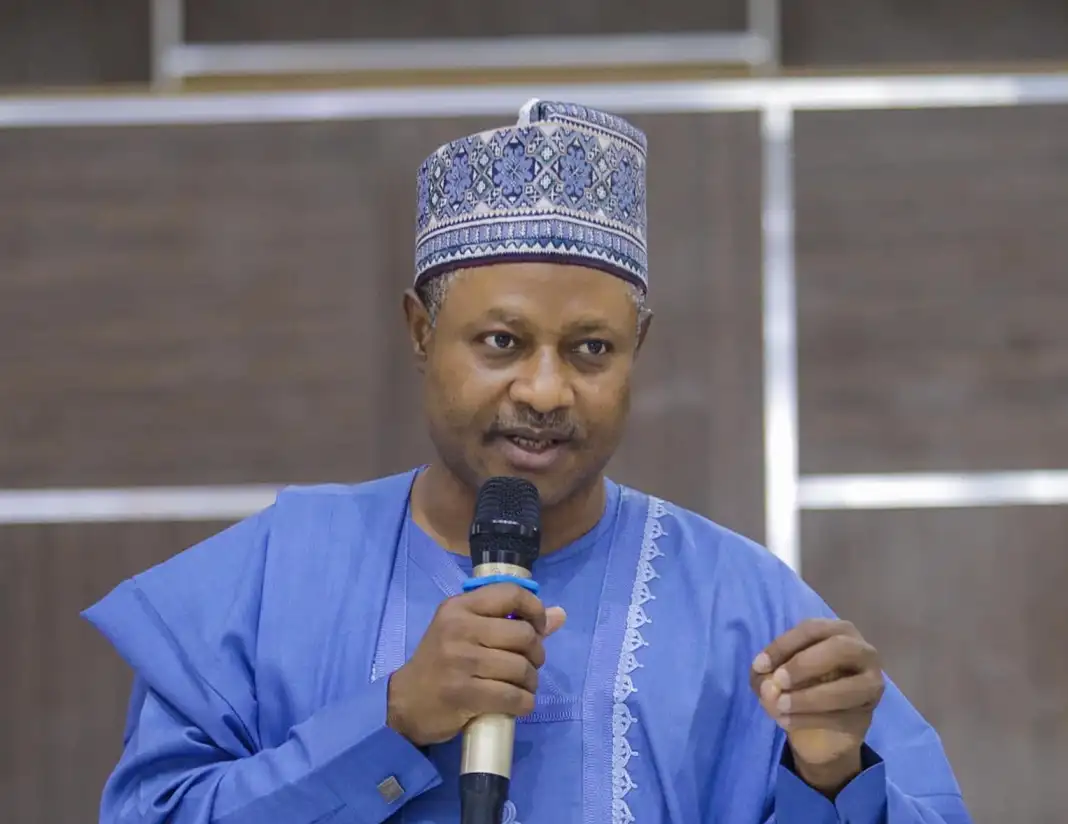
It was an unusual session at Africa’s foremost diplomacy think-tank, the Nigerian Institute of International Affairs (NIIA) in Victoria Island, Lagos. Known for hosting presidents, diplomats, foreign ministers and global policy shapers, the hall on this particular day was filled with an audience equally distinguished: statesmen, academics, civil society leaders, former activists and security experts. But the star of the day was unmistakable: the performing Governor of Kaduna State, Senator Uba Sani, was invited as guest lecturer for the Institute’s leadership lecture series.
For Governor Sani, it was familiar territory. Many of the eminent personalities seated before him were not just acquaintances from public life, they were his comrades from an earlier era, men and women he had stood with in the trenches during the struggle for Nigeria’s democratic restoration. The setting, therefore, had the feel of a reunion, though the issues at stake were anything but nostalgic. Nigeria is once again battling an existential threat: insecurity, extremism and the frightening resilience of organised banditry.
The governor arrived at the podium with a reputation already preceding him. In Kaduna, he is seen as a hands-on leader, one unafraid to take difficult decisions and equally open to unconventional approaches in solving some of the state’s longest-running problems. Still, the audience expected clarity and candour, particularly on a subject as contentious as security. They were not disappointed.
From the onset, Governor Sani set the tone: calm, factual, direct, yet empathetic. He began by addressing one of the most misunderstood concepts in recent security conversations: the non-kinetic approach to combating violent extremism. In Nigeria’s often sensationalised public discourse, the idea has been reduced to simplistic interpretations, some claim it means “negotiating with criminals,” others argue it amounts to “rewarding violence.” These assessments, the governor said, were products of ignorance, mischief or both.
He proceeded to “set the record straight,” laying out the philosophical, strategic and practical foundations of the non-kinetic method as applied in Kaduna.
“Insecurity is no abstraction,” he declared. “It is a reality demanding grounded, compassionate and strategic responses.”
With that simple but powerful framing, he dismissed the half-truths pushed by self-styled commentators who pontificate from the comfort of television studios, while communities in Kaduna bear the real human cost of banditry, displacement, fear, economic disruption, orphaned children and lives cut short.
The governor explained that the non-kinetic approach in Kaduna is not an alternative to military action but a critical complement, which is entirely community-driven. While security forces continue kinetic operations, raids, offensive patrols and dismantling of criminal enclaves, communities must also be rebuilt, youth must be redirected, and local intelligence networks must be strengthened. The approach requires a delicate balance of toughness and empathy, deterrence and development.
It was clear he had come prepared not just for applause but for scrutiny. After delivering what many described as a “masterclass in security governance,” Governor Sani did something not often seen in Nigeria’s political culture, he opened the floor to questions, without restrictions. He invited comments, interrogations and even criticisms. “Ask anything,” he said. “No question is too sensitive.”
Other News
This single gesture, observers noted, reinforced his reputation as a transparent and accessible leader. When the conversation turned to the broader national debate on policing, the governor became even more animated. He strongly re-emphasised the urgent need for state policing, stating unequivocally that Nigeria can no longer continue with a centralised system conceived in an era with vastly different realities.
“Nigeria must summon the political will to amend the Constitution,” he insisted, “to allow the establishment of state police forces and state police service commissions.”
He argued that the current structure in which a single national police authority presides over a country of over 200 million people, is not only outdated but impractical. Security threats are no longer uniform; they are localised, unpredictable and require rapid, community-based responses. A central command cannot understand the nuances of every forest corridor, every cultural practice, every local grievance or the informal economies that shape crime patterns.
Kaduna, with its enormous landmass, complex ethnic configuration and varied terrain, exemplifies this challenge. Many of the communities facing attacks are in remote areas where federal policing resources cannot be deployed with the required speed and consistency. A state police system, the governor argued, would be more agile, accessible and accountable to local populations.
He did not shy away from the obvious concerns surrounding the proposal, fears of politicisation, the misuse of state police by governors and the possible manipulation of the security architecture for partisan ends. But he debunked these fears as “manageable risks,” stressing that every institution in a democracy carries risks, which are resolved not by rejecting innovation but by developing safeguards. “No reform is perfect from inception,” he noted. “We perfect through practice.”
Beyond security, the governor’s lecture subtly revealed his broader governance philosophy, one anchored on data, citizen engagement, empathy and institutional collaboration. He highlighted the need for strategic partnerships with traditional rulers, local government officials, religious leaders and civil society. He emphasised that security is not the sole responsibility of the government but a joint commitment between the leaders and the led.
The reactions from the audience were telling. Many praised his depth, clarity and sincerity. Some described him as “one of the few Nigerian leaders who understands the security challenge both intellectually and emotionally.” Others said he exemplified the kind of leadership needed in an era where Nigerian states are increasingly becoming laboratories of policy experimentation.
The NIIA lecture provided more than just a window into Governor Uba Sani’s mind; it offered a glimpse into his governance template, practical, inclusive and driven by a willingness to confront hard truths. It showcased a leader who does not see insecurity merely as a military challenge but as a social, economic and psychological one. This is a leader willing to engage, to listen and to act.
As participants filed out of the hall, the sentiment was almost unanimous: Kaduna, though plagued by one of Nigeria’s toughest security grids, is fortunate to have a governor who understands the complexities of its problems and is brave enough to chart a realistic path forward.
Governor Sani has not promised miracles, but he has demonstrated clarity of vision, depth of understanding and the courage to innovate. And in a country yearning for solutions and sincerity, this is, perhaps the most powerful template of all.