Follow Us on Google

By the time Imo State marks fifty years of existence, it would have lived through triumphs and trials, hopes and heartbreaks, unity and division. From its birth in 1976 through the vision and sacrifice of its founding fathers, Imo was conceived as a home for all, a place where Owerri, Orlu, Okigwe, and every community could grow together in fairness and mutual respect.
Fifty years later, the question before us is no longer how Imo was created. It is how Imo must be preserved.
Anniversaries are not just for celebration. They are moments for reflection. They compel societies to pause, look back honestly, and ask difficult questions about the road travelled and the road ahead. At fifty, Imo stands at such a crossroads.
The burden of history
Imo’s political journey has not been smooth. We have witnessed seasons of progress and seasons of turbulence. We have seen administrations that united the state and others that deepened divisions. We have experienced moments when governance inspired confidence and moments when it created uncertainty.
Perhaps no period reflects this more clearly than the political rupture of 2011, a turning point that disrupted existing structures, weakened institutional stability, and created wounds that are yet to fully heal. That episode reminds us that elections are not merely contests for power. They are decisions that shape destinies.
Since then, Imo has struggled, sometimes quietly, sometimes loudly, to rediscover its balance.
The present moment
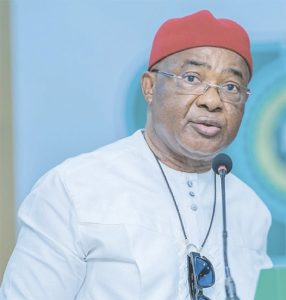
Under Governor Hope Uzodimma, the state has witnessed renewed focus on infrastructure, security, and institutional rebuilding. Roads have been opened, public institutions strengthened, and governance has regained a measure of predictability.
These efforts matter. They represent continuity in a political environment that has often been unstable. They also impose a responsibility on the next generation of leaders: not to waste what has been rebuilt.
As Uzodimma’s tenure approaches its conclusion, the conversation about 2027 grows louder. Predictably, voices of zoning, entitlement, and sectional claims have returned to the centre of political debate. While equity and fairness are legitimate concerns, history teaches us that when they are pursued without wisdom, they become instruments of division.
Imo cannot afford another season of political experimentation.
Lessons from the past
One of the defining moments in Imo’s democratic journey was the era of Chief Ikedi Ohakim. His emergence was rooted in the logic of balance and inclusion. His administration emphasized calmness, order, and institutional discipline. While no government is without imperfections, that period reflected a governance culture anchored on restraint, dialogue, and respect for diversity.
Over time, many who once criticized that era have come to reassess it. In retrospect, it represented a stabilizing force in a fragile political environment.
That lesson is important today.
Leadership is not always about noise. Sometimes, it is about steadiness.
It is not always about dramatic gestures. Sometimes, it is about quiet competence.
The meaning of harmony
At fifty, Imo does not merely need another governor. It needs a harmonizer.
A harmony candidate is not defined by geography alone. He is defined by character, temperament, and vision.
Such a leader must possess:
The ability to listen across zones and interests.
The humility to build consensus rather than impose will.
The maturity to heal old wounds rather than reopen them.
The discipline to protect institutions.
The wisdom to continue good policies while improving weak ones.
Harmony is not weakness. It is strategic leadership.
States that grow sustainably are not those led by the loudest voices, but by the calmest minds.
Zoning, equity, and responsibility
Zoning has played an important role in managing diversity in Imo. However, it was never designed to be a weapon. It was meant to be a bridge.
The truncation of previous rotational arrangements contributed significantly to political distrust. Restoring balance is therefore not an act of charity. It is an act of justice.
Other News
At the same time, justice must walk hand in hand with competence.
The goal is not merely whose turn it is. The goal is who can best protect Imo’s collective future.
The youth factor and 2030 vision
Imo is blessed with a vibrant population of young, educated, and ambitious citizens, particularly in urban centres like Owerri. Many of them represent the future leadership of the state. Their time will come.
But leadership succession is a relay, not a scramble.
A stable transition in 2027 can create the environment in which credible young leaders can mature, build experience, and prepare for greater responsibility by 2030 and beyond.
Chaos today robs tomorrow.
Continuity with progress
A harmony candidate must understand that development is cumulative. Roads, institutions, security frameworks, and social systems cannot be rebuilt every four years.
From Mbakwe’s foundational vision, through Ohakim’s stabilizing governance, to Uzodimma’s infrastructural consolidation, Imo’s progress has always advanced when continuity was respected.
Disruption has always been costly.
The next leader must therefore see himself not as a conqueror, but as a custodian.
A moral choice for imo at 50
As Imo celebrates fifty years, the choice before its people is moral as much as political.
Do we choose peace over pride?
Dialogue over domination?
Balance over bitterness?
Stability over speculation?
Our founders did not sacrifice for Imo to become a battleground of personal ambitions. They laboured for a state where every zone would feel protected and valued.
That vision must guide 2027.
Conclusion: preserving the imo idea
Imo at 50 is not merely marking time. It is searching for direction.
The state needs a leader who understands its history, respects its diversity, values its institutions, and prioritizes its unity.
It needs a harmony candidate.
A leader who will consolidate the gains of the present, draw wisdom from the past, and prepare the ground for the future.
From Ohakim’s calm stewardship to Uzodimma’s infrastructural drive, Imo has learned that progress thrives in stable environments.
Now is the time to deepen that lesson.
At fifty, Imo must choose harmony.
For peace.
For progress.
For posterity.
•Obinna Ndukwe, writes from Owerri