Follow Us on Google
By Chinwendu Obienyi
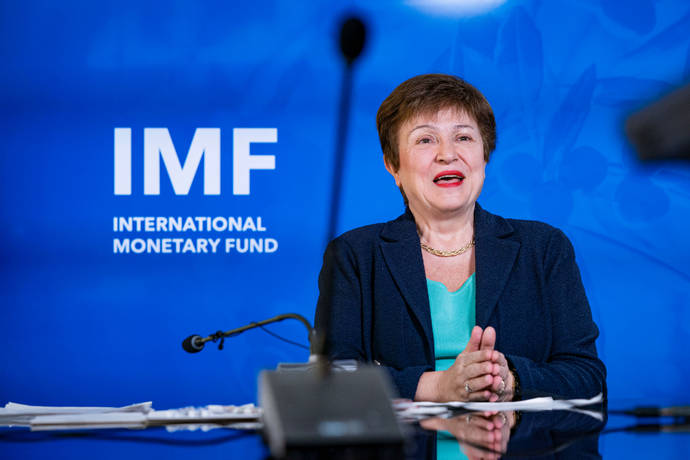
As the International Monetary Fund (IMF) sounds the alarm over surging global debt, warning that the world’s public debt could soar beyond 100 per cent of GDP by 2029, policymakers in Nigeria face a difficult but urgent task.
This task or even tasks is expected to be around tightening near-term deficits and building fiscal buffers without stifling growth or deepening social hardship.
In its latest Fiscal Monitor Report, released at the IMF/World Bank Annual Meetings in Washington DC recently, the monetary body projected that global public debt will exceed 100 per cent of global GDP by 2029, the highest level since 1948.
Presenting the report, IMF fiscal affairs director, Vitor Gaspar, revealed that global public debt prospects have worsened significantly since April.
“Global public debt prospects and risks have deteriorated further since our last meetings. We now project that global public debt will rise above 100 per cent of GDP by 2029”, he said.
The Fund warned that under a more adverse scenario, the ratio could reach 124 per cent by the end of the decade, underscoring the fragility of global finances.
While advanced economies have the fiscal muscle and deep markets to absorb higher debt levels, the IMF cautioned that emerging and developing economies face a tougher reality. “Relatively low debt-to-GDP ratios are often accompanied by low debt tolerance,” Gaspar explained. “It’s not only the size of debt but also the cost that matters.”
For Nigeria, the IMF’s message could not be more timely. The country’s debt-to-GDP ratio — around 46 per cent by mid-2025, remains below international red lines. Yet, its debt service-to-revenue ratio remains alarmingly high, consuming nearly 80 per cent of government income.
This imbalance leaves little room for productive investment or social spending. In 2024 alone, debt service obligations gulped more than N8 trillion, dwarfing allocations for education, health, and infrastructure combined.
Gaspar recommended that governments make spending “smarter and more efficient”, reallocating resources toward productivity-enhancing areas such as education, health, infrastructure, and digital capacity.
He also urged policymakers to rebuild fiscal buffers to respond to future shocks, warning that “the room for maneuver is much smaller than before.”
The IMF’s advice to countries like Nigeria is clear, tighten near-term fiscal deficits but do so strategically, without choking off growth.
This advice comes as Nigeria faces the dual challenge of inflation and low growth. Headline inflation, according to the National Bureau of Statistics (NBS) declined for the sixth consecutive month, down to 18 per cent year-on-year (y/y).
Disaggregating the consumer price index (CPI) into component parts, the food inflation sub basket eased to 16.9 per cent y/y (August: 21.9 per cent), marking the lowest level in 19 months. On a month-on-month (m/m) basis, the index trimmed to -1.6 per cent from 1.7 per cent, the prior month.
The decline was driven by improved food supply following the commencement of the main harvest season across northern and middle-belt regions, as well as the continued pass-through of import duty waivers on key grains. The core sub-basket (all items excluding food and energy) moderated slightly, easing to 19.53 per cent y/y and 1.42 per cent m/m from 20.33 per cent and 1.43 per cent respectively in August.
This marginal decline reflects slowdown in cost pressures across transport (0.9 per cent from 2.6 per cent m/m), healthcare (1.8 per cent from 4.0 per cent), clothing & footwears (0.6 per cent from 2.1 per cent), and personal care (0.1 per cent from 3.2 per cent) – aided by a relatively stable exchange rate (up 2.7 per cent m/m to N1,494.42/$1 in September), and lower diesel prices (September avg. price: N988.00, August average: N1,008.70).
Nonetheless, the still-elevated monthly reading highlights lingering cost-push influences from energy prices and FX-linked production costs, keeping core inflation broadly sticky.
Thus, fiscal consolidation, therefore, must be carefully calibrated, tightening deficits while protecting vulnerable households and sustaining investment in critical sectors.
President Bola Tinubu’s administration has embarked on bold reforms aimed at stabilising public finances. The removal of fuel subsidies and the floating of the naira have saved the treasury billions but also triggered a cost-of-living surge that tested political patience.
Other News
The government in response, pledged to use part of the savings from subsidy removal to fund targeted social interventions. Initiatives such as the Renewed Hope Conditional Cash Transfer programme and support for smallholder farmers are designed to offset hardship and maintain social stability. However, the World Bank recently, despite applauding the reforms, estimated that 139 million Nigerians now live in multidimensional poverty.
“Nigeria’s economic growth has picked up, revenues are rising, debt indicators are improving, the foreign exchange market is stabilizing, reserves are rising, and inflation is beginning to ease. These are big achievements. However, despite these stabilization gains, many Nigerians are still struggling. In 2025, we estimate that 139 million Nigerians live in poverty”, Country Director, World Bank, Matthew Verghis stated.
This therefore means that fiscal tightening might not be the only tool to save Nigeria from the impact of the impending global debt surge without a massive boost in revenue.
The IMF, World Bank, and independent analysts all agree that Nigeria’s tax-to-GDP ratio, hovering around 10 per cent, is unsustainably low for a country of its size and needs.
Raising that ratio to 15 per cent within five years could unlock an estimated $25 billion annually, equivalent to the nation’s entire capital budget.
The Federal Inland Revenue Service (FIRS) has begun digitising collection systems, expanding the tax base, and cracking down on evasion. But experts insist that deeper structural reforms, such as reducing tax exemptions, widening the informal economy, and improving compliance, are critical.
IMF Senior Resident Representative, Nigeria, Tobias Rasmussen, said, “Fiscal tightening must be revenue-driven, not just expenditure-driven. That is how to create space for inclusive growth while keeping debt sustainable.”
Furthermore, there is now an urge for smart borrowing. For example, the Debt Management Office (DMO) has taken steps to lengthen the maturity of government bonds and reduce the proportion of short-term, high-interest borrowing. It has also leaned more on concessional loans from multilateral and bilateral partners, which carry lower interest rates and longer tenors.
However, risks persist. Rising global interest rates and a stronger dollar have made external debt servicing costlier, while volatile oil earnings continue to pressure foreign reserves.
Experts’ views
Experts are of the opinion that Nigeria’s path forward will be defined by its ability to strike a balance, tightening near-term deficits without derailing fragile growth.
According to them, the current administration must indeed pursue growth friendly fiscal consolidation whilst maintaining transparency to build investors’ confidence.
Chief Executive Officer, Economic Associates, Dr Ayo Teriba, said, “The problem is not the size of Nigeria’s debt but its revenue base. We have one of the lowest tax-to-GDP ratios in the world, so our fiscal space is very limited. If revenues don’t improve, every borrowing adds more stress.”
Heirs Holdings Chairman, Tony Elumelu, argued that true productivity lies in empowering people.
“Productivity is really about opportunity per person. Governments must invest in human capital and inclusion,” he said. For his part, Professor of finance and capital markets at Nasarawa State University, Professor Uche Uwaleke, stated that Nigeria needs to make its budget much more efficient.
“Fiscal tightening does not mean fiscal starvation. It means making the budget more efficient, focusing on outcomes, and aligning spending with development priorities”, Uwaleke explained.
Conclusion
Nigeria’s fiscal outlook is not without hope. The combination of ongoing reforms, a young workforce, and vast resource potential gives the country room to rebuild resilience.
But time is short. The IMF’s warning is not just about global debt levels rather it is about the narrowing window for policy mistakes.
If Nigeria consolidates now, through smarter spending, credible budgeting, and aggressive revenue reforms, it can avoid being swept up in the global debt storm.