Follow Us on Google
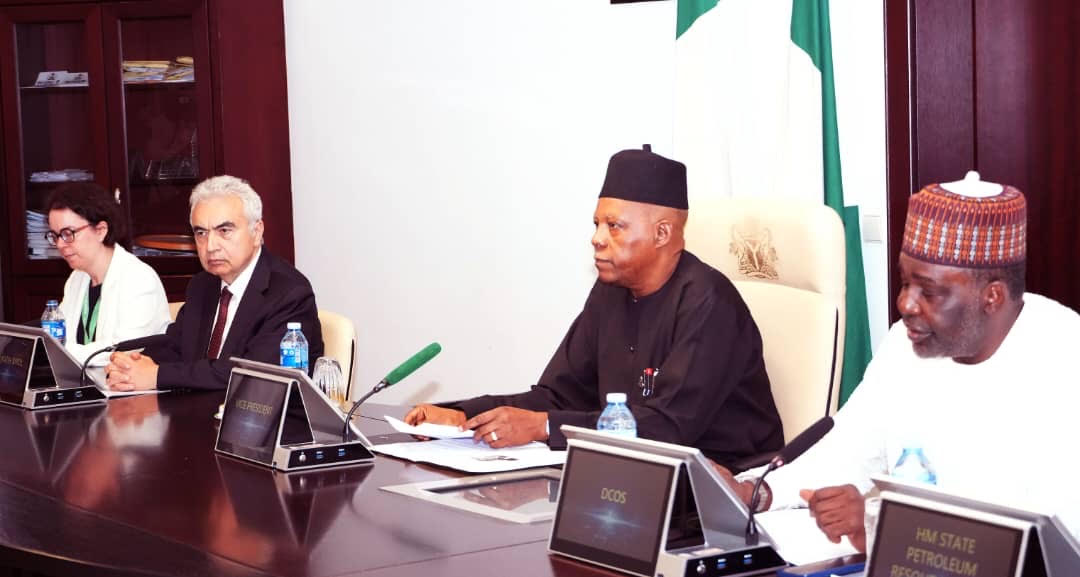
Nigeria has secured unanimous admission into the International Energy Agency (IEA) as an Association Country, opening the door to deeper international cooperation, technical expertise, and policy support for the country’s ambitious drive to transform its vast energy resources into economic growth and energy security.
The development, which Vice President Kashim Shettima described as a major validation of President Bola Tinubu’s economic reforms and policy choices, was formalised on Thursday with the signing of a Joint Work Programme between Nigeria and the Paris-based global energy organisation.
According to a statement issued by the Vice President’s media aide, Stanley Nkwocha, the agreement is expected to strengthen Nigeria’s capacity to develop reliable energy data for policy formulation and investment across the energy value chain, covering areas critical to economic growth, energy security, and the country’s transition to cleaner sources of energy.
Shettima, who spoke on behalf of President Tinubu at the signing ceremony, said Nigeria’s admission into the IEA family was a significant milestone and evidence of growing international confidence in the direction of the country’s economic and energy policies.
He said the development reflected Nigeria’s strategic importance in the global energy landscape and justified the administration’s efforts to reposition the economy by harnessing the country’s enormous energy potential.
“Nigeria’s admission as an association country with the IEA is a significant milestone for our country and it reflects Nigeria’s strategic importance in the global energy landscape and the confidence that IEA has placed in our commitment to constructive international energy cooperation,” the Vice President said.
Shettima said Nigeria stood to benefit enormously from the IEA’s institutional knowledge, intellectual resources, and global expertise as the country seeks to maximise its oil, gas, and renewable energy resources.
“Given Nigeria’s potential, the country will benefit from IEA’s institutional knowledge, the intellectual resources, the reach and expertise to support our nation’s ambitions in this sector,” he said.
The Vice President said the Tinubu administration was determined to leverage Nigeria’s abundant energy resources to reposition the economy, noting that the impact of the government’s policies was already becoming evident across different sectors.
He also assured the international agency that Nigeria would continue to play an active role in global discussions on energy, particularly in pursuing what he described as a fair and just energy transition.
But perhaps the strongest indication of the significance of Nigeria’s admission came from the Executive Director of the IEA, Dr Fatih Birol, who disclosed that the decision to admit Nigeria received unanimous approval from the organisation’s governing board.
Birol explained that membership of the IEA family was not automatic, saying countries seeking to join must undergo rigorous considerations and assessments.
He said following detailed engagements with the Nigerian government, particularly the Minister of State for Petroleum Resources (Gas), Ekperikpe Ekpo, the IEA Board comprising governments including the United States, Japan, Germany, Italy, and the United Kingdom voted unanimously to admit Nigeria.
According to him, the decision signalled the beginning of a long-term partnership aimed at building a stronger and more sustainable Nigerian energy sector.
Other News
“The IEA will accompany the Nigerian energy sector for the next few years to come for a much better energy future,” Birol said.
“We will provide policy advice from clean cooking to gas markets, from gas markets to training Nigerian experts at the IEA on our own.”
Birol said the IEA was an organisation of governments with expertise cutting across virtually every major area shaping the future of global energy, including oil, gas, solar power, nuclear energy, artificial intelligence, and electric vehicles.
He added that the agency works with about 500 leading energy experts globally in providing governments with policy advice, energy data, and technical expertise.
Minister of State for Petroleum Resources (Gas), Ekpo, said Nigeria’s admission into the organisation was linked to the performance of the Tinubu administration and the far-reaching reforms being implemented in the economy.
He said the Joint Work Programme would bring the technical expertise of the IEA directly into Nigeria’s efforts to develop credible data needed to drive energy policy and attract investments across the value chain.
The programme is expected to focus on improving the quality of energy information available to policymakers and investors, a critical requirement for planning investments and addressing Nigeria’s long-standing challenges in electricity supply, gas development, clean cooking, and energy access.
Minister of State for Foreign Affairs, Sola Enikanoaiye, described the partnership as strategically important to Nigeria’s national interest.
He said the Nigerian Mission in Paris played a significant role in facilitating the process and pledged the commitment of the Ministry of Foreign Affairs to ensuring that Nigeria derives maximum benefits from the partnership.
“Our role is to ensure that whatever government does at home is projected effectively in advancing and promoting the interest of Nigeria,” he said.
“We take this as a critical component of our national interest and we will not fail in ensuring that we assist, as facilitators and coordinators, in ensuring that the maximum benefit of this endeavour is derived for the benefit of the Nigerian people.”
Director-General of the Energy Commission of Nigeria, Mustapha Abdullahi, said the relationship between Nigeria and the IEA was not entirely new, recalling that the agency jointly sponsored Nigeria’s last National Energy Master Plan.
However, he noted that the relationship had previously lacked a formal institutional structure, expressing optimism that Nigeria’s admission and the signing of the Joint Work Programme would deepen cooperation between both sides.