Follow Us on Google
By Chinyere Anyanwu [email protected]
Nigeria’s endless cash crunch that has crippled households and businesses over the last two months following the Central Bank of Nigeria (CBN)’s currency redesign policy has left produce farmers in parts of the country in severe agony as they have continued to count their loses with the inability of offtakers and buyers to mobilise enough cash to buy from them.
The development which has made it almost impossible for citizens to access cash for everyday transactions has had its worst impact on the food sector where consumers are facing hard time meeting their daily food needs. The situation is worsened by the non-acceptance of transfers by some traders and service providers.
Unavailability of cash and non-acceptance of bank transfers by traders have so far resulted in the agricultural sector suffering huge losses.
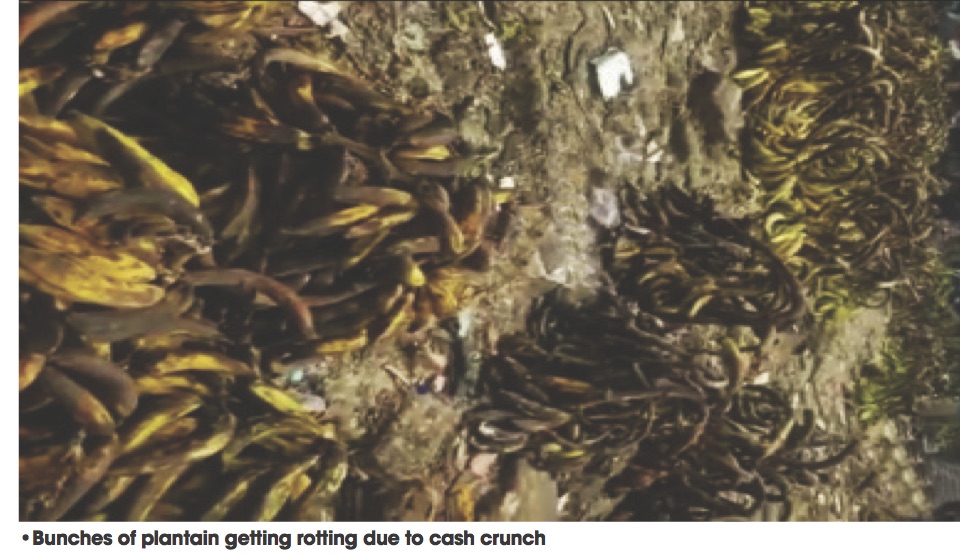
Perishable foods, including plantain, vegetables, fruits, etc., were left to rot away because buyers had no cash and sellers were not accepting transfers. Though the volume of loss cannot be specifically estimated yet, it could run into millions of naira.
A visit during the thick of the cash crunch to one of the Lagos-based markets, Idioro, Mushin, revealed numerous bunches of rotting plantain and vegetables littering the ground with no buyers in sight.
One of the sellers at the market, Mrs. Modinat Adekunle, while lamenting the cash crunch, listed the challenges it has posed to their business.
She said, “we were not collecting transfers or old notes because the farmers we buy goods from in the hinterland were refusing to sell to us by transfer and they were not also collecting old notes. Owing to this situation, I suffered a lot of losses. On the average, I usually buy N200,000 worth of plantain daily but during this cash crunch, I hardly sold up to N100,000.
“Buyers did not have cash to buy with and I couldn’t accept transfer because the farmers we buy from are not accepting transfer. I lost a huge chunk of my business capital to the cashless wahala plus the unprecedented waste of food crop (plantain) we experienced at the market. We’ve never seen it like that before.”
Another trader at the market, Mariam Ogunbiyi, lamenting the economically stifling cash shortage, said, “it’s difficult to quantify the extent of loss we suffered because of the scarcity of cash and non-acceptance of transfers by the producers we buy from. Because they are not accepting transfers from us, we too cannot accept it from our buyers so that left us with millions of naira worth of plantain that got rotten and ended up in the waste bin.”
The level of food wastage experienced owing to the cash crunch has raised the issues of poor value addition, post-harvest losses, and poor storage facilities.
A post-harvest specialist, Dr. Wasiu Awoyale of the Department of Food Science and Technology, Kwara State University, while commenting on the level of losses suffered by food crop sellers in the cash shortage period, said, “the solution is in our hands. The issue of post-harvest losses should be the concern of everyone of us.
“The issue of this cash crunch we’re experiencing now is teaching us that we should abide by what post-harvest scientists are preaching. What they are preaching is that as a farmer, you must learn how to add value to your produce. For instance, plantain is one of the highest crops Nigeria is good at its production. Now that the issue of cashless economy is arising, you add value to your crop. You can make matured unripe plantain into chips, which can be milled and sold as plantain flour. Even with this little value addition, the farmer can make more money than selling the crop in its raw unripe or ripe state. And this is the simplest form of value addition.
“What the farmer needs here is just a knife, one of the commonest culinary tools at home; peel and slice the plantain into small bits and dry them in the sun, which we already have enough of. Then you take it for milling and after that, package it for sale. As you continue to get more money, you continue to expand to other aspects of value addition.”
Awoyale noted that, “at the end of the day, the farmers are losing, especially with those crops that are very perishable; they continue to deteriorate with time but you must not be watching them deteriorate. You just add value and the simplest form of value addition is turning them into chips. We all know that the losses will be huge because large quantities of these crops come to the market daily and there’s no cash to buy them. And most of these farmers don’t have bank accounts, especially those in the rural areas.”
Also speaking on the situation, the Vice President of Nigeria Agribusiness Group (NABG), Mr. Emmanuel Ijewere, identified a disconnect between the private and public sectors as the reason agricultural producers still suffer loss of their produce. Ijewere stated that after many years of independence, “95 per cent of our perishable produce perish except we eat them quickly and what is responsible for this is that there’s no synergy between the private sector and the public sector. Government does not come to the farmer who produces the food, to the one who transports it, to the one who sells it, to form a partnership, to say, ‘how can we work together?’
He said, “there’s a disconnect between the private and public sectors and because of that, we have a situation where a lot of our goods get wasted. And in the eyes of the government, it is the farmer who has lost, it’s the transporter, the poor trader who has lost but that’s not true. The country as a nation has lost because every produce is an asset of the country. Government does not think that way. The moment they start thinking that way, they will start the preservation process. In fact, they will give special land for preserving these goods, they’ll help these farmers by providing refrigeration systems, they’ll look into how to provide warehouses that will create longer shelf life for our goods. These have not been done by government.”
The agribusiness expert who noted that a loss suffered by the farmer is a loss by government, stated that, “what happened with the cash crunch situation has been happening over the years but it was multiplied this time because people did not have cash to pay for these goods and the poor women in the market whose families live on these goods they sell have invested a lot of money bringing these goods from the farms but they have no form of storage to store them, so nature takes its course and these goods go bad and become useless, and they throw them away. They become poorer than they were before, so this particular issue of cash crunch has made them even poorer faster and many may never recover from this.”
He called on government, which he said sees itself as Alfa and Omega, to have a change of mentality and dialogue with agro sector operators as equal partners so they can take advantage of the wealth of the nation together.
According to Ijewere, “if the farmer is successful, government is successful; if the farmer fails, government fails; if the farmer is poor, government is poor.”
He said, “before the cash crunch, we were losing about 30-40 per cent of our produce because of lack of storage facilities. Now, because of the cash shortage, I’ll say it has moved to about 70-80 per cent. Then you now use that to calculate the value of all goods we produce in Nigeria that were lost here.”
Regretting the hardship the Nigerian masses have been thrown into with the cash shortage, he said, “another issue that must also be brought up is the mentality of those who brought this cash crunch. Did those who took the decision that brought the cash crunch think about its effect on the poor beans seller, the poor plantain seller, the poor pepper/tomato seller, the rice seller, the poor oil seller, etc., who could not sell their goods. Those who took the decision that brought about the cash crunch, did they think about the losses they would suffer? No. That’s the disconnection I’m talking about.
“So until the people in government have a change of mindset and begin to see themselves as partners of the private sector, see that the private sector in Nigeria is very vibrant, such losses may still be the experience of the private sector operator.”
The currency redesign policy, which has brought untold hardship to the Nigerian masses, has been regarded by the Chief Executive of the Centre for the Promotion of Private Enterprise (CPPE), Dr. Muda Yusuf, as “a repressive, poorly conceptualised and badly implemented currency redesign policy,” that “is taking a huge toll on small businesses and the agricultural sector.” He added that, “the cost to the economy and the welfare of the people is enormous. It is now a major risk to the livelihoods of most Nigerians.”