Follow Us on Google
By Rita Okoye
The auditorium at the Enugu State University of Science and Technology was thick with anticipation that morning, the kind of atmosphere that only builds when an undergraduate prepares to defend a thesis that has already generated whispers in academic corridors.
Faculty members filed in with an air of casual expectation, students clutched their notebooks, and external examiners adjusted their glasses with the practiced skepticism of veterans. Yet the tension was unmistakable. Something about this defense felt different.
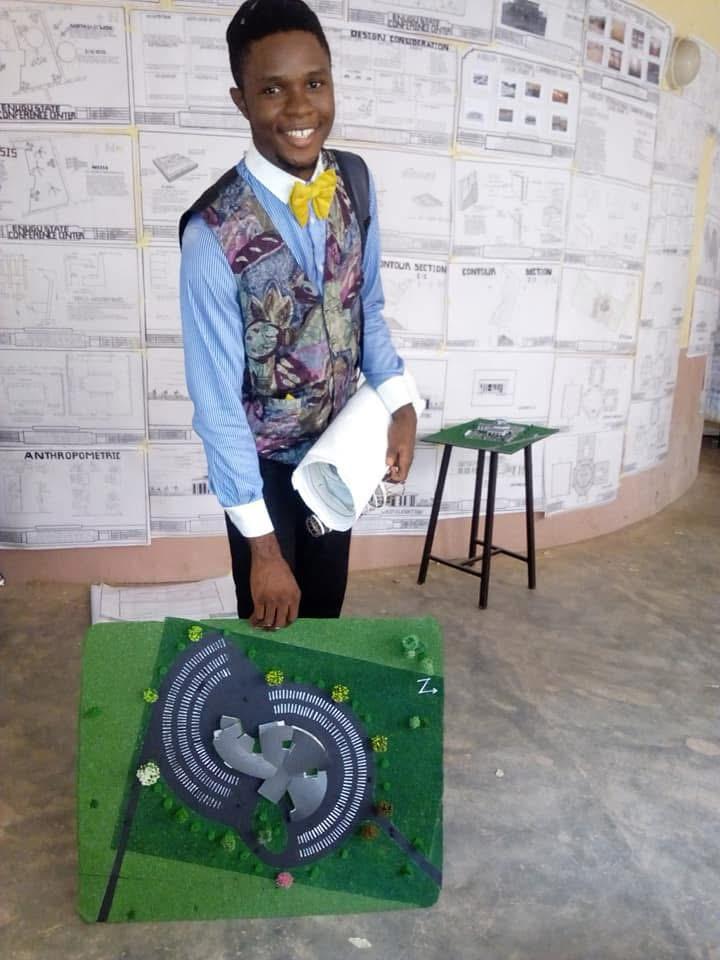
At the center of it all was Gil-Ozoudeh Ifechukwu Stephen, a final-year architecture student guided by his supervisor, Arc. Umeokafor Okechukwu. His project was boldly titled “Enugu State Library: An Architectural Approach to the Preservation of Modern Data.” It sounded, at first glance, like another student project confined to the margins of academia. But by the time he concluded his defense, the room was convinced they had witnessed something more; a blueprint for the future of Nigeria’s knowledge economy.
The hush that settled over the room as Gil began was absolute. His voice was steady, his arguments methodical, and his sheets filled with carefully drawn models, data tables, and architectural perspectives that testified to months of painstaking research. From the very beginning, it was clear he was not merely defending a thesis, he was issuing a challenge.
The young researcher began by laying bare the shortcomings of Nigeria’s libraries. “A library is not merely a storehouse of books,” he declared, his voice echoing across the hall. “It is a monument of knowledge, a sanctuary of culture, and the soul of a literate society.” For a nation where public libraries have been left to rot for decades, his words hit with unusual force.
He described libraries with broken windows, poor ventilation, dim lighting, and insufficient ICT facilities; environments that repel rather than attract readers. His field survey revealed that 70 percent of respondents strongly agreed on the urgent need for a modern state library in Enugu, while only 22.5 percent believed the current facilities met their needs. Those numbers were damning, but his proposed solutions were visionary.
Gil’s design featured reading halls bathed in natural light, acoustically treated floors to silence distractions, and wide, open spaces for study. There were digital learning centers, Braille libraries for the visually impaired, skill acquisition spaces, and even design elements inspired by Nsibidi symbols, tying the structure back to indigenous knowledge systems. “We cannot preserve knowledge if we erase identity,” he told the audience. That line drew spontaneous applause, rare in a thesis defense.
The climax of his presentation came when he unveiled detailed architectural renderings of his library. The images projected onto the screen seemed to pull the audience into a future where libraries were not relics but vibrant hubs of education, culture, and innovation. A professor leaned toward his colleague and whispered, “This is beyond a student project; this is a manifesto.”
The external examiners, who had entered the room with folded arms and skeptical gazes, began scribbling notes more furiously. When questions were opened, they pressed him with technical and philosophical challenges: How feasible was the design in a state with limited infrastructure budgets? How would he reconcile traditional cultural motifs with modern construction materials? Could libraries compete with smartphones and social media in attracting young Nigerians?
Each time, Gil responded with composure. His answers revealed not rehearsed scripts but the fluency of someone who had internalized his subject. “Architecture shapes behavior,” he told the panel. “Where the eye is, the mind will be. If you design beauty, people will come. If you design neglect, they will leave.” The room nodded in agreement.
By the end, the applause was not just sustained but thunderous, a standing ovation in a setting where polite claps usually suffice. The session was no longer an evaluation. It had become a moment of collective reflection on what Nigeria’s academic talent could achieve if nurtured properly.
Afterward, in the corridor, I caught up with him. The tension of the defense had melted, but his eyes still carried the fire of his conviction.
“Why libraries?” I asked. “Why not technology startups, real estate projects, or commercial design like so many of your peers chase?”
He paused. “Because a library is the root of all of that. Without a culture of knowledge preservation, without spaces where ideas are nurtured, technology and commerce lose their foundation. I wanted to design not just a building, but a catalyst.”
“Do you believe your design will ever move from thesis to reality?” I pressed further.
His eyes lit up. “Absolutely. The need is there; seventy percent of the people I surveyed demanded it. It only takes vision and political will. My hope is that my generation will not just dream it but build it.”
“And if Enugu does build this library,” I asked finally, “what do you think will change?”
He smiled faintly. “Everything. Our mindset, our reading culture, our sense of identity. A library is not just walls and shelves. It is where a society meets itself and dares to go further.”
His supervisor, Arc. Umeokafor Okechukwu, who had quietly joined the conversation, nodded approvingly. “This,” he said softly, “is why we teach.”
The implications of Gil’s project go far beyond the walls of ESUT. Nigeria is a nation of over 220 million people, with more than half of its population under the age of 19. Yet according to UNESCO, Nigeria’s literacy rate hovers around 62 percent, trailing behind peers like Ghana (79 percent) and South Africa (87 percent). Nearly 40 percent of Nigerians over age 15 are functionally illiterate, a staggering figure in an era where knowledge drives economic competitiveness.
Public libraries, once designed to bridge this gap, have been crippled by neglect. The National Library in Lagos has been described as an “empty shell,” and countless state libraries exist more in name than function. Roofs leak, books gather dust, and digital resources remain inaccessible. Against this backdrop, Gil’s thesis is not an ivory-tower exercise. It is an urgent call for reform.
Consider the economic argument. A World Bank study estimates that every additional year of schooling raises individual earnings by 10 percent. But classrooms alone cannot deliver that benefit. Libraries extend learning beyond the classroom, offering students and adults alike access to information, resources, and skills. In a country battling recurring blackouts, crumbling infrastructure, and unemployment rates hovering near 33 percent, the efficiency and cost-saving frameworks proposed in Gil’s thesis could ripple across sectors.
Educationally, the benefits are even clearer. The rise of misinformation and digital distractions means young Nigerians need spaces where they can access reliable, curated information. Libraries, equipped with digital learning centers, can become safe havens for intellectual growth. Politically, they can serve as neutral spaces for civic education, equipping citizens with the knowledge needed to hold leaders accountable.
One cannot ignore the cultural implications either. By embedding traditional Nsibidi symbols into modern architectural design, Gil suggests that libraries can serve as bridges between past and future. They can be both archives of indigenous wisdom and incubators of digital literacy. This dual role is especially vital in a globalized world where cultures risk being erased by homogenizing forces of mass media.
The reactions from students were telling. One whispered to her friend, “He made me realize libraries are not dead.” Another said, “It felt like he was speaking about us; our need to read, to create, to think differently.” The resonance was generational.
What happened that day in Enugu State University of Science and Technology was more than a thesis defense. It was a reminder that the solutions Nigeria seeks are not always buried in expensive foreign consultancies. Sometimes, they emerge in the minds of undergraduates who dare to think differently.
The applause that rang through the hall was not just for Gil, but for what he represented: a generation capable of addressing Nigeria’s challenges with intellect, creativity, and courage. Whether policymakers will heed the call remains uncertain. But the seed has been planted.
As I left the campus, I carried with me not just the memory of a brilliant defense but the echo of his words: “A library is not just walls and shelves. It is where a society meets itself and dares to go further.”
In a country struggling with infrastructural decay, energy crises, and an uncertain educational future, his thesis was more than academic. It was prophetic. And if Nigeria listens, it might just find in the vision of one undergraduate the blueprint for a more literate, empowered, and resilient nation.