Follow Us on Google
From Sola Ojo, Abuja
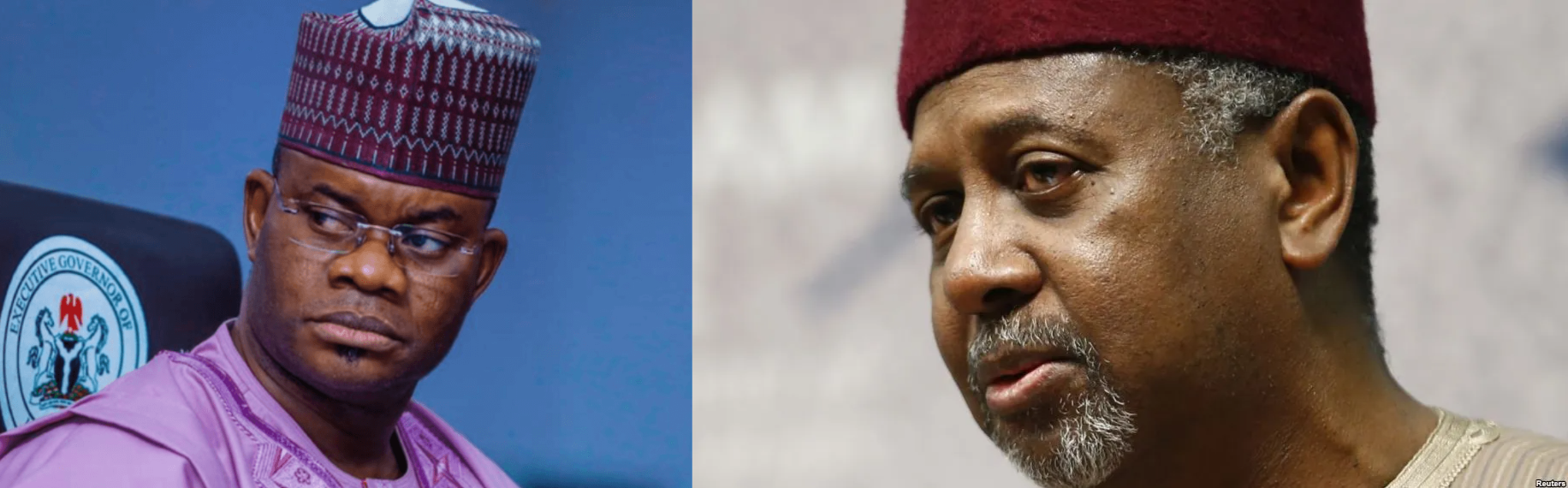
The Economic and Financial Crimes Commission (EFCC) on Tuesday, November 11, 2025, presented fresh evidence before two Abuja courts, detailing how billions of naira were allegedly moved through official government accounts under former Kogi State Governor Yahaya Bello and former National Security Adviser Colonel Sambo Dasuki (retd).
In separate proceedings, prosecution witnesses narrated before Justices Emeka Nwite and C.O. Agbaza how public funds meant for local government administration and national security operations were diverted into private accounts through suspicious withdrawals and transfers.
At the Federal High Court, Maitama, a compliance officer with Access Bank, Olomotane Egoro, told the court that several cash transactions were carried out from the Kogi State Local Government Statutory Accounts during Bello’s administration.
According to him, on December 21, 2018, ₦10 million was withdrawn three times in favour of one Aminu Jimoh Olarenwaju, while ₦50 million followed on December 24, 2018.
Similar patterns were recorded on March 8, 2019, when ₦100 million was withdrawn in ten tranches, and on August 1, 2019, when ₦300 million was withdrawn in thirty separate ₦10 million transactions by Abdulsalami Hudu.
Egoro noted that ₦300 million was credited to the account a day earlier and withdrawn entirely the next day — a pattern he described as “suspicious.”
The EFCC witness further identified transactions showing that ₦117 million was transferred from 13 Kogi local government revenue accounts into an Access Bank account belonging to Faza Business Enterprise in May 2022.
The funds were later withdrawn in cash by one Yakubu Adebenege Siyaka, leaving a closing balance of about ₦1.4 million.
Other News
Justice Nwite adjourned the matter till January 29 and 30 and February 4 and 5, 2026, for continuation of trial.
In another courtroom, before Justice C.O. Agbaza of the Federal Capital Territory High Court, the first prosecution witness in the ongoing ₦33.2 billion “Dasukigate” trial detailed how funds were allegedly diverted from the Office of the National Security Adviser’s (ONSA) Operations Account into companies linked to Dasuki and his associates.
Led in evidence by EFCC counsel, Rotimi Jacobs, SAN, the investigator said records from the Corporate Affairs Commission (CAC) showed that Acacia Holdings Limited, Aravcaria Farms, and Pinmax Security and Gas were all connected to the second defendant, Aminu Baba-Kusa, with his wife holding 1.8 million shares in Acacia.
Further investigations revealed that a Zenith Bank account belonging to ONSA was debited on Dasuki’s instructions to transfer ₦650.75 million to Acacia Holdings’ UBA and Eco Bank accounts and to Reliance Referral Hospital’s First Bank account.
Another ₦200 million was transferred to Acacia Holdings on October 9, 2014.
The analysis also showed several internal transfers, including ₦3 million withdrawn by Acacia’s financial controller, Atahiru Maccido, and ₦1 million credited to Aravcaria Farms, owned by Baba-Kusa.
Justice Agbaza adjourned the case to January 13, 14, and 15, 2026, for continuation of trial.
Both cases, according to the EFCC Spokesman, Dele Oyewale, underlined ongoing efforts to trace and recover public funds allegedly laundered through state and federal accounts under the guise of official transactions.