Follow Us on Google
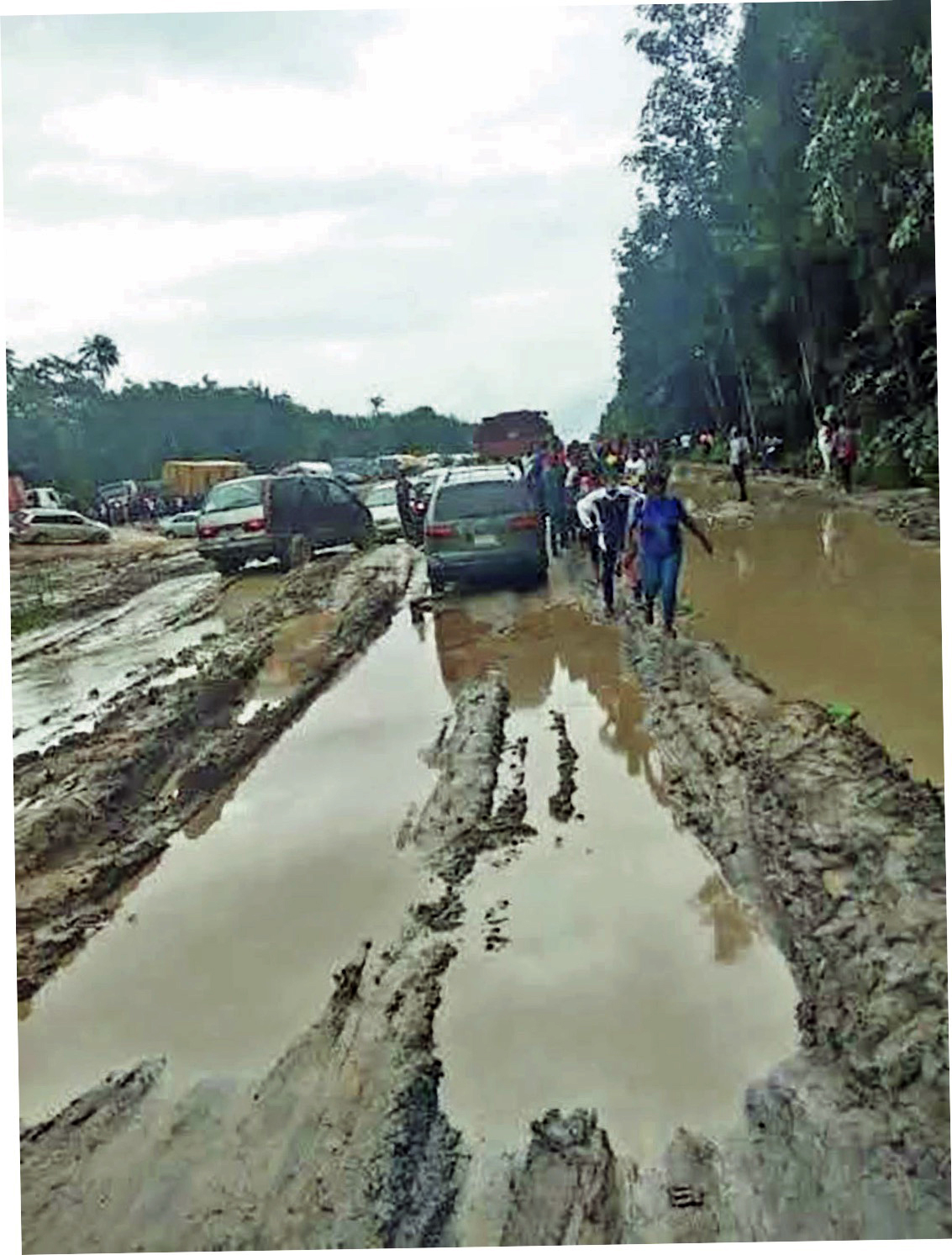
• Commuters share hellish experiences on collapsed federal roads in Kogi, Edo, Ekiti. Delta, Abia, Imo, others
By Vincent Kalu, Oluseye Ojo (Ibadan), Emmanuel Adeyemi (Lokoja), Ighomuaye Lucky (Benin), Enweliku Kent (Asaba), Stanley Uzoaru (Owerri), Okey Sampson
The cost of being caught up in traffic for more than 24 hours along major roads across the country and the agony of travellers in the last two weeks is almost incalculable.
A journey from Lagos to Asaba, the Delta State capital, which ordinarily should not take more than seven hours, now takes no less than 36 hours as a result of the deplorable condition of the dual carriageway, which has almost completely collapsed in some sections.
From Lagos to Asaba, motorists enjoy a relatively smooth drive only along the Lagos–Ibadan Expressway and for a few kilometres after the Sagamu Interchange. Thereafter, the journey of agony begins as motorists wade through craters, gullies and deep potholes that dot the road.
The Benin Bypass debacle
For Margaret and Jane, who left Abakaliki, the Ebonyi State capital at about 8pm last Saturday aboard a luxury night bus, the journey became an experience they would not wish even on their enemies.
The bus reached the Benin Bypass at about 2am the following day and got stuck in the gridlock caused by the collapsed part of the road. It remained there until 3pm, a total of 13 hours. According to the two travellers, the experience was nightmarish.
“The vehicle began to swing as it tried to manoeuvre through the failed portion, making us afraid it could fall. We asked the driver to open the door so we could alight, and we started trekking,” Jane recounted.
Other commuters also abandoned their vehicles as motorists switched off their engines as they were unable to continue the journey.
“From Asaba until we got to Sagamu, the road was in bad shape. We are not even talking about the South-East portion of the road because we are already used to it. It has been bad for a long time,” Margaret said.
For Mrs. Nkwachi, a school proprietor in Iba Town, Lagos, the journey from Anambra State to Lagos was equally traumatic. She left Anambra in her Honda Pilot SUV on a Friday morning but did not arrive at her destination until Sunday afternoon.
Describing the experience as “bloodcurdling,” Nkwachi said there were moments when she feared for her life.
“At one point, we were afraid that either a trailer laden container or a luxury bus might fall on our vehicle. They kept swinging as they navigated the gullies and narrow portions of the road,” she said.
The experience was so frightening that she vowed never to travel by road again unless the road was fixed. The deplorable road has also affected the transportation of corpses, creating distress for bereaved families. A motor hearse conveying a corpse from Ajegunle to Abam in Arochukwu Local Government Area of Abia State left on Thursday, August 20, afternoon. The corpse had been given a temporary embalmment to last for about 16 hours. However, about 24 hours later, the vehicle was still within Delta State, and the corpse had begun to emit an offensive odour.
The crisis is also taking a toll on transport operators and businesses whose livelihoods depend on the movement of vehicles along the route. By Monday evening, most of the transporters who normally load about four buses every night had no vehicle to load at their Lagos terminals. Buses travelling to the South-East, as well as those returning to Lagos got stock in gridlock.
Benin: From Nation’s Heartbeat to Heartbeat of Bad Roads
Edo State is christened The Heartbeat of the Nation because of its strategic location and extensive road network, making it one of Nigeria’s most important economic corridors, linking the South-South to the North and the South-East while facilitating movement of people, agricultural produce, goods and services across the country.
For decades, the state’s highways have served as vital arteries of commerce and connectivity. But that role is increasingly being undermined by years of neglect, poor maintenance and the dilapidated state of several federal roads.
Across the state, roads that once provided relatively seamless connections are now characterised by potholes, failed sections, erosion, damaged shoulders and other dangerous defects.
For a state whose economic strength is closely tied to its position as a major transport and commercial hub, the continued deterioration of its federal highways represents not only an infrastructure crisis but also a serious economic and public-safety concern.
Ekeleyede Rick Odion, a resident of the state, recounted his recent experience while travelling to Edo Central. Odion described the journey as harrowing, saying it was an ordeal he would not want to experience again.
“Actually, some of the federal roads in Benin have been in dilapidated condition. A lot of commuters and travellers have been finding it very difficult. I had that terrible experience on Saturday when I was travelling to Edo Central. If not for the help of the escorts, it would have been quite an unhealthy situation for me,” he said.
Lucky Oboh-Onokwe, also lamented the condition of the roads, recounting how a journey from Delta State to Benin stretched into several exhausting hours.
Benin–Asaba-Onitsha
Motorists plying the Benin–Asaba–Onitsha Expressway have appealed to the Federal Government and relevant authorities to urgently rehabilitate the highway, citing frequent vehicle breakdowns, gridlock and accidents caused by its deteriorating condition.
Godwin Ufaro, a motorist, said he spent about a week travelling from Benin to Asaba due to the bad condition of the road. He lamented that his vehicle broke down while he was navigating the affected section, forcing him to join other motorists struggling to make their way through. He said articulated vehicles got stock while others fell into potholes along the road, further worsening traffic and delaying other road users.
“We are suffering on this road. Many vehicles are falling, including tankers, trailers and small vehicles. We need the government to help us.”
He appealed to the Federal Government to urgently patch the worst sections of the road and remove stones and other obstructions that make it difficult for motorists to pass.
Another road user, Mrs Ebere John, said the situation becomes worse during rainfall, when water accumulates on the road and leaves motorists stranded in traffic for hours.
For Mrs Helen Osagiede, a business woman from Benin who lives in Asaba, what should have been a 3-hour trip, turned out to be a 10 hours journey on the Benin-Agbor-Asaba highway.
Speaking to Saturday Sun on Tuesday after finally getting to Asaba for a trip she made to Benin during the weekend and returned on Tuesday, Osagiede, described the road as a death trap and a highway of tears.
“The road is completely bad – big potholes, trailers falling, and there was no movement. We spent hours inside the bus, trying to manoeuvre through link roads inside some villages. Children were crying. Some pregnant women were in that traffic too.”
Agony of travellers across Imo, Abia
In Abia state, commuters are suffering untold hardship on some of the dilapidated federal roads in the state. Some of the roads in bad condition in the state are the Aba-Ikot Ekpene Road, Bende-Ohafia Road, Ohafia-Arochukwu Road, and the Umuahia-Ikot Ekpene highway.
Although the Abia government awarded a contract for the rehabilitation of the Umuahia-Ikot Ekpene highway, nothing appreciable has been done, making motorists who use the road go through untold hardship.
Equally, residents of communities which the highway traverses are facing economic hardship as they find it difficult in most cases to bring their agricultural produce to markets in the urban centres.
Although the Federal Government had awarded a contract for the rehabilitation of the Aba-Ikot Ekpene highway, the snail speed of work on the road is having an unpleasant effect on motorists plying the road which is a major getaway to Akwa Ibom and Cross River states.
If contracts have been awarded for the rehabilitation of the Aba-Ikot Ekpene and Umuahia-Ikot Ekpene highways, the same does not seem to apply to the Bende-Ohafia Road.
This route is the shortest for commuters who are travelling from the state capital to Ohafia and some other parts of Abia North, but due to its deplorable condition, motorists prefer using the Umuahia-Uzuakoli-Ohafia route which is double the distance.
For millions of Imo residents, plying federal roads in the state is no longer a journey, it is a daily struggle for survival. Despite on-going collaborative efforts between the Imo State government and the Federal Government to rehabilitate key Trunk A roads, delays, funding gaps and poor workmanship have turned major highways into death traps.
The most affected corridors include: Onitsha-Owerri Road along the Mgbidi Axis, The Mgbidi-Oguta junction has deep craters where trucks and other long vehicles get trapped for days. When it rains, potholes are covered with water, leading to frequent vehicle breakdowns and accidents.
Owerri-Port Harcourt Road is listed as a “lifeblood” corridor in the 2026 budget but remains largely unrepaired. Erosion, failed sections and heavy truck traffic have doubled transport costs and travel time.
Orlu–Mgbee–Akokwa–Uga Road was dualised in parts but with poor maintenance. Potholes return within months and drainage is absent.
Ngor Okpala internal Roads: The LGA is described as “the worst in Imo State regarding infrastructure.” Roads like Ulakwo–Nguru–Nkwala Eziama and Ihette junction–Umuneke to the LGA headquarters are impassable. Residents walk through flood waters to access the council headquarters.
Other hotspots bad areas are Nekede-Ihiagwa-Obinze to FUTO/Nekede Poly, Umuma Isiaku–Nkwerre, Amaimo–Umukabia–Okigwe, and the Owerri-Aba Expressway through Ngor Okpala where 22 passengers died in a single accident in 2024 after a bus swerved to avoid a pothole.
Travellers’ nightmare across Kogi
There are terrible federal roads in Kogi State that leave lasting nightmares on travellers.
Some of the roads are portions of Lokoja-Abuja highway, the 255-KM Kabba – Ilorin Road, the 35-Kilometre Kabba-Omuo Road and the 32-Kilometre Kabba- Okene road. The worst of these roads is said to be the Kabba-Ilorin Road, which has been abandoned for more than 45 years after reconstruction. Some road users narrate their ordeals.
“On August 3, I travelled from Lokoja to Ilorin enroute Kabba for a burial. I travelled with my husband in his Toyota Corolla car and the journey ordinarily should be seven to eight hours but we ended up spending over 12 hours,” said Abigail Ojo.
She said: The road was a death trap with deep potholes especially from Mopa axis to Egbe, it was so bad that sometimes we would be at a loss contemplating on which side to take as every side of the road was terribly bad coupled with the large numbers of trucks plying the road who most of the time drive dangerously “Honestly, we didn’t know it was as bad and that is why robbery and kidnapping attacks were so rampant on the road, we thought the road was faster than passing through Ekiti but we ended up blaming ourselves for taking that dangerous decision.
“When we got to Ilorin around 8pm, our car was badly damaged and my husband had to spend N96,000 to fix it.
Other News
Ayodele Oluwatosin, another passenger who recently plied through the Kabba-Omuo Road said the journey was hectic.
“Omuo-kabba road has been eaten up by erosion and is a nightmare for motorists. The trip which was supposed to take like One hour now takes about three hours and that’s why the drivers capitalised on that to triple the transport fares.”
Also narrating his ordeal, a young graduate who had to attend an interview in Abuja the following day by 10 am, said he had to leave Lokoja a day before the interview.
“I spent almost eight hours on the road from Lokoja to Abuja due to gridlock. The road was full of trailers and our driver had to navigate through bush paths before we could escape from part of the long hold up.
“In fact when I got to the interview venue, I was so stressed and worn out that the man who interviewed me had to ask me if I could do the job because I looked fagged out.
Ekiti roads in shambles despite multi-billion-naira contracts
Across Ekiti State, billions of naira have been committed to federal highways. Contracts have been awarded and construction promises repeatedly renewed. The figures are impressive, but the roads are not.
On the ground, motorists still dodge craters, students endure hazardous journeys and communities watch construction sites go quiet.
From the Akure–Ado-Ekiti dual carriageway to the strategic corridors around Afe Babalola University, the Federal Polytechnic and the Ekiti State Cargo Airport, the roads have probably become a measure of the gap between what the government promises and what citizens receive.
For motorists entering Ado-Ekiti from Akure, the first lesson is that in Ekiti, a road can be worth billions of naira on paper and still feel like a road to nowhere.
There are contract awards, revised figures, Federal Executive Council approvals, project flag-offs and promises of completion.
There are also potholes, broken shoulders, traffic jams, abandoned equipment and stretches of highway, which residents described as death traps.
For many residents, the question is no longer whether the Federal Government knows about Ekiti’s roads, but when the billions being announced would become roads that people can actually drive on.
Akure–Ado-Ekiti Road
The road was conceived as a modern dual carriageway linking the two neighbouring state capitals and easing one of the principal transportation corridors in the region. But more than three years after its formal flag-off, only one carriageway has effectively been delivered, leaving the promised second lane hanging between earthworks, bridges and an uncertain future.
Former Senator Babafemi Ojudu, who represented Ekiti Central Senatorial District in the Senate from 2011 to 2015, has become one of the prominent voices demanding answers over the project.
His verdict was unusually blunt: “Nigeria has happened to the Akure–Ado-Ekiti Road.”
The section from the Ekiti boundary towards Ado-Ekiti went for ₦49.295 billion, with a 30-month completion period.
The project was formally flagged off in May 2023. The deadline came and went. The second carriageway did not. Instead, the heavy construction equipment disappeared and the site became quiet.
Ado–Afe Babalola University–Ijan–Ikole Road
If the Akure–Ado highway represents the frustration of a stalled mega-project, the Ado-Ekiti–Afe Babalola University–Ijan–Ikole corridor demonstrates how a bad road can disrupt everyday life.
The route connects Ado-Ekiti with Afe Babalola University (ABUAD), the Federal Polytechnic, Ado-Ekiti, several communities and the corridor towards Ondo State. It also serves travellers accessing the Ekiti State Cargo Airport.
Yet residents said the road has become increasingly hazardous.
For students of the Federal Polytechnic, it is not merely a matter of inconvenience. It can mean struggling to get to lectures.
Ifedolapo Ogunrunlade, a resident of Ado-Ekiti, said the deplorable state of the road had contributed to accidents involving students travelling by motorcycles.
She added that residents had been forced to trek home on many occasions because motorcycle operators were reluctant to use the route.
Taiwo Adesola, another resident, drew attention to the importance of the corridor, noting that it connects major educational and medical facilities as well as the cargo airport.
In the same vein, Oluwaseun Jawolusi believed the answer should be more ambitious than patching potholes. He argued that the narrow road should be dualised from the Anglican Roundabout towards Omuo because of the number of institutions and strategic facilities along the corridor.
One of the users of the road, Taiwo Ibitoye, also said: “The road is a death trap, starting from the heart of Ado-Ekiti down to Afe Babalola University, which is face to face with The Federal Polytechnic, Ado-Ekiti.
Oye–Ilupeju Corridor
The Oye–Ilupeju corridor occupies a crucial position in Ekiti’s federal road network. It connects Oye-Ekiti, home to the Federal University Oye-Ekiti (FUOYE), with Ifaki and other communities, while the wider corridor links towards Omuo and, in the opposite direction, Kabba in Kogi State and Abuja. It carries heavy trucks daily.
Oye is home to the main campus of the Federal University Oye-Ekiti (FUOYE), a federal institution with students and staff moving daily between the university, their homes, markets, transport terminals and neighbouring communities, including Ado-Ekiti.
It was gathered that the road’s condition already spilled into the university community.
In November 2024, FUOYE students took their anger to the Federal Road Maintenance Agency (FERMA) office in Ado-Ekiti, and protested what they described as the deplorable condition of the Oye–Ikole federal road.
The protest followed fatal accidents involving students, with the Students’ Union leadership alleging that more than 10 students had lost their lives in road crashes.
Nearly two years later, the wider Oye–Ilupeju corridor is again under pressure.
In August 2026, a section of the federal road around Oye was damaged badly and triggered heavy traffic build-up. This prompted the Federal Road Safety Corps (FRSC) to divert motorists to alternative routes.
Further along the Ifaki–Oye–Ilupeju axis, the situation became even more dramatic. Hundreds of loaded trailers were reportedly stranded for days after a section of the road collapsed, disrupting the movement of goods and leaving motorists and commuters trapped in prolonged gridlock.
Ado–Iyin–Aramoko–Itawure Road
The 56.18-kilometre Ado-Ekiti–Iyin–Aramoko–Itawure–Osun State border road has one of the biggest price tags among the recent Ekiti interventions.
The project was awarded to a contractor and work officially commenced in March 2026.
In August 2026, the Federal Executive Council endorsed a ₦159.826 billion contract for reconstruction of the road. Residents and critics questioned whether some sections of the route are actually receiving the level of construction suggested by official announcements.
Ifaki–Oye–Ikole–Omuo Road:
Another important corridor is the Ifaki–Oye–Ikole–Omuo Road, which residents have repeatedly identified as one of the federal routes requiring urgent attention.
President Tinubu approved rehabilitation contracts covering the corridor in November 2025.
The road is significant because it links communities across central and eastern Ekiti and provides another important route towards the Ondo axis.
But the residents complained about damaged sections, difficult movement and concern over the pace at which federal interventions are being translated into usable roads.
Kabba–Ifaki–Ado-Ekiti Alignment
A related ₦24.7 billion rehabilitation contract for the Kabba–Ifaki–Ado-Ekiti alignment was approved in June 2026. This probably underlined the Federal Government’s current attention to the broader road network.
The opinion poll conducted in Ado-Ekiti showed that the challenge now is to ensure that the various interventions do not become isolated projects that wouldbstop at administrative boundaries, while the larger transport corridor remains dysfunctional.
Ifaki–Ido–Ijero–Aramoko Road
The Ifaki–Ido–Ijero–Aramoko Road is another federal route cited by residents as being in poor condition.
According to them, its importance goes beyond the towns directly connected by the road. Every damaged kilometre, as gathered, adds to the cost of movement, affects commercial activity and increases pressure on alternative routes.
For communities dependent on agriculture and small-scale commerce, the road is an economic lifeline.
Iluomooba–Ijesha-Isu–Ikole Road
Residents have also raised concerns about the Iluomooba–Ijesha-Isu–Ikole Road, describing it as another corridor requiring urgent rehabilitation.